
Authored by Matthew Piepenburg via VonGreyerz.gold,Fifty-four years ago (August 15, 1971), Nixon took the USD off its gold standard, thereby officially putting the final nail in the Constitutionally mandated concept of US money.But hey, at least the Constitution can still serve as a nice museum piece for kids to walk past.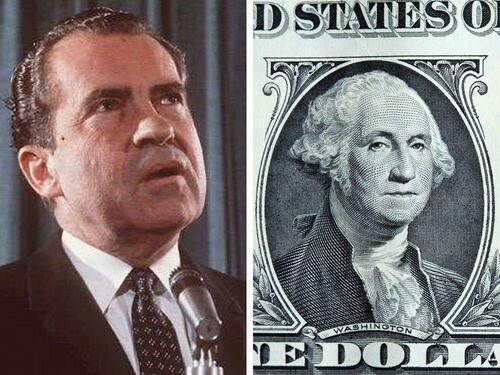
Lies from on High
Back in 1971, the lies from on high (which are nothing new to any sophisticated and critically thinking citizen) were at full swing.Nixon got on live TV and promised us the decoupling was “only temporary” (sound familiar?) and that “your dollar will be worth just as much tomorrow as today.”But the fibbing did not start or end there.Prior to the decoupling of August 15, the Treasury Secretary and Fed officials were making the case that gold was actually holding the dollar down and that decoupling gold would strengthen the dollar going forward, while gold’s value would, in fact, fall.Hmmm.
Facts from Math…
A little fact-checking may be worth a smirk here…First, the decoupling from gold has lasted more than half a century, so it hardly feels “temporary.”As for the USD holding its purchasing power, well, when measured against a milligram of gold, that paper dollar has lost > 99% of its value since 1971.Meanwhile, and contrary to the expert hearing testimony of a 1971 Fed Chairman and Treasury Secretary, gold has not got down in price, but has risen, by well… 8000%.EIGHT THOUSAND PERCENT.Huh?
What the Heck?
How was this possible? What did gold do in the last 54 years?In fact, gold did very little.But the dollar, now unfettered by its Constitutionally mandated gold-backing, got very, very, very busy multiplying (i.e., debasing) itself to pay for just criminally negligent deficit-spending.Like a teenager with dad’s Amex, the debt and spend addiction of US “leadership” was officially born on August 15, 1971 –the very same day the USD’s death spiral began.Don’t want to believe me? Don’t see the correlation?Here’s another stubborn fact: In 1971, US public (governmental debt) was $ $398B.As of this writing, that number has skyrocketed to $37.2T in the literal course of my lifetime…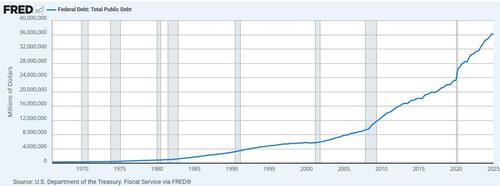
History Ignored = History Repeated
The lesson is simple: Currencies backed by nothing will encourage debt addictions, which debase the purchasing power of paper money.This is a cycle which has been repeated countless times throughout history. (See: The Faces and Cycles of Gold).Gold, which is far more honest than policy makers, rises because paper money ALWAYS dies under the weight of dishonest spending.
From Dishonesty to Desperation
Dishonesty, of course, is always followed by a lack of accountability, which is in turn followed by behavioral patterns of desperation, finger-pointing and madness – like a sitting President calling a Fed Chairman, of whom we are no fans, “a total loser.”The scope of policy desperation now masquerading as bold action (tariff policies, the Genuis Act, Fed name-calling and even increased “buzz” of a gold revaluation) is now a daily thing.What’s even scarier is that such patterns aren’t unique to the USA; they are global…Global debt in 1997 was $30T. Today, that figure has skyrocketed well past $300T.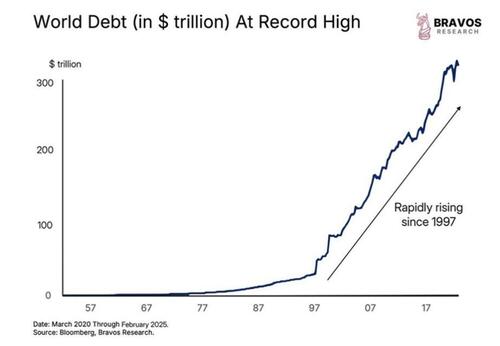 In the interim, politicians and paid-for economists in DC think-tanks (oxymoron?) have hypnotized the masses into falsely believing that such otherwise unthinkable debt-levels could be sustained.How?By the equally unthinkable proposal that currencies mouse-clicked at a central bank could safely absorb such debt with no risk to the currency, economy or market.But as we (and common sense) have reminded for years: You can’t solve a debt crisis with more debt that is then monetized with money created ex-nihilo out of thin air.
The First Kinks in the Armor: Credit Markets
Debt (as David Hume, von Mises and other critical-thinking “gold bugs” have warned for generations) breaks, well, just about everything…Nowhere is this truer than in the US and global credit markets, where policy makers and investors whistle past debt crisis after debt crisis.But debt crises are effectively just liquidity crises, and we have seen quite a string of them in recent (yet media-ignored) memory.The repo crisis of 2019, for example, as well as the market implosion of 2020, the GILT crisis of 2022, the banking crisis of 2023 and even the tariff crisis of April, 2025 were ultimately just signposts of a liquidity/credit/debt crisis percolating in plain yet ignored sight.In each instance, the foregoing credit implosions were “resolved” by dovish central bank reactions of either lower rates or higher money printing.In other words: Can kicking to buy time, votes and excuses as the next generation inherits a nightmare.
The Second Kink in the Armor: Inflated Equity Bubbles
But expanding currency creation via grotesque credit expansion to provide “emergency” liquidity while subsidizing an otherwise unloved UST market and inflating an objectively over-valued stock market is no “solution.”It is merely a frog-boil currency debasement which widens the pace of wealth inequality while rapidly feeding market bubbles, and by extension, market risk.
Market Bubbles Don’t Equal Strong Economies
For years, we have openly mocked the falsely positive fiction writing of the Bureau of Labor Statistics (BLS) for their false inflation reporting and comically (and seemingly constant) optimistic labor data.But with Main Street now crawling under the invisible and misreported tax of inflation as well as downwardly revised job growth (which confirms a recession we have said is already here), Trump just fired the head of the same BLS for actually telling the truth.Folks, regardless of your political bias, one really can’t make this kind of crazy up.But why worry, as the immortal S&P, NASDAQ and DOW (90% owned by the USA’s top 10%) is going to save us, right?Hmmm.This S&P takes 40% of its market cap from 7 stocks whose net-income-margins are just waiting for a mean-reversion whenever the AI meme (just like prior memes, from dotcoms, real estate, electricity, automobiles and railroads) becomes over-crowed and over-bought.Margin debt in US markets has surpassed the $1T mark, which is greater than prior peaks in the dot.com and pre-08 bubbles.Meanwhile, insiders like Bezos are selling billions in personal shares, and Buffet himself is sitting largely (hundreds of billions) in cash as the NASDAQ trades at 49X earnings.In short, if you think the markets with such a profile will save the US economy, think otherwise.They are teetering on interest rate and recession risk reminiscent of 1929 America and 1989 Japan. When these bubbles popped, it took decades, not months, to recover prior highs.Just saying.
The World (and Gold’s) Reaction to US Decline
As a post-2022 world turns increasingly away from a weaponized USD, and as the BRICS+ nations look with each passing day for new ways to trade outside the Greenback and net settle global trade deals in physical gold, the trend away from the USD and US debt, just like the BLS’ pessimistic labor data, can no longer be hidden in plain sight.Equally undeniable is gold’s objective rise as a strategic global reserve asset preferred over the UST.Since the USA shot itself in the foot by weaponizing an allegedly neutral reserve asset (the USD) in 2022, central bank stacking of gold has tripled while demand for USTs has tanked.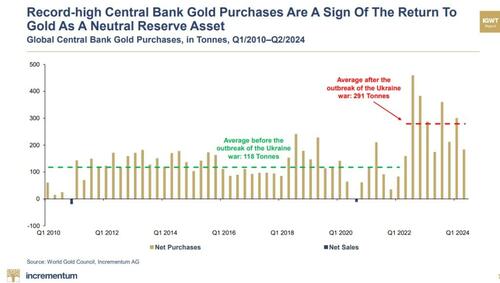 As of July 2025, even the BIS has confirmed gold’s status as a Tier-1 asset alongside the far less credible 10Y UST.Demand for physical gold has shattered the hitherto (and legal)price-fixing at the New York and London metals exchange.Rather than lever gold with paper, these dubious market-makers/exchanges are now forced to execute actual delivery rather than churn short contracts.Meanwhile, gold trades are moving East, where the Shanghai and St. Petersburg exchanges are turning the tables on Western manipulation of an asset the East has understood far better (and longer) than the West.
More Desperation Follows…
In this backdrop of a world awash in unloved US Dollars, IOU’s and fantasy policies, DC has been forced to become more desperate in the face of a DXY which has seen the worst half-year performance in 40 years.This desperation takes many forms, including shoot-from-the-hip tariff policies which change almost daily and send markets up and down like yo-yos, wherein trillions of equity market caps can be made or lost in hours.
Genuis Act Ruse
As demand and trust in the USD gyrates, DC is forced to create clever new projects to boost this demand, of which the Genuis Act (2nd oxymoron?) is the most recent example.By pairing stablecoins to UST’s (and hence the USD), this king-maker act simply allows fintech giants (Tether, Circle Internet) and favored banks (JP Morgan) to issue stablecoin users a digital buck while the issuers reinvest client money into a UST arbitrage whereby they keep all the yield (profits) and the coin owner just gets a trackable, programable and take-able “coin.”Such a profile, of course, makes stablecoins a CBDC in substance rather than form, as they are merely CBDC’s issued by private actors (directly tied to the Fed) rather than a central bank.In short, a classic distinction without a difference.Nor are stablecoins (3rd oxymoron?) either “stable” or a “coin.”Like the banks which failed in 2023 due to UST volatility and interest rate swings, stablecoins rise and fall with bond yield gyrations.Hence, these “stablecoins” are no more stable than Signature Valley Bank or the Treasury market itself, which, for anyone paying attention, is anything but stable…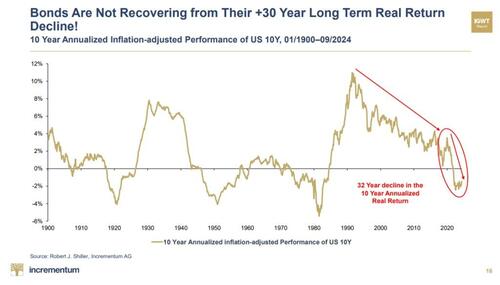
The Only Option Left: More Debasement
Uncle Sam’s sovereign bonds are as sick as Uncle Sam’s fatally ill debt levels.Unless trillions are “printed” at the Fed to buy those bonds, their demand and hence prices will fall, which means their yields will rise.Bond yields, of course, represent the true cost of debt/borrowing, and with the US so indebted, it can NOT afford to allow bond yields to spike.Like all debt-soaked nations throughout history, the Fed will thus be forced to chose between saving the bond market or saving the currency.The dollar will be sacrificed (debased) to sustain the bond/debt market for the simple reason that debt is the only “force” supporting so-called American “growth” and “hegemony.”
Gold Revaluation – More Desperate than Effective
Meanwhile, there is serious talk of revaluing Uncle Sam’s 261 million ounces of $42.22 gold certificates to market or higher. There is equal and realistic buzz of a gold-backed Treasury, themes I’ve addressed at length elsewhere: Gold Revaluation: Trump’s Red Button Option.Gold owners certainly welcome such revaluation, but the very need for such policies is merely enhanced confirmation that gold is needed and trusted more than the USD – even among US leadership…
Looking Ahead? It Looks Bad…
America’s Debt–Heavy Future
In 2025 the United States is locked in a debt trap. The country’s spending keeps rising while the money it earns falls behind.
What the Numbers Say
- The debt-to‑GDP ratio is now over 120%.
- Each dollar of debt takes a bigger bite out of the economy.
- When the ratio passes 100%, growth slows about one‑third.
Slower growth means fewer jobs, lower wages, and a weaker economy for everyone.
Why the Debt Keeps Growing
The two biggest culprits are:
- Entitlements – programs like Social Security, Medicare, and Medicaid.
- Military spending – defense budgets that have swelled for decades.
These are built into the government’s budget. Politicians cannot cut them easily because they are needed to keep people safe and supported. That leaves little room for other changes.
What Happens When We Try to Fix It
One obvious solution is cutting spending. But we would need big cuts. Small adjustments like shrinking a DOT or USAID budget won’t make a dent.
Smaller savings are accidental. Mostly we lose money because government programs just keep getting bigger.
Other options are hard to find. Raising taxes can’t be done easily either because people love their jobs, and businesses need fair prices to stay competitive.
Common Mistakes Politicians Make
- They say we have to cut spending, but they only bump up miscellaneous budgets.
- They keep asking for more money for the military and social programs when the real need is to cut the numbers that add up to debt.
- They do a little bit about credit ratings, but those ratings don’t help the real problem of too much debt.
Why the Debt Trap Works for Politicians
When everybody says we need more spending, it sounds like a plan that protects everybody’s jobs. It’s easier to talk than to narrate the next steps that will actually bring down the debt.
Many politicians think that messages shared will keep people pleased, while reality says we need major cuts, which would lose jobs and causes people to worry.
The media and leaders can keep the story simple: “We still have to keep these programs.” They do not talk about the cost of bigger budgets.
What We Can Do Now
We have looked at the problem, and we have some ideas. These are:
- Cut parts that are not essential. There are many projects that can wait. No one needs them right now.
- Make budgets more tidy. When the numbers line up better, the debt can slowly go down.
- Use better ideas for taxes. Maybe it is easier to read the taxes that are needed for the common job.
- Control interest rates. A better plan reduces the cost of borrowing money for the future.
- Increase revenue in different ways. This can mean better taxes on incomes that we can handle.
Working on these ideas can help us start to reduce the debt. It will be a hard journey. The number changes may not be fast, but the change can happen over the next decade.
The Path to a Better Future
We cannot do a big makeover overnight, but we can do small actions that add up. In the past, examples of basic changes brought a measurable result. Those are still a part of the solution. A big part of progress is to get to that next phase. The changes have to involve courage.
Having a plan with smaller changes is useful. The data will show growth is possible. The changes are more of a small adjustment that can be handled quickly rather than a big makeover.
How Will This Look in Practice?
There are simple schedules that have been talked about before. You should learn about a few of them. The goal is to stay within the overall plan. For example, if the number of people are high, you can keep track of sales for that period. The difference between a large drop and a small decrease can be focused on big and small changes that will be a better way.
There are a few more short courses you can study that align with the plan. The typical rule can be handy.
What Progress Looks Like
- Growth of the economy next time you have to adjust the numbers from the truth.
- Another move to keep the economy so that governments can grow at more power.
- Changes that connect to different incomes and citizens of the local places.
- Next steps will rely on a good plan. We cannot see the other people who may get more; it is a big part of these pairs.
What is important right now is to keep the feeling of urgency and the sense of crisis in the public conversation. When the public senses what we need to do, the chances are higher that we can keep the effects. The sense of scale does not get changed. The public is aware.
What If the Problem Persists
Even if we do not get the exact plan to cut everything. In the next ten years there has been a big change in the decisions that the government has to keep. That means we do know how it can be done. We will provide big changes. That will get us to a level of extra and accidental.
Will The Plan Be Enough?
People will have hidden problems, and if we have a plan that goes over it, we will have a big chance to keep a more stable story. At the same time, we will have some support from the future.’ This is the most important part to keep the next big steps to gain the next line that will help when the chance of kids. This some of given a learning to keep the projects that we will have no financial unexpected problems.
Our Final Message
In short, the United States is stuck in a debt grab. The scale of the debt is huge. Growing less means we only see a weaker economy. We must do something. The people in charge can do small changes, but they should also support a big plan. Only then we can step forward. Let us always see the broader impact, and keep the world future in a more smooth way for everyone. The new system for the time will be a hopeful future that helps the world of all the social and jobs, and keep us stable and the biggest number that we ourselves will grow -> and our future always remain happy, normal and clearer for the next future.
The US Already in Default?
Again, this leaves the US with only bad options to address unsustainable debt. It can either default or inflate away its debt.Guess which option DC will (and has) take(n)?But here’s the rub.By inflating away its debt via currency debasement, inflation levels are soaring past UST yields, resulting in negative real rates – i.e. a NEGATIVE returning UST, which by definition, IS a defaulting bond.The ironies abound…But the US avoids publicly displaying this irony and default by simply lying about (i.e., misreporting) the US inflation rate, measured by a CPI scale that has been “modified” over 20 times since the Volcker era to mask actual inflation data.Again: Just more desperation hiding in plain sight.
Gold Is Now So Clear
All of this explains gold’s massive rise after the 2022 turning point. If folks like you and I can see the desperation and balance sheet of the USA, the rest of the world can too.That is why central banks, sovereign wealth funds and even the BIS itself are openly transitioning from bad “money” (i.e. fiat/paper “money”) to real money, i.e., physical gold.
Silver
Silver’s real moves, already significant in 2024 and 2025, are yet to come. In gold bull markets, silver dramatically outperforms.We are not close to the gold/silver ratios of 1980 or 2011 (15 & 32, respectively), for the simple reason that despite 40% rises in 2025 (and outperforming the S&P since 2000), the gold bull market has yet to even gain its stride.Meanwhile, silver, sitting atop a 5-year supply deficit and a 45-year cup & handle formation, continues to rise, and when priced in gold terms, silver is still attractively undervalued.For patient investors, silver will be quite rewarding.
Preservation Is Wealth
Ultimately, however, our aim is wealth preservation first and foremost. Gold’s historical role as a store of value in times of paper money debacles means wealth is made by: (1) not losing it and (2) not measuring it in fiat terms.If your own governments fail to protect your currency and wealth, the responsibility rests within each individual.And with capital controls and centralization (as evidenced most recently by Stablecoin rushes) on the rise, the importance of holding an analog “pet rock” – directly in your name and outside of a dangerous banking system (with a legal firewall between your government) – could not be more compelling than today.Secure your wealth against inflation with JM Bullion.BUY GOLD AND SILVER TODAY Loading recommendations…