The US and European Union finally laid out the details of their recently announced trade deal which reduces tariffs on European automobiles while opening the door to new potential discounts for steel and aluminum.
The joint statement issued this morning represents an advancement of the preliminary deal announced a month ago, and includes specific benchmarks for the EU to secure its promised sectoral tariff discounts on cars, pharmaceuticals and semiconductors, as well as new commitments for addressing the bloc’s digital services regulations.
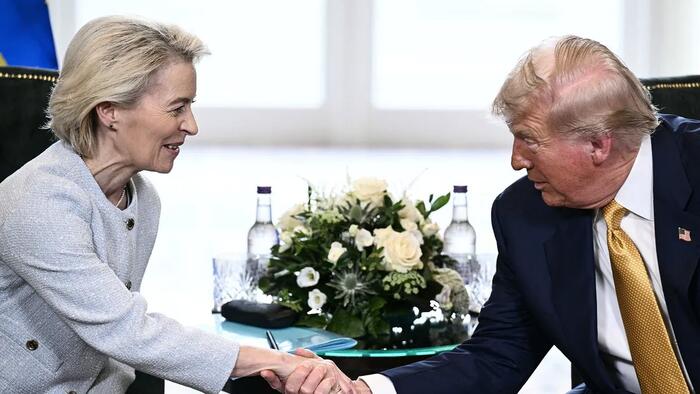
Trump had repeatedly praised the sweeping US-EU trade framework, extolling it as “a big deal” in a Monday White House meeting with foreign leaders including European Commission President Ursula von der Leyen.
The development underscores the nature of trade talks under Trump, with some initial, broad pronouncements of deals giving way to weeks or more of work to hammer out detailed agreements. Many of them are also tied to sweeping policy changes that could take time to materialize.
For example, Trump already imposed a flat 15% rate on most European goods, half the 30% he’d previously threatened. But the US promise to extend that lower levy to autos and auto parts now hinges on the EU formally introducing a legislative proposal to eliminate a host of its own tariffs on US industrial goods and provide “preferential market access” for some US seafood and agricultural products.
Below we summarize the highlights from the deal:
- US to levy 15% tariff on most EU imports, including autos, pharmaceuticals, semiconductor chips and lumber.
- US and EU to consider steps to ensure secure supply chains, including tariff rate-quota solutions.
- US and EU commit to address ‘unjustified digital trade barriers,’ with EU agreeing not to adopt network usage fees.
- US and EU to consider cooperation on ring-fencing domestic steel and aluminum markets from overcapacity.
- US and EU to negotiate rules of origin to ensure the trade agreement benefits predominantly both partners.
- EU companies to invest an additional USD 600bln across US strategic sectors through 2028.
- EU intends to procure USD 750bln in US LNG, oil and nuclear energy products, plus at least USD 40bln of US AI chips.
- From September 1, US to apply only MFN tariffs on EU aircraft and parts, generic pharmaceuticals, ingredients, chemical precursors and unavailable natural resources.
- US will lower tariffs on autos and auto parts when EU introduces legislation to enact tariff reductions.
- EU intends to eliminate tariffs on all US industrial goods and provide preferential market access for US seafood and agricultural goods.
- Senior US official expects tariff relief for EU automakers to come in ‘hopefully weeks.*
- US and EU release joint statement locking in details of trade deal reached last month.
Tariffs:
- 15% on most goods (vs 30% threatened)
- 15% on Autos (prev. 25%)
- 15% on Pharma + Chips
- US will retain a 50% tariff on EU steel and aluminium
- Zero-for-zero tariffs have been agreed for some agricultural products, aircraft component parts, and certain chemical
- No final agreement has been reached yet on tariffs for spirits
- Aircraft exports are temporarily exempt from tariffs pending the outcome of a US investigation
EU Investments
- EU will invest USD 600bln in the US, including in military equipment
- EU will purchase USD 750bln worth of US energy, mainly LNG
As Bloomberg reports, the statement outlines choreographed action on both sides of the Atlantic, with the US codifying reduced auto tariffs once the EU “formally introduces the necessary legislative proposal to enact” its own promised tariff reductions. The discounted 15% tariffs on European auto imports, lower than a 27.5% Trump previously imposed on them, would be effective from the start of the same month that legislation is advanced.
They could be in place within weeks, said a senior Trump administration official who briefed reporters on the initiative. The shift has been anxiously anticipated by some EU member states, particularly Germany, which exported $34.9 billion of new cars and auto parts to the US in 2024.
The legislative trigger is designed to help ensure the EU delivers on its promised tariff reductions — and ensure the 27-nation bloc has sufficient pressure to obtain the political mandate needed to make the changes, the administration official said.
Meanwhile, the US is committing to apply lower most-favored-nation tariffs to a slew of other European products — including aircraft and aircraft parts, generic pharmaceuticals and their ingredients and some natural resources such as cork. The US is also renewing its commitment to cap sectoral tariffs on European pharmaceutical products, semiconductors and lumber at 15%.
It’s also opening the prospect for discounted rates on some steel, aluminum and derivative products under a quota system. That’s a shift from the White House’s stated plans in July, when the Trump administration insisted those metal tariffs would remain at 50%, helping to lower trade deficits with the EU and bring revenue to US coffers.
On steel and aluminum, the EU and US now assert they “intend to consider the possibility to cooperate on ring-fencing their respective domestic markets from overcapacity, while ensuring secure supply chains between each other,” according to the joint statement.
As discussed here before, the document raises major questions about how the EU might fulfill its promise to invest $600 billion in the US or purchase some $750 billion in US energy resources, including liquefied natural gas, oil and nuclear power products. through 2028.
Private sector investments by European companies would be expected across strategic sectors in the US, including pharmaceuticals, semiconductors and advanced manufacturing, the senior administration official said. Meanwhile, the EU plans to substantially increase procurement of military and defense equipment from the US, according to the statement, and intends to buy at least $40 billion worth of US artificial intelligence chips.
According to the joint statement, the EU intends to provide preferential market access for seafood and non-sensitive agricultural goods imported from the US, including tree nuts, certain dairy products, fresh and processed fruits and vegetables, processed foods, planting seeds, soybean oil, and pork and bison meat.
In recent weeks, deliberations over the EU’s digital services regulations and potential relief for some goods — including wine and spirits – were seen prolonging talks. The EU didn’t secure lower rates for alcohol in the joint statement.
But the US and EU are pledging to address some of what the statement calls “unjustified digital trade barriers,” with the bloc confirming that it will “not adopt or maintain network usage fees.”
The EU has committed to work toward providing more “flexibilities” in its levy on carbon-intensive imports set to kick in next year, the statement said, and it will seek to ensure its corporate sustainability due diligence and reporting requirements don’t pose “undue restrictions on transatlantic trade.”
Potential changes could include eased compliance requirements for small- and medium-sized businesses, according to the statement.

 Image Credits:Apple