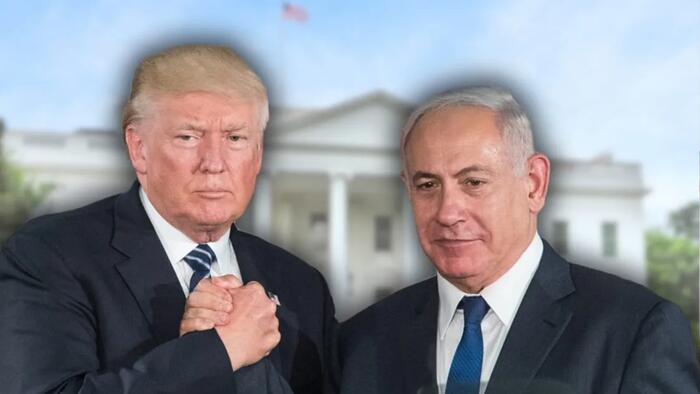
Should they be getting military medals pinned on them? …Not quite (imagined ‘battlefields’ and self-delusions notwithstanding), but President Trump in an interview which aired Tuesday with Mark Levin hailed Israeli Prime Minister Benjamin Netanyahu as a “war hero” for ordering his military to launch a surprise attack on Iran in June.
Trump then quickly followed by saying that the same label should apply to himself. He had started in the interview by calling Netanyahu a “good man” – echoing the chummy atmosphere of self-congratulations on display when the two leaders met at the White House in July, following the 12-day war which by the end saw the US military hit three key Iranian nuclear sites, upon orders from the Commander-in-Chief.
“He’s a war hero, because we work together. He’s a war hero,” Trump said of ‘Bibi’… “I guess I am too,” he added. Show host Levin can be heard quickly chiming in with a “yup” – apparently in full agreement. Listen to the brief exchange below:
Donald Trump on Benjamin Netanyahu: “He is a war hero because we work together. He’s a war hero, I guess I am too”
HUH? 🥴
pic.twitter.com/wsl4x4DNIq— Lucas Sanders 💙🗳️🌊💪🌈🚺🟧 (@LucasSa56947288) August 19, 2025
Trump had elsewhere in the interview proclaimed, “I’ve settled six wars, and we did Iran, and I wiped out their total nuclear capability, which they would have used against Israel in two seconds if they had the chance.”
But this of course ignores the fact that a significant chunk of Trump’s base was outraged over the new and brazen US military adventurism targeting Iran – given he had long campaigned on not starting new wars in the Middle East, and Iran has not attacked the United States. Also, Trump has lately in effect given a greenlight for Israel to obliterate and decimate Gaza and the hundreds of thousands of civilians therein. More like war criminals, perhaps.
Trump himself has of course never served in the military. One prior report observes that “Donald Trump avoided the military draft 5 times, but it wasn’t uncommon for young men from influential families to do so during the Vietnam War.”
An additional irony is that all of this was said on Mark Levin’s show – a pundit who for many years has presented on Fox News. In any other context whatsoever, Levin and his Fox neoconservative-leaning audience would rant and rage over ‘stolen valor’… but of course this is Trump we’re talking about, and so there’s barely a whimper out of the mainstream Right – he gets a permanent pass, apparently.
To be fair, this is nothing new for the upper echelons of the political elite class. Remember last-action-hero Hillary Clinton claiming to have come under ‘sniper fire’ during a 90s visit to Bosnia?
“I remember landing under sniper fire. There was supposed to be some kind of a greeting ceremony at the airport, but instead we just ran with our heads down to get into the vehicles to get to our base,” she said at the time. And then later:
Hillary Clinton has been forced to admit she exaggerated claims of coming under sniper fire during a visit to Bosnia in the 1990s after video footage showed the then first lady walking calmly from her plane.
…The row centers on a comment she made during a campaign stop in Washington DC last week. Keen to talk up her experience, she spoke vividly about a harrowing and dangerous trip she made in March 1996 to Tuzla airport, in Bosnia.

We could also bring up Senator Richard Blumenthal to further illustrate the propensity for the political class, who make decisions to initiate acts of war on faraway foreign lands from posh air-conditioned offices and their hand-stitched leather chairs, to envision themselves as ‘heroes’ and as ‘courageous’. From 2018 false claims about having “served in Vietnam”…
Sen. Richard Blumenthal, D-Conn., said he had “misspoken” about his service in the Vietnam War. His admission came after The New York Times obtained his Selective Service Record showing he received five draft deferments before joining the U.S. Marine Corps Reserves, according to a Snopes fact check.
Trump’s latest comments about himself and Netanyahu, while absurd and laughable, sadly stand in a long tradition of American politics.
Skin in the Game: Talk is Cheap
All of this is illustrative of a decline and illusions of empire which was aptly articulated by Nassim Nicholas Taleb in his book Skin in the Game, and various accompanying essays:
But what we call “empty suits”, of the kind you see in think tanks or large corporations – those who want to increasingly run our lives or intervene in Libya – look like actors playing the part, down to their vocabulary and the multiplicative meetings. Talk is cheap and people who talk and don’t do are easily detectable by the public because they are too good at talking.
Taleb continues with an explanation which now could just as easily apply to Trump’s ‘surprise’ bombing of Iran this summer alongside Israeli jet raids – which killed many unsuspecting Iranian civilians – from the book [emphasis ZH]:
Now some innocent people-Ezidis, Christian minorities in the Near (and Middle) East, Mandeans, Syrians, Iraqis, and Libyans – had to pay a price for the mistakes of these interventionistas currently sitting in comfortable air-conditioned offices. This, we will see, violates the very notion of justice from its prebiblical, Babylonian inception – as well as the ethical structure, that underlying matrix thanks to which humanity has survived. The principle of intervention, like that of healers, is first do no harm (primum non nocere); even more, we will argue, those who don’t take risks should never be involved in making decisions.
Further, We have always been crazy but weren’t skilled enough to destroy the world. Now we can. We will return to the “peacemaking” interventionistas, and examine how their peace processes create deadlocks, as with the Israeli-Palestinian problem.

Taleb further emphasizes, “This idea of skin in the game is woven into history: historically, all war- lords and warmongers were warriors themselves, and, with a few curi- ous exceptions, societies were run by risk takers, not risk transferors.” At this moment, Lindsey Graham is probably the absolute worst offender, simultaneously salivating over ramping up offensive actions against Russia, Gaza, and Iran. And then China (over Taiwan) will likely soon follow.
