Tag: customer

  • Grapevine Golf Cars: Your Reliable Source For High-Grade Golf Carts And Outstanding Support

    Grapevine Golf Cars: Your Reliable Source For High-Grade Golf Carts And Outstanding Support

    Selecting an ideal supplier when purchasing golf carts for business, leisure, or residential community use is critical to success. Grapevine Golf Cars stands out as an established dealership due to its wide range of carts and exceptional customer service. With years of expertise in this market, it has established itself among local clients seeking reliable cars that seamlessly fit different requirements. Grapevine Golf Cars’ customers benefit from unmatched reliability that caters to individual client and company requirements with ease.

    Wide Selection Of Golf Carts To Meet Any Need

    Grapevine Golf Cars provides an assortment of golf carts suitable for various applications and uses. They are perfect whether you are an organization seeking a fleet of carts for your property or simply hoping to improve your game with reliable rides around the course. They stock both new and pre-owned models from popular manufacturers.

  • Working out your next steps on the road to business growth: Part 3 – Implementation

    Working out your next steps on the road to business growth: Part 3 – Implementation

    You’ve developed your plan to grow your business and you’re ready to go – now comes the implementation.

    I’ll kick off with another cautionary note from the field of exploring – this time Sir Ernest Shackleton, the great Antarctic explorer. One of my favourite quotes of his, from his book “South” is: “I continue to marvel at the fine line between success and failure”.

    My interpretation regarding business growth: if you’ve done the preparation and planning we’ve already covered (in parts 1 and 2), you’ll be in the right ballpark. However, success could easily slip away.

    So here are my five tips for implementation:

    1. Monitor the market and your customers extra carefully, looking out for any signs of trouble. For instance a wobble in orders from a significant customer might require you accelerate your plan, or cut back on expenditure.

    2. Review your activities against your 100 day plan regularly – weekly or even daily. Are things going as expected? If not, why not and what can you do? Being able to assess the cause quickly is essential. E.g. was it an inherently bad idea (in which case improve your preparation phases for next time), or was it poorly executed?

    Whatever the situation, figure out what needs doing now in the light of reality, get over any disappointments and crack on!

    3. Maintain focus. There are two main tasks to carry out – keeping the existing business running and ensuring successful implementation of the growth project.

    Depending on the size of your business, it might be you want to split those – and depending on who/what skills you’ve got available – you’ll decide where to put your focus. The other party needs to be equally clear where their focus is too.

    4. Keep taking action yourself and ensure weekly (daily if required) meetings with staff and contractors to keep the momentum building. However, do stick to your equivalent of the “turn-around time” from the Everest example I quoted in part 2, rather than pressing on regardless if things are going off-track.

    5. Celebrate successes. Note any problems and put the emphasis on fixing them in the short term. The enquiry about why can come second. And certainly avoid any blame game nonsense as it’ll shut people and their creativity down.

    To set the context for all the three steps on the road to business growth, in my view, the only thing that’s certain in life is that if you sit on your butt, nothing will happen. Doing something will generate a result, though that might not necessarily be what you expected. It could be worse – or even better!

    So the key is to have worked through the revenue and cost scenarios, made sure the worst case wouldn’t kill you or the business, and go for it.

    The more you can break your business growth into bite-sized pieces, that you can test, measure and refine at each stage, and fund through variable rather than fixed costs, the more you increase your chances of success.


  • Data breach at French telecom giant Bouygues affects millions of customers

    Bouygues Telecom, the third-largest phone carrier in France, has confirmed a cyberattack and data breach affecting millions of its customers.

    In a statement posted to its website, the telecommunications giant said the hack allowed the intruders to access the personal information on 6.4 million customer accounts. Bouygues said it detected the cyberattack on August 4, but did not give a time frame for when the breach was remediated.

    In a separate page dedicated to victims of the cyberattack, Bouygues said the stolen data includes customers’ contact information and contractual data, their civil status (or company data if the subscriber is a professional), as well as IBANs, or international bank account numbers.

    Bouygues said it has about 26.9 million mobile customers.

    The cyberattack has been reported to France’s data protection agency, CNIL.

    At the time of publication, Bouygues’ web page about the cyberattack contained a hidden “noindex” tag in its source code, which instructs search engines to ignore the page, making it difficult for anyone searching the web to find the page. 

    A spokesperson for Bouygues did not immediately respond to a request for comment asking for details about the cyberattack, or explain why the page was hidden from search engines.

    News of the breach comes soon after a cyberattack at French telecom giant Orange, the country’s largest phone carrier and one of the largest telecommunication companies in the world. On July 29, Orange told customers to expect disruption as it moved to “isolate potentially affected services.” Orange serves more than 290 million customers worldwide.

  • Can You Ever Be ‘Too Expensive?’

    Can You Ever Be ‘Too Expensive?’

    Now I know this particular speaker pretty well, and I know that he’s good value for money, but what was most interesting was one of the responses to his post. The person who commented wrote ‘You can’t be too expensive. And you’re value for money. They must have cash flow issues!’

    Now whilst I would agree the speaker concerned IS most certainly value for money, there are 4 quick things we can learn from the other person’s comment:

    Sales Tip Number 1 – People’s Beliefs ARE Reality – To THEM

    The problem I see here is that I think you CAN be too expensive. One of my favourite sayings when it comes to sales and pricing in particular is that ‘people’s beliefs ARE reality – to them’.

    What I mean by that in this example is that if someone says ‘that’s too expensive’ it may be that in the moment they DO consider you too expensive – as long as it’s not a negotiation tactic to bring your price down of course.

    Now of course there will be some context behind them saying that. They might think it’s too expensive compared to their budget. They might think it’s too expensive compared to what they’ve paid in the past. They might think it’s too expensive compared to what they were expecting to pay.

    However, unless you deal with the fact that right now, they consider you too expensive – it’s unlikely you’re going to be able to win this deal, and bring them on board as a customer. Fail to change their belief and therefore THEIR reality, and you’ll fail to pick up their business.

    Sales Tip Number 2 – It’s Not Their Fault – It’s Yours

    If someone says to you that you’re ‘too expensive’, make sure you don’t dismiss them and the sales opportunity too quickly. As an ex-sales director, I often used to hear my team come back from new business appointments with excuses like ‘they weren’t ready to buy’, ‘they didn’t have the budget‘, and ‘our price was too rich for them’.

    My response was usually something like ‘Ahh, so you failed to deal with their price concern then?’

    My belief is that the majority of the time, a price concern or price objection is normally the salesperson’s fault, not the prospect’s.

    – It might be that…. the prospect doesn’t see enough value in your offering to think it worthwhile paying the price you asked for – YOUR FAULT for not positioning your value to them correctly!

    – It might be that…. the prospect doesn’t have the budget to pay the price you want – YOUR FAULT for not finding that out, or speaking to the person who can make a NEW budget!

    – It might be that…. the prospect has bought a similar product/service in the past and not paid anything like the price you want to charge them now – YOUR FAULT for not finding out their buying history and positioning correctly against it!

    – It might be that…. the prospect won’t get enough value from your offering, in order to generate enough ROI to justify the purchase – YOUR FAULT for not qualifying the Sales Opportunity well enough in the first place!

    How many of the above are you and your team guilty of right now? Stop putting the ‘blame’ for price concerns on the client, and see what you and your team could do to handle them better.

    Sales Tip Number 3 – Find Out – Or Set – Their Expectations

    One of the biggest reasons people get price objections, is that the price they want to charge isn’t what the prospect was expecting to pay.

    This often occurs when the salesperson fails to find out, manage, or on some occasions – set – the price expectations of the prospect.

    In the old days, Sales Managers used to lecture their reps ‘make sure you get the customer’s budget BEFORE talking about price’.

    Whilst back then that was pretty solid sales advice, these days people don’t always have budgets. They don’t always have cash available right now. But they ALWAYS have price expectations – and if you don’t find out what they are, re-set them if necessary – or even set them in some circumstances – then you’re always going to struggle with objections to your price.

    How well do you and your team set prospects’ price expectations currently?

    Sales Tip Number 4 – Qualify Harder Early In The Process

    Another reason I find that salespeople come up against price objections is that often they’re sat in front of or speaking to the wrong people! People that may not have the money to be able to pay the price the salesperson wants to charge, or have the authority and ability to find extra money if necessary.

    This is usually caused by a failure to qualify well enough or hard enough earlier in the process. Then often results in the salesperson spending lots of their precious time dealing with people that aren’t able to buy what they offer at the price they want to charge.

    Often this leads to the salesperson becoming frustrated, having to walk away from deals, or heavily discounting just to win the business – none of which are good outcomes for the salesperson.

    Follow the tips above and watch your performance and that of your sales team soar!  I look forward to hearing about your future success….


  • Google is shutting down Tables, its Airtable rival

    Google is shutting down Tables, its Airtable rival

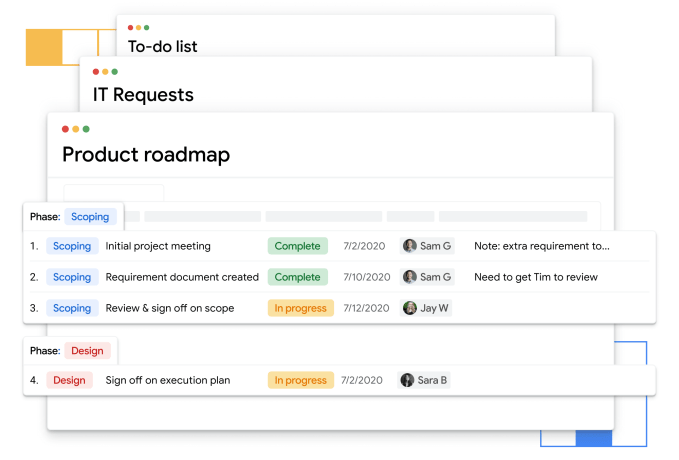
    Google Tables, a work-tracking tool and competitor to the popular spreadsheet-database hybrid Airtable, is shutting down.

    In an email sent to Tables users this week, Google said the app will not be supported after December 16, 2025, and advised that users export or migrate their data to either Google Sheets or AppSheet instead, depending on their needs.

    Launched in 2020, Tables focused on making project tracking more efficient with automation. It was one of the many projects to emerge from Google’s in-house app incubator, Area 120, which at the time was devoted to cranking out a number of experimental projects. Some of these projects later graduated to become a part of Google’s core offerings across Cloud, Search, Shopping, and more.

    Tables was one of those early successes: Google said in 2021 that the service was moving from a beta test to become an official Google Cloud product. At the time, the company said it saw Tables as a potential solution for a variety of use cases, including project management, IT operations, customer service tracking, CRM, recruiting, product development and more.

    The app was created by Google employee Tim Gleason, who had spent over a decade at the company. Gleason later moved on to become a tech lead manager for NotebookLM before announcing that he would retire beginning September 2024.Image Credits:Google

    Area 120, meanwhile, was the victim of a Google re-org in 2022, when the company canceled half its projects and informed staff that a reduction in force would cut the in-house R&D division to half its size. The division that remained would focus on AI projects, Google said.

    The following year, Area 120 was wound down amid broader layoffs, and a small handful of projects would move on to core Google product areas. (One of those was Aloud, which was building tools that let creators quickly dub their videos. YouTube announced an auto-dubbing feature in 2023 that became more broadly available this year.)

    Tables had survived these changes, as it was a part of Google Workspace’s team under Google Cloud. Unfortunately for Tables users, the service now has its own end-of-life date, too.

    In the email, Google advises Tables admins to export their data either directly to Google Sheets, then continue to manage their workflow in Sheets using tables and conditional notifications, or take advantage of a new migration tool to import their data to Google’s no-code platform, AppSheet. The latter solution preserves formatting like column types and relationships, and the workflow can then be managed with automations, fine-grained permissions, and Workspace integrations, Google says.

    The company earlier this month announced the coming closure on Table’s website and directed users to an FAQ, which noted that the team behind Tables had created a new data experience to power automated apps and workflows directly inside AppSheet. This alternative, launched in June 2023, lets users build data models for custom apps and workflows directly within AppSheet, the company said.