Authored by Mike Shedlock via MishTalk.com,
Color me quite unimpressed with the current capabilities. Let’s investigate.

The Coming Robot Home Invasion
In what appears to me to be far more hype than reality, the Wall Street Journal discusses The Coming Robot Home Invasion.
Robots are hot. Humanoid ones were literally running amok at this month’s World Robot Conference in Beijing. Think of robots as artificial intelligence in motion. Maybe you’ve seen Elon Musk’s new Tesla humanoid robot Optimus bust a move in a YouTube dance video. A tad creepy. All I really want is for robots to fold my laundry like Rosey the Robot from “The Jetsons.” Or to watch my kids, shouting “Danger, Will Robinson!” when they’re lost in space.
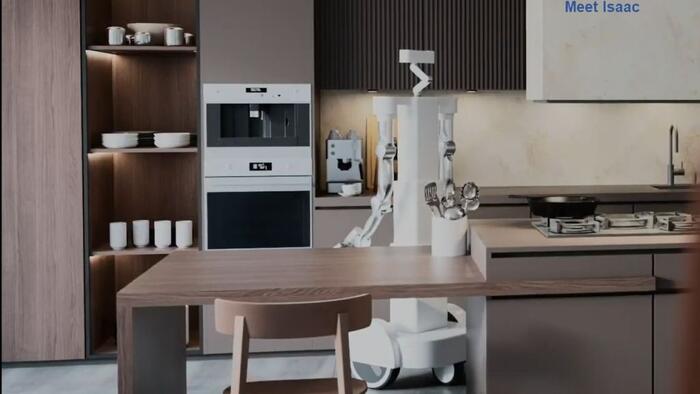
It’s starting. I recently met with Weave Robotics’ founders, Evan Wineland and Kaan Dogrusoz, friends from Carnegie Mellon and Apple. They showed me live demonstrations of Isaac, their home robot likely priced at more than $10,000, to ship by year’s end. I watched it autonomously fold T-shirts and pick up cups and toys. It’s mesmerizing. Isaac triggered visions of future homes, much as “labor-saving devices” like dishwashers and washing machines changed 1950s home life.
The Cost Reality
“Isaac” is a home robot developed by Weave Robotics, a startup founded by former Apple engineers. While originally hinted to be priced at over $10,000, it’s now available for a refundable $1,000 reservation fee. The full purchase price is $59,000, or a payment plan of $1,385 per month for 48 months. Isaac is slated to begin shipping to its first 30 US customers in the fall of 2025
The Performance Reality
Seriously, “what a joke” is my reaction.
The above video is an infomercial and not a good one. It shows no clips of folding clothes or other household chores the bot can allegedly do. It repeats images of the bot picking up toys on the floor, a roughly 1-minute task.
Watch how clumsy the ironing is in this alternate robot.
Advanced Humanoid Robots
Also consider advanced humanoid robots at 2025 World Robot Conference in Beijing.
China’s Startups Race to Dominate the Coming AI Robot Boom
Bloomberg reports China’s Startups Race to Dominate the Coming AI Robot Boom
That’s a free link.
The country’s startups have caught the attention of Elon Musk, whose Tesla Inc. has set its sights on the humanoid market. On an April conference call, the billionaire said he thinks his Optimus robots lead the industry in performance, but China may end up dominating the field. “I’m a little concerned that on the leaderboard, ranks 2 through 10 will be Chinese companies,” he said.
Leadership in this field matters because humanoids appear poised to move beyond the realms of sci-fi and curiosity. Citigroup Inc. recently projected the market for the machines and related services will surge to $7 trillion by 2050 when the world could be populated by 648 million human-like bots.
Some scholars warn that Beijing’s approach may give China the edge in developing strategically important, capital-intensive sectors, like it has already done with electric vehicles and solar panels.
While it’s still possible the humanoid market never takes off, China is making an audacious bet that it will. The country is on track to produce more than 10,000 humanoid robots this year, or more than half of the machines globally, according to an April study from the China think tank Leaderobot and other institutions.
“China is winning the humanoids war, I have no doubt,” said Henrik I. Christensen, director of the Contextual Robotics Institute at the University of California San Diego.
Still, even the most elegant humanoids won’t have a future unless they provide value. People-like machines captured the popular imagination at least as far back as Isaac Asimov’s writings in the 1950s, yet they’ve remained largely a novelty. Boston Dynamics has impressed tech geeks since its founding in 1992, but it’s never built much of a business. Google and SoftBank Group Corp. each bought the startup and then sold it again without commercial success; it’s now owned by Hyundai Motor Co.
China’s robot was far more impressive than “Isaac” or anything from Tesla. Click on the link to see.
Musk eluded he will be number one. I would be shocked if that happened.
Anyone laying out $58,000 for “Isaac” is someone interested in the latest gadgets at any price.
I suppose this robot home invasion is coming, eventually. But price needs to drop by 90 percent and capabilities rise by 500 percent before there’s a hint of prime time for household tasks.
Industrial robots trained for one specific task are another matter. They are already here.
I side with Romain Moulin, CEO of the French startup Exotec, which makes box-like robots for warehouses that he thinks are more utilitarian.
Humanoids “just don’t make economic sense for most people and companies for the foreseeable future,” said Moulin.
But they do capture the imagination (and dreams of no more household chores) including the futurists at the Wall Street Journal.