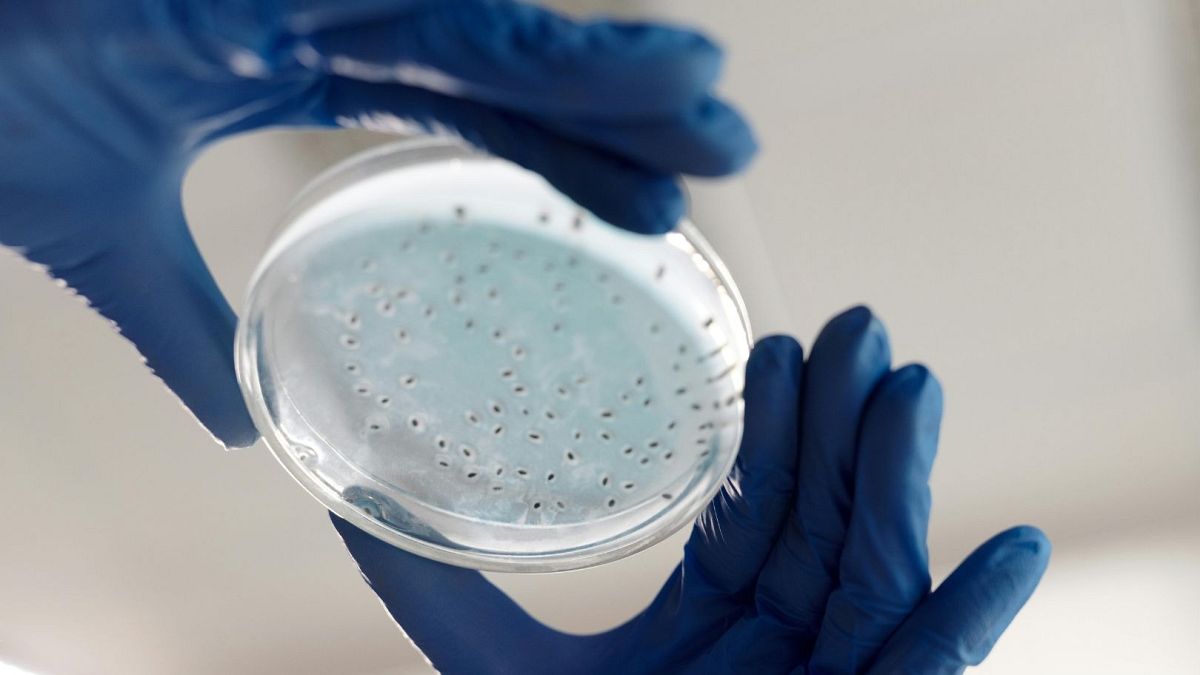
The researchers aimed to find completely new ways of tackling antimicrobial resistance.
 ADVERTISEMENT
Scientists have used artificial intelligence (AI) to create potential new drugs for so-called superbugs – stubborn bacterial infections that can evade existing treatments.
AI has reshaped drug discovery in recent years, helping researchers and drugmakers pinpoint promising treatments by speeding up the painstaking process of finding effective compounds that could be turned into medicines.
But the scientists from the Massachusetts Institute of Technology (MIT) went a step further, using AI to generate hypothetical chemical molecules that either haven’t been discovered or don’t exist yet.
They aimed to find completely new ways of tackling antimicrobial resistance, which is when bacteria, viruses, fungi, or parasites evolve to the point where the drugs designed to kill them are no longer effective, making infections harder to treat.
The MIT team targeted drug-resistant gonorrhoea, which US health officials call an “urgent public health threat,” and multi-drug resistant Staphylococcus aureus (MDRSA). That includes methicillin-resistant Staphylococcus aureus (MRSA), which people can acquire through contact with infected people or contaminated medical equipment.
Related
Bacteria strain that is resistant to antibiotics is spreading in Europe, scientists warn
“We wanted to get rid of anything that would look like an existing antibiotic, to help address the antimicrobial resistance (AMR) crisis in a fundamentally different way,” Aarti Krishnan, an MIT researcher and one of the study’s authors, said in a statement.
“By venturing into underexplored areas of chemical space, our goal was to uncover novel mechanisms of action,” Krishnan added.
The team used generative AI algorithms to create more than 36 million potential compounds and then find the best candidates to kill the bacteria.
They identified a fragment that appeared to work well against gonorrhoea bacteria – and after some additional fine-tuning, they developed two of these digital candidates into actual compounds.
One of them, which they named NG1, was highly effective at killing gonorrhoea bacteria in a lab dish and a mouse model.
After a similar process to find potential treatments for MDRSA, six molecules appeared effective against bacteria that was grown in a lab dish.
The researchers said the findings, which were published in the journal Cell, could help them create and evaluate potential new compounds to target other species of bacteria.
Related
Antibiotic-resistant superbugs could kill 39 million people by 2050, researchers warn
Globally, drug-resistant bacterial infections contributed to an estimated 4.71 million deaths in 2021, and that figure is expected to rise in the coming decades.
“Our work shows the power of AI from a drug design standpoint, and enables us to exploit much larger chemical spaces that were previously inaccessible,” James Collins, an MIT professor and one of the study’s authors, said in a statement.
The scientists are now working with Phare Bio, a nonprofit biotech company, to continue testing compounds in the lab. If they continue to show promise, these drug candidates could eventually be tested in clinical trials.
“We’re excited about the new possibilities that this project opens up for antibiotics development,” Collins said.