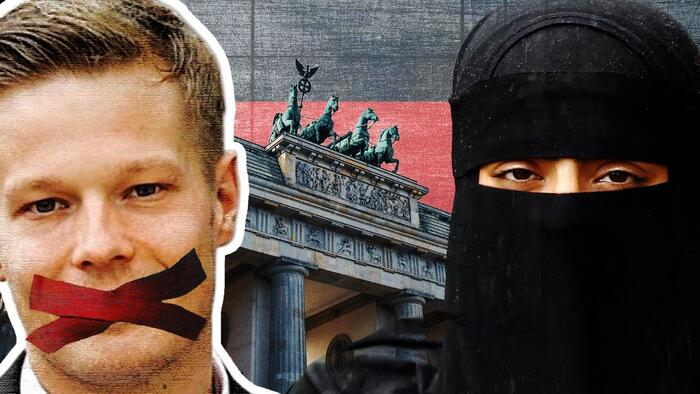
What will Germany look like in 2050? The outspoken deputy head of the German police union (DPolG), Manuel Ostermann, published an excerpt from his book on X about what he sees as the perils of mass immigration. His post described Arab clans dominating big cities in 2050, Sharia law, child marriage, grooming gangs, and a host of other ills. Now, the European Union has censored his post from being seen across the entire continent in a major escalation against a public official, one who is considered one of the leading voices of tens of thousands of German police officers, and a voice frequently appearing in major German news outlets, including Welt and Bild.

Here is the original text, published by Remix News in English, which was translated before his post was censored.
For those looking for the post, they are now greeted with this text. Likely, the post was removed under the Digital Services Act, a powerful tool used to suppress speech on Europe’s web.

However, Ostermann’s prediction is a perfectly valid exercise of speech in any free and democratic society. Even if his predictions are wrong, or even if some do not turn out to be true, Germany and other EU nations still guarantee a constitutional right to such speech.
Furthermore, there is much evidence to support his conclusions, at least in part.
“By the way, this text comes from my book ‘Germany is no longer safe.’ I’m pleased that it’s being debated, because that’s how reality, unfortunately, can look quite rapidly in Germany,” he wrote in a post that is still visible.
Will the EU also ban his book? If they are willing to censor sections of a book, they are also willing to censor entire books. It is certainly a dark turn of events that Europe is actively censoring a police official and union deputy leader amid an ongoing public debate about immigration and its effect on European nations.
Dieser Text stammt im Übrigen aus meinem Buch „Deutschland ist nicht mehr sicher“.
Freut mich, dass darüber debattiert wird, denn so kann die Realität leider ziemlich zügig aussehen in Deutschland.— Manuel Ostermann (@M_Ostermann) August 27, 2025
Ostermann’s post was not created in a vacuum. He has a bird’s eye view in his role as a police officer of the chaos wrought by Germany’s open borders ideology. While his warning is stark, it is fair to make predictions based on current events and data.
Let’s address some of the facts.
Arab clans dominate the big cities
“Imagine Germany in 2050. Arab clans dominate the big cities. Gangs fight each other in the fight for sovereignty in organized crime. People who don’t belong to the “right side” are murdered on the street. Even the police hardly dare to go to certain areas known as no-go areas anymore. Drug deaths hit an all-time high,” wrote Ostermann.
What exactly is the issue with the censors here?
Clan crime is a major problem within German cities, and it is almost entirely derived from Muslim countries, including Lebanon, Turkey, and even Syria. There are similar problems in neighboring countries, including Moroccans and Chechens operating in France and the Netherlands, and warring over the country’s drug trade.
Germany’s only public media networks routinely run articles and documentaries on the country’s growing clans and their power. In fact, a recent slickly produced ZDF documentary details how these clans have infiltrated the government and police forces to the point that fellow police officers cannot even trust each other.
“Kriminelle Clans in Deutschland” shows that criminal networks not only exercise control in some areas of large cities, but have also established their influence nationwide, right up to state institutions. Accumulating huge wealth illegally, they have built a tight network that includes law enforcement professionals.
“It is a murderous and extremely criminal milieu that goes on there. And now on so many levels that we no longer know whether we can really stop it at all. Were raids betrayed, investigations manipulated and employees bought off by the authorities? There is even despair in certain police stations,” states the narrator.
As Germany’s foreign population grows, so does clan crime, or at least the potential for such crime.
Just this year, 100 Lebanese clan members battled on the streets. Here is what Remix News wrote: “There was a bloodbath on the streets of Germany after two extended Lebanese family groups fought in a battle that reportedly involved 100 people in the city of Heiligenhaus. The two groups battled using machetes, knives, and other weapons, leading to a mass police operation that resulted in at least five serious injuries, including one that is life-threatening. Police made several arrests.”
Incredible violence, attacks on police, and corruption at the highest levels are already the case to a large degree in a number of European cities. In Marseilles, killings have hit a record high and foreign gangs dominate the city’s drug trade.
🇫🇷 Marseilles. France
The French port city is now a major narcotics hub for Europe.
Last year, a 15-year-old was stabbed 50 times and burned alive in the drug violence as murders hit record highs.
This is the “New France.” pic.twitter.com/2ueIZ5BKH4
— Remix News & Views (@RMXnews) April 4, 2025
In the Netherlands, even the royal family has been threatened by the power wielded by foreign criminals.
Regarding the potential for drug overdose deaths, the situation could go many different ways, but drug overdose deaths in the EU are hovering near a peak. With the flood of synthetic opioids coming into Europe, the situation could worsen.
Is there any guarantee that Germany can escape such developments? Certainly not. Osterman presents a valid prediction based on trend lines, and certainly, there are no grounds to censor his prediction.
Sharia law and women’s rights
“In some districts, only Sharia law is recognized as valid law.“
Already, Austrian courts are recognizing Sharia law as valid so long as it does not contradict fundamental rights and higher state laws. However, this may be only a stepping-stone ruling.
In Germany itself, there is a small but vocal minority of Muslims who are openly protesting in favor of a German caliphate in cities like Hamburg.
However, this is not the most concerning development. Instead, in a major study conducted by the Criminological Research Institute (KFN), it showed that nearly half of young Muslims in Germany believe a theocracy is the best form of government.
In the same study, 67.9 percent of young Muslims said that the rules of the Quran were more important than the laws in Germany. This was also all reported by the state-run news network WDR.
This also means there are hundreds of thousands of Muslims who do not hold these beliefs, but the sheer numbers are also extremely worrying.
Nearly every single Muslim country on Earth is either ruled by classic Sharia law or has many elements of Sharia law incorporated into its legal system. Not every country is ruled by a strict standard, but many feature extremely harsh versions of such laws, including laws that openly target homosexuals and women.
Within Germany itself, the situation is potentially explosive, with an alarming number of Muslims feeling alienated living in a Western democratic society. Many of them harbor ideas that can be considered more radical, including a willingness to turn to violence.
A study by the University of Münster showed that “for around 20 percent of the approximately 1,900 (Muslim) respondents, a perceived insult would not be compensated for. Those affected then blame their emotional misery on an abstract perpetrator, namely German society in general. Around 11 percent of this group are also prepared to defend Muslim interests with violence.”
That 11 percent is no small number, and could represent hundreds of thousands of people. Often, it is radicals in a society who push social reform in their direction.
One quote from Ostermann’s excerpts stood out: “Women are only allowed to go out on the streets unless fully veiled and accompanied by a male relative.”
Again, Ostermann is not making an idle claim here. In many Middle Eastern and African countries, this is a serious issue for women. In fact, Human Rights Watch released an entire report on the issue, writing:
“Women across the Middle East and North Africa region face varying restrictions preventing them from moving freely in their own country and from traveling abroad without the permission of their male guardians—typically their fathers or brothers, and when married, their husbands.”
As Human Rights Watch notes, there is a tremendous number of countries where women need outright permission from their husbands to leave their homes.
“In positive news, some countries such as Algeria, Morocco, and Tunisia have removed language around women’s obedience to their husbands which led to restrictions on their movements. However, 15 countries in the region still apply personal status or family laws that require women to either “obey” their husbands or live with them, and/or deem women disobedient if they leave the marital home or work or travel without their husbands’ permission. Courts can order them to return to their marital home; if they do not, they can lose their right to spousal maintenance from their husbands.”
Even Germany’s own Deutsche Welle has covered this topic.
Why is this development impossible in Germany?
In 25 years, Germany’s baby boomer population will have mostly passed away, which will represent a massive demographic shift in the country. The country will, according to all demographic trends, become more Muslim. Pew Research predicts up to 17.1 milllion Muslims in Germany in 2050. If more and more Muslims hold positions of power, as they do in the U.K., they may have more and more opportunities to shape Germany in ways that align with their cultural norms. Certainly, they may enforce these rules in their own neighborhoods and districts, with authorities mostly turning a blind eye to such practices.
Another prediction from Ostermann: “The streetscape in these cities is dominated by Arab shops and traders.”
Ostermann’s claim here is more or less already the reality in many neighborhoods in Germany’s big cities. German stores, pubs, and even butchers have been greatly pushed out, often because there is simply no market for them. However, there are other forces at work that lead to these developments, not only immigration.
Arabic dominates
“You only hear Arabic. Germans have moved to other parts of the city and no longer dare to go back. In schools, lessons can only take place bilingually,” Ostermann also writes.
Again, what is the issue with this prediction? Already, there are numerous schools where 98 percent of the student body has a migration background and where the majority of students entering the school do not even speak a word of German. This is simply a fact.
This trend is already in its early stages. There have been massive demographic shifts in a number of major European cities. Vienna is already farther along. There, Muslims make up 41 percent of the elementary school student body, outnumbering Christians for the first time.
Language problems are rife, and in many areas, Arabic languages dominate. In fact, in Vienna, 70 percent of students do not speak German in their everyday life.
🇦🇹🚨Mass immigration DESTROYING Austria’s education system
🔺Around 70% of school-age children in Vienna do not speak German in their everyday life. 39%, or nearly 80,000 children, do not have Austrian citizenship,
🔺Teachers are quitting schools in Vienna “in droves” over mass… pic.twitter.com/idjcga6NIU
— Remix News & Views (@RMXnews) July 22, 2024
In 25 years, if these trends continue, it is hard to see how this situation will not dramatically worsen, just as Ostermann predicts: “The law of the strongest prevails in the playground.”
Remix News has discussed this issue many times. Berlin schools have seen violence skyrocket. Students are stabbed or threatened with knives at an alarmingly high rate. Ethnic Germans are picked on, marginalized, and assaulted.
🇩🇪❓”Why don’t you have any German friends?”
🔺”Because they don’t belong to us. I can’t stand the Germans too much.”
Thousands of German students now face discrimination and sometimes outright assault from foreigners in their school systems.
Yet, the narrative of the “evil… pic.twitter.com/3EtIdpGpna
— Remix News & Views (@RMXnews) August 19, 2025
🇩🇪🔴 A young German girl spoke of the nightmare she experiences from her Muslim classmates.
“Sometimes they say to me that I’m German. And yeah, then they laugh at me, curse at me and tease me. Others are always Muslim, and they ask me why I am not a Muslim. I said I am a… pic.twitter.com/gggVOm9IPs
— Remix News & Views (@RMXnews) August 21, 2025
🇩🇪‼️ A 14-year-old schoolgirl was brutally beaten up by a Libyan and Syrian gang of girls, who were known for sharing Islamic State (IS) videos in a chat.
When the victim tried to help her sister, she was pulled to the ground, brutally kicked and taken to hospital.
She… pic.twitter.com/MQScfabzBo
— Remix News & Views (@RMXnews) July 27, 2025
These are not isolated incidents, and even left-wing voters will acknowledge that there are tremendous problems for German children in heavily migrant schools. Green and affluent left-wing voters increasingly isolate their children in private schools, in gifted programs, or in wealthy enclave neighborhoods to protect their children from these issues. All the while, these same parents hold true to their ideology, despite the reality on the ground for thousands of other students.
“Girls and women only dare to be around people with pepper spray in their pockets. Gang rapists and so-called grooming gangs wreak havoc with impunity.”
Ostermann refers to a reality that is already in place, as insecurity among women has already greatly increased. Surveys show that the German populace feels increasingly afraid to go outside and feels the police have lost control, while violent crime is near or has surpassed record highs, largely due to mass migration.
Women have turned to self-defense tools, but those are largely limited in Germany.
🇳🇱🇩🇪 Women in the Netherlands and Germany are now trying to defend themselves with “Smurf spray” after an asylum seeker raped and murdered 17-year-old Lisa.
“Since Lisa’s death, many of (self-defense) products have been sold out, including the Smurf spray.”
Pepper spray is… pic.twitter.com/CorZ9UKhbi
— Remix News & Views (@RMXnews) September 2, 2025
Women are expressing their feelings of insecurity on the web quite openly.
🇩🇪🔴 A young German teen ponders what Germany would be like if Merkel had not welcomed over 1 million migrants.
She was only 4 when the former chancellor made her decision, but life has dramatically changed.
“I can hardly recognize the Germany you tell me about today. And since… pic.twitter.com/uHRFov08z1
— Remix News & Views (@RMXnews) September 3, 2025
Foreigners and men with a migration background already account for up to three-quarters of all gang rapes in Germany. However, in the U.K., where grooming gangs were targeting thousands of women, nearly all suspects were from Pakistan and other Muslim countries. To say that such a development in Germany is impossible is simply not realistic.
Does that mean all Muslims are gang rapists? Of course not, but what is happening in Germany, what has happened in countries like the U.K., and the threat that Muslim and African women face in their own countries cannot be denied.
Child marriage, genital mutilation
“Muslim girls, who are still pre-adolescent, like to be married to older men. Genital mutilation is practiced quite naturally in certain circles.”
Again, Ostermann is not far off. Regarding child marriage, this is already a growing problem in Germany, which the government readily admits.
Already in 2019, the authorities registered 819 marriages with a minor. Although Germany has a law to protect minors from forced marriages, it does not apply in practice, and the number of child marriages in Germany was described as rapidly rising, with 98 percent of those affected having a migration background.
Child marriages are not only the practice of people from Syria, Iraq, or Afghanistan but also from Turkey and even Bulgaria, according to German news outlet Focus.
“In fact, there are many more,” said Monika Michell from the Terre des Femmes organization in 2019.
India leads the world in child marriages, with over 15 million recorded. However, other countries like Pakistan, Bangladesh, and Nigeria feature millions of child brides.
How prevalent this practice will be in Germany depends entirely on what share of the population features foreigners from countries where this is already commonly practiced. As Germans head towards minority status, foreigners may become more open about such practices as they gain political power and shape cultural norms.
That leads us to the next issue, genital mutilation.
Germany once again admits itself that it has a serious problem with this practice, entirely due to foreign populations arriving in the country. Already five years ago, the federal government reported that Germany had 68,000 victims of female genital mutilation.
The number of girls and women who are victims of female genital mutilation (FGM) in Germany has increased by 44 percent since 2017 to 68,000, announced German Minister for Family Affairs Franziska Giffey
According to the minister, mainly migration is to blame for the massive increase as many migrants coming to Germany commonly practice FGM in their own home countries. The practice, which is a human rights violation, involves the ritual cutting off some or all of the external female genitalia.
Giffey confirmed that the increase in cases compared to 2017 is so significant because of the rising numbers of immigrants from Eritrea, Somalia, Indonesia, Egypt, and Nigeria arriving in Germany,
Censorship is not the answer to these issues
All of Ostermann’s fears and predictions are grounded in reality, even if some do not come to pass. The EU’s act of censorship is a gross violation of his fundamental rights.
Will they all turn out to be true? Much could happen in the future, but the answer is not to censor leading voices, even if they are delivering a message that is highly uncomfortable for the ruling elite.