As Russia became the first country to recognise the Taliban as the ruling government of Afghanistan, Moscow’s long-standing ties with its traditional allies have been falling apart. Who are Moscow’s ex-partners, and who are the new allies?
 ADVERTISEMENT
In a move sparking significant backlash, Russia became the first country in the world to recognise the Taliban as the ruling government of Afghanistan.
“We believe that the act of official recognition of the government of the Islamic Emirate of Afghanistan will give impetus to the development of productive bilateral cooperation between our countries in various fields,” Russia’s Foreign Ministry said in a statement on Thursday.
The Taliban, an Islamist militant group, seized control of Afghanistan in August 2021 following the withdrawal of US and NATO forces, toppling the Western-backed government.
Neither the US nor the EU have formally recognised the group, and Washington still designates the Taliban a terrorist organisation, or more specifically, a Specially Designated Global Terrorist (SDGT).
In July 2024, Russian President Vladimir Putin called the Taliban “allies in the fight against terrorism”. Russia’s president also previously referred to the Taliban as “allies,” while Foreign Minister Sergey Lavrov called them “sane people”.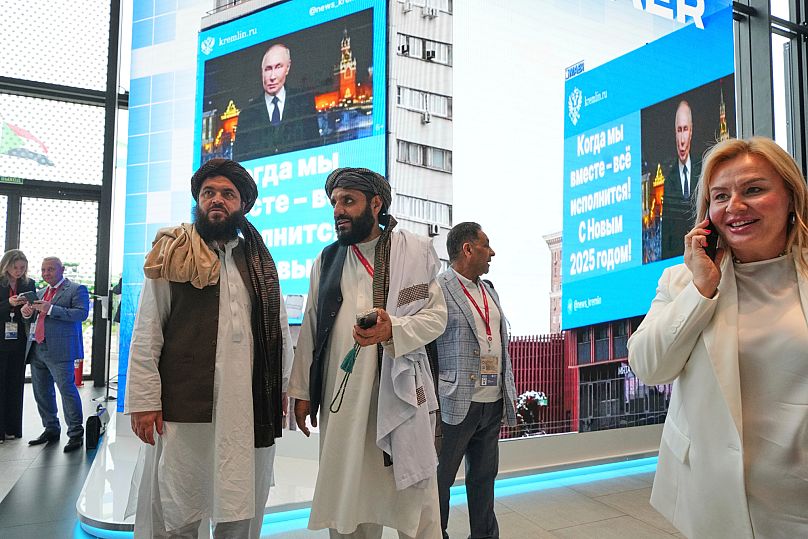 Members of the Taliban stand in front of TV screens as they attend the St. Petersburg International Economic Forum in St. Petersburg, Russia, Wednesday, June 18, 2025
AP Photo
Moscow’s new friends
Since the beginning of Moscow’s full-scale invasion of Ukraine in early 2022, the Kremlin has increasingly sought more cooperation with totalitarian regimes, including North Korea and Iran, to advance economic and military partnerships.
Iran was among the first to strengthen its ties with the Kremlin. Tehran delivered thousands of Shahed attack drones to Russia and then shared the relevant technological blueprints, enabling Moscow to establish domestic production lines of its own.
These drones are now being made at Russian facilities in rapidly increasing quantities and are playing a key role in the Kremlin’s bombing campaign against Ukrainian cities, infrastructure sites and civilians.
In January, Russia and Iran signed a Comprehensive Strategic Partnership Treaty, which Vladimir Putin praised as a “real breakthrough” in bilateral relations.
But when Israel and later the US began a campaign of airstrikes against Iranian targets, Moscow did not come to support an ally and was unwilling or unable to offer anything more substantial than diplomatic gestures.
Putin described the US airstrikes on Iranian nuclear facilities as acts of “unprovoked aggression” with “no basis or justification” amid his own unprovoked all-out war against Ukraine in its fourth year.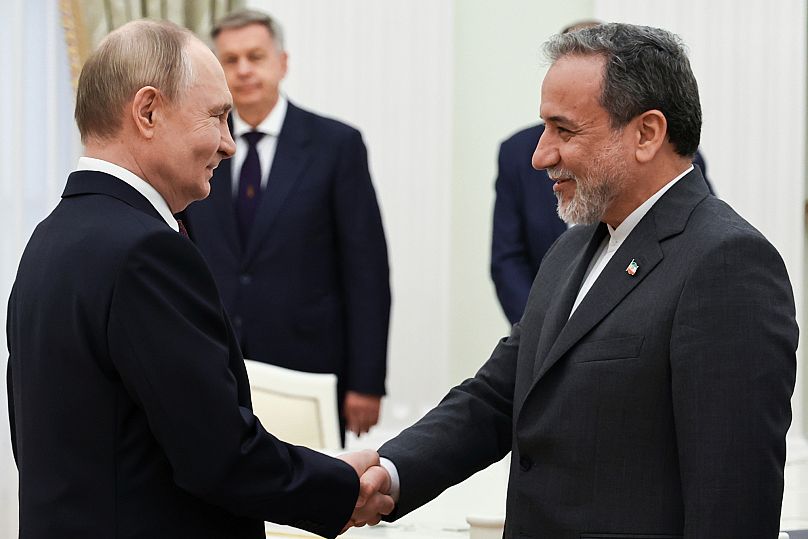 Russian President Vladimir Putin, left, greets Iranian Foreign Minister Abbas Araghchi prior to their talks at the Kremlin in Moscow, Russia, Monday, June 23, 2025.
AP Photo
By the end of last year, when Iranian drones and technology did not bring Russia any closer to occupying all of Ukraine or even all of Luhansk and Donetsk regions, which Moscow has been attempting to seize since 2014, the Kremlin got another ally involved.
This time the support came not in the tech or equipment, but in the boots on the ground.
North Korea sent tens of thousands of soldiers to support Russian troops as they couldn’t push Ukrainian forces out of Russia’s Kursk region after Kyiv’s surprise incursion in August 2024.
After it initially sent 11,000 troops to Russia in autumn last year, around 4,000 of those North Korean soldiers were killed or injured in the deployment, according to Western officials. Yet, Pyongyang’s cooperation with Moscow has since strengthened even more.
North Korea is now set to triple that number and send as many as 30,000 further soldiers to reinforce Moscow troops.
According to a Ukrainian intelligence official, these new troops may arrive in Russia in the coming months.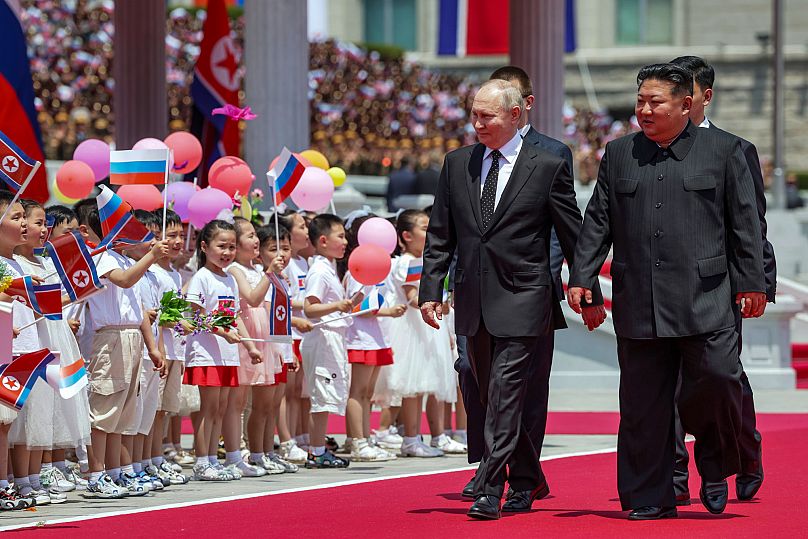 Russian President Vladimir Putin, left, and North Korea’s leader Kim Jong Un, foreground right, attend the official welcome ceremony in the Kim Il Sung Square in Pyongyang, No
AP Photo
Moscow’s former allies
While bogged down in Ukraine, Russia has been gradually losing its influence in the ex-Soviet space. The most striking evolution in this sense is the loss of Russia’s decades-long stronghold in the South Caucasus region.
In September 2023, Azerbaijan reclaimed full control of the Karabakh region after a lightning military campaign, following a decades-long conflict with Armenia in which Russia was a central actor.
Almost two years later, Yerevan and Baku are making history away from Russia by agreeing on the text of a peace accord and normalising their relations after a bloody conflict that until recently had no end in sight.
And although the road ahead is still a challenge for both countries, the path seems to be clear and now includes Turkey, but not Russia, which has been pulling the strings in the conflict since the 1990s.
Moscow’s relations with both Baku and Yerevan have never been as bad as they are now.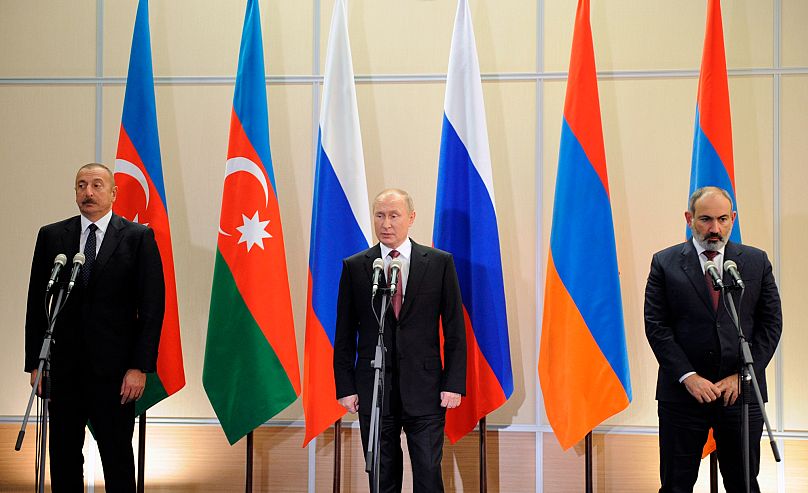 Russian President Vladimir Putin, center, Azerbaijan’s President Ilham Aliyev, left, and Armenia’s Prime Minister Nikol Pashinyan attention a news conference, Nov 26, 2021
AP Photo
Azerbaijan and Russia
In December 2024, an Azerbaijan Airlines passenger jet crashed while on a flight from Baku to Grozny, the regional capital of the Russian republic of Chechnya.
Azerbaijani authorities said the jet was accidentally hit by fire from Russian air defences, then tried to land in western Kazakhstan when it crashed, killing 38 of 67 people aboard.
Putin apologised to Azerbaijan’s President Ilham Aliyev for what he called a “tragic incident” but stopped short of acknowledging responsibility. Aliyev criticised Moscow for trying to “hush up” the incident and asked for those responsible to be punished.
But the relations between the former allies have only gotten worse since.
In May, Aliyev declined to attend Russia’s Victory Day parade in Moscow alongside other leaders of ex-Soviet nations. Later that month, a Ukrainian foreign minister visited Baku, a sign of closer ties with Kyiv.
The tensions escalated rapidly over the past week, when Russian police raided the homes of several ethnic Azerbaijanis in Yekaterinburg, Russia’s fourth-largest city, in what authorities said was part of an investigation into murders dating back decades.
Brothers Huseyn and Ziyaddin Safarov died in the raids, and several other ethnic Azerbaijanis were seriously injured.
Baku responded swiftly and robustly by first calling off previously scheduled Russian official visits, summoning the Russian ambassador to Baku to protest, then cancelling Russian cultural events.
However the backlash culminated so far with Azerbaijani authorities raiding the offices of Russia’s state-run news agency Sputnik Azerbaijan, owned by Rossiya Segodnya, which is in turn owned and operated by the Russian government. The executive director and editor-in-chief have been issued four-month detentions.
On the same day, the Azerbaijani president had a phone call with his Ukrainian counterpart, which further angered the Kremlin.
Ukrainian President Volodymyr Zelenskyy said he expressed support for Baku “in a situation where Russia is bullying Azerbaijani citizens and threatening the Republic of Azerbaijan.”
Shortly after, an Azerbaijani news outlet released what it said was a recording suggesting the Russian military ordered the December 2024 missile strike on AZAL Flight 8243.
Azerbaijani news outlet Minval claims it received an “anonymous letter … containing testimonies, audio clips, and technical details” pointing to “technical deficiencies in the communications equipment used at the time. The outlet didn’t provide details on when the alleged letter had been sent.
Three days after the crash, in an address to the nation, Aliyev said, “we can say with complete clarity that the plane was shot down by Russia (…) We are not saying that it was done intentionally, but it was done.”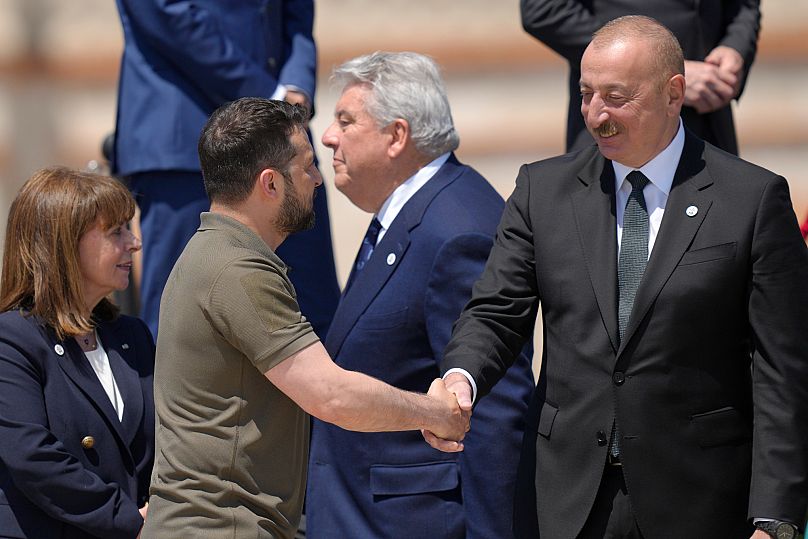 Ukraine’s President Volodymyr Zelenskyy, second left, shakes hands with Azerbaijan’s President Ilham Aliyev during the European Political Community Summit, June 1, 2023
AP Photo
Armenia and Russia
Azerbaijan’s lightning campaign in Karabakh in 2023 demonstrated to Armenia what Syria’s and Iran’s regimes found out later – Russia is not stepping in to support its allies when they need it.
Military experts add that Russia also is not fully capable of doing it since February 2022 with all of its resources and troops blocked in Moscow’s full-scale invasion of Ukraine.
A few weeks after Azerbaijan’s operation, Armenia ratified the International Criminal Court’s statute, which had issued an arrest warrant for Putin on suspicion of illegally deporting hundreds or more children from Ukraine in March 2023, half a year before Yerevan subjected itself to the jurisdiction of the court in The Hague.
In 2024, in an unprecedented development, Armenia put a freeze on its participation in the Kremlin-led Collective Security Treaty Organisation (CSTO) — Moscow’s answer to NATO.
And one year later, in early 2025, the Armenian parliament adopted a bill aimed at starting the process of joining the European Union – an ultimately hostile step as far as Moscow is concerned.
Moscow has been trying to repair the cooperation with its former ally. Lavrov visited Yerevan on 20 May, signalling the Kremlin’s intent to stabilise and reinforce ties with Armenia.
A few days after, EU High Representative for Foreign Affairs and Security Policy Kaja Kallas visited Armenia, signing a partnership agreement with the authorities in Yerevan.
According to Armenia’s Ministry of Foreign Affairs, the sides not only completed the negotiations on the new partnership agenda, but – what might be even more important – launched consultations in the field of defence and security “aimed to align cooperation with current challenges”.
But the most important visit took place not in Yerevan, but in Turkey. As Russia’s foreign minister was in Yerevan, Armenia’s prime minister was in Istanbul meeting with Turkey’s president.
In what was previously considered an unimaginable scenario, Recep Erdoğan and Nikol Pashinyan discussed possible steps for normalising relations between Turkey and Armenia. The sides do not have any formal diplomatic ties, and it was Pashinyan’s first “working visit” to Turkey.
Armenia is seeking the reopening of its joint border with Turkey, which would help alleviate the country’s isolation. Turkey, a close ally of Azerbaijan, shut down its border with Armenia in 1993 in a show of solidarity with Baku over the Karabakh conflict.
With the unprecedented escalations between Azerbaijan and Russia, Recep Tayyip Erdogan said he will support Armenia’s peace efforts with Azerbaijan.
It is hard to overestimate the importance of this statement and this display of how the diplomatic tables turn not only in the South Caucasus region, but beyond, with the possible repercussions all the way to Russia’s invasion of Ukraine.