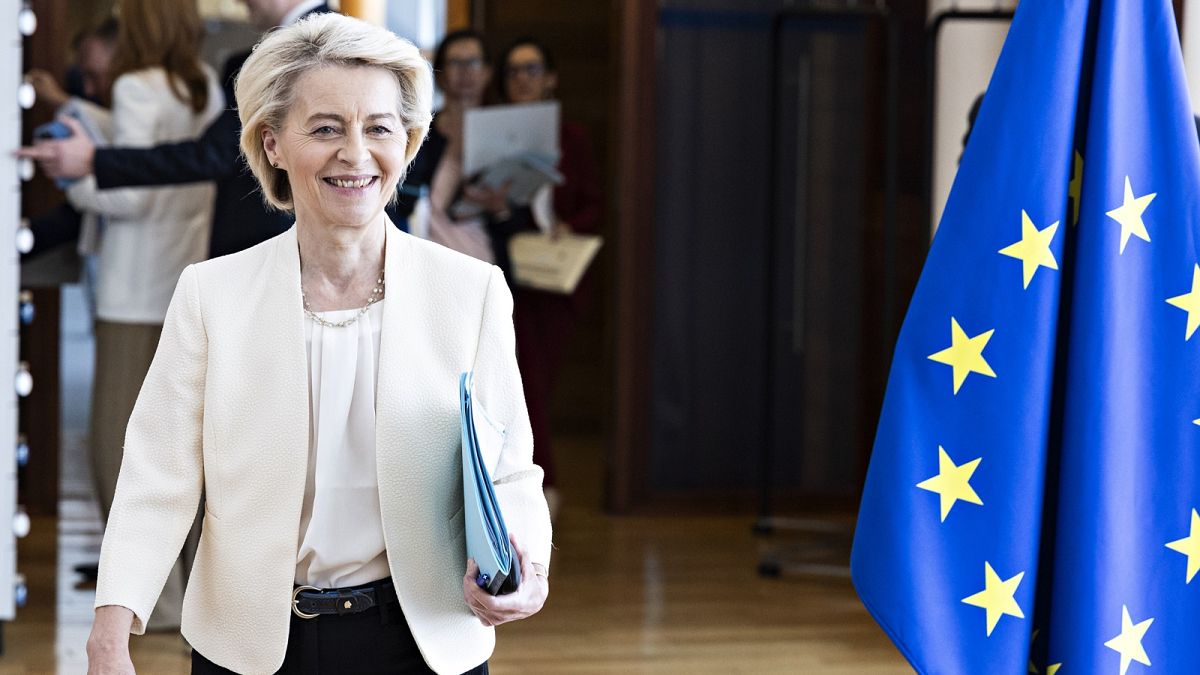
The new budget will be more flexible to cope with unforeseen crises.
 ADVERTISEMENT
Ursula von der Leyen has unveiled her much-anticipated proposal for the new budget of the European Union, worth €2 trillion between 2028 and 2034, a sizable increase compared to the €1.21 trillion approved by leaders in the summer of 2020.
“It is more strategic, more flexible, more transparent,” the president of the European Commission said on Wednesday afternoon.
“We are investing more in our capacity to respond and more in our independence.”
Her blueprint remodels the budget’s structure along three main pillars.
€865 billion for agricultural, fisheries, cohesion and social policy.
€410 billion for competitiveness, including research and innovation.
€200 billion for external action, including humanitarian aid.
While direct contributions from member states will cover the majority of the budget, von der Leyen also envisions new EU-wide taxes on electric waste, tobacco and revenues of big corporations to allow Brussels to raise additional revenue on its own.
All the financial envelopes will be made conditional on compliance with the rule of law, a key change in reaction to democratic backsliding in Hungary.
“The rule of law is a must,” von der Leyen said.
“We will ensure responsible spending and full accountability with strong safeguards, clear conditions, and the right incentives. This serves the citizens.”
Wednesday’s presentation officially kicks off a political squabble between member states and the European Parliament, expected to be protracted, gruelling and explosive, as each constituency fights tooth and nail to secure money for its priorities.
Von der Leyen’s proposal for the new multi-annual budget is strongly shaped by the experience of her first mandate at the top of the powerful executive.
Shortly after she arrived in Brussels, a largely unknown figure plucked from Berlin, von der Leyen was faced with the COVID-19 pandemic, which forced her to design a new recovery fund, repair supply chains and negotiate vaccine contracts on behalf of the 27 member states. She was then tasked with navigating the consequences of Russia’s full-scale invasion of Ukraine, the spike in energy prices, record-breaking inflation, fierce competition from China and a string of devastating natural disasters.
The sweeping tariffs of US President Donald Trump are the latest chapter in a series of back-to-back crises that have put the bloc’s finances under unprecedented strain, seriously challenging the collective ability to respond to unforeseen events.
Mindful of these constraints, von der Leyen has reformed the long-term budget to make it less rigid and more flexible, giving her services greater room for manoeuvre to deploy money according to the ever-changing circumstances inside and outside Europe.
“I have witnessed crises since the beginning of my mandate,” she said. “Each time, it was extremely difficult to react fast and with the financial firepower that was necessary. Because our budget today is designed in a way that 90% (of the money) is fixed.”
The strategy represents an ambitious departure from the traditional thinking underpinning the budget, formally known as the Multiannual Financial Framework (MFF), which until now has been based on clearly defined allocations for specific programmes managed by the European Commission’s specialised departments.
The ongoing 52 programmes will be reduced to just 16, and a share of the funding will not be pre-allocated, making it easier to shift money as necessary.
Additionally, von der Leyen offers a special mechanism of up to €400 billion in loans that will be made available for member states only when an “unknown crisis hits”.
“It’s something we have as a possibility but not to be used in normal times,” she added.
Three main pillars
One of the most eye-catching modifications in von der Leyen’s proposal is the merger of the budget’s two largest envelopes: the Common Agricultural Policy (CAP), which encompasses the subsidies for farmers, and the cohesion funds.
Instead of being separate entities, both will be grouped under the first pillar: the National and Regional Partnerships, worth €865 billion in total.
The two envelopes appear to be significantly downsized in comparison with the present budget, where the CAP and cohesion make up for over 60% of allocations.
The deep cut is set to be fiercely contested by southern countries, which are wary of any backlash from the agricultural sector, and by eastern countries, which are dependent on cohesion policy to bridge the gap with richer member states.
At the same time, the reduction will be cheered by western and northern countries, which have consistently advocated for a greater focus on modern-day priorities, such as climate action, defence, security, research, innovation and cutting-edge technologies.
This plea was reinforced last year by the landmark report of former Italian Prime Minister Mario Draghi, who called for “radical changes” to reverse the steady decline of the bloc’s competitiveness and face up to the intense competition from the US and China.
Von der Leyen’s response is another novelty: the European Competitiveness Fund, worth €410 billion. The fund is intended to leverage private capital to maximise the effect of public money, often decried as being woefully insufficient.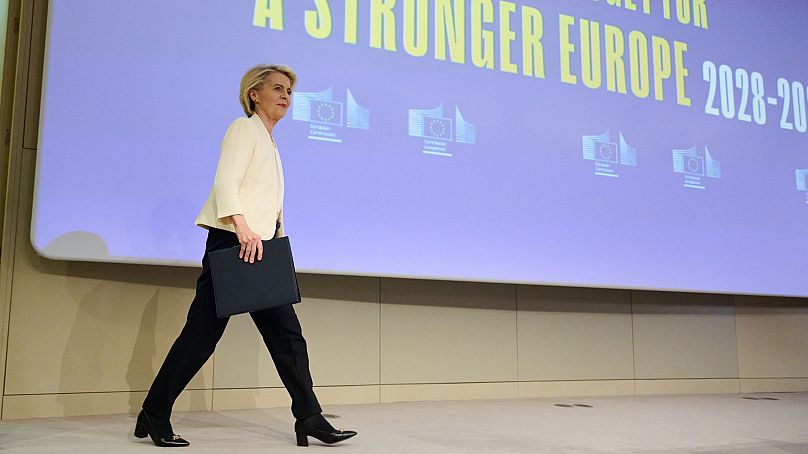 Ursula von der Leyen during the presentation of the new EU budget.
European Union, 2025.
The draft budget’s third pillar combines all the instruments of foreign policy under Global Europe to the tune of €200 billion. Separately, von der Leyen proposes a €100 billion fund dedicated exclusively to supporting Ukraine’s recovery and reconstruction.
The idea follows the steps of the €50 billion Ukraine Facility that leaders approved in early 2024 to make aid more reliable and predictable. By establishing the facility, Brussels protected disbursements of aid against internal clashes and individual vetoes.
Von der Leyen is keen to replicate and enlarge the model in the next budget to ensure Ukraine, whose accession process is under Hungary’s veto, can count on the bloc’s assistance as the United States takes a step back.
Besides the three pillars, the blueprint features €292 billion for other expenses, such as civil protection, the single market, justice affairs and administration, and €49 billion for Erasmus, the student exchange programme.
In parallel, the Commission will begin repaying the COVID-era debt, estimated to be at €24 billion per year, a hefty factor that did not exist in the previous budget.
Brussels insists the recovery fund should be entirely repaid through so-called own resources, such as customs duties, value added tax (VAT), the Emissions Trading System (ETS) and the newly proposed taxes, raising about €58.5 billion per year.
“The goal is simple: we have to repay our shared recovery borrowing (and) we must meet our modern priorities,” von der Leyen said.
Own resources, however, face entrenched resistance from member states and are notoriously complicated to approve, suggesting the goal of collecting €58.5 billion per year might not be reached any time soon, if ever.
This article has been updated with more information about the new budget.
