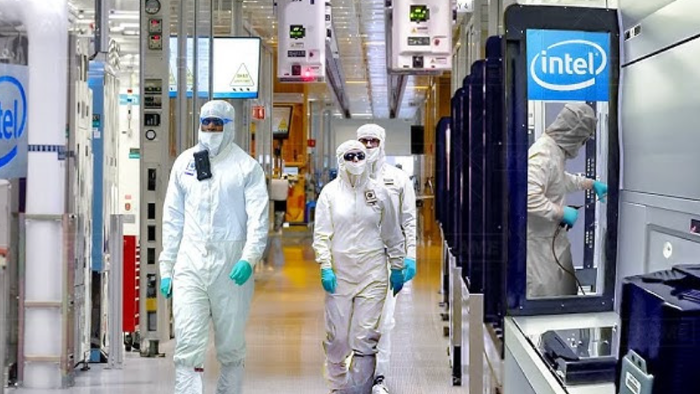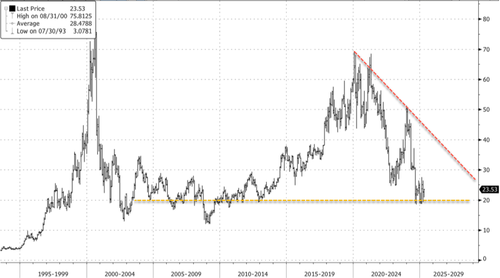
Late last week, 475 workers at a Hyundai / LG battery plant being built in Ellabell, Georgia – mostly Korean nationals – were arrested by US Immigration and Customs (ICE) in a massive raid. The factory was previously touted by former President Joe Biden as a ‘win for manufacturing jobs in the United States,’ which obviously didn’t mean American jobs.
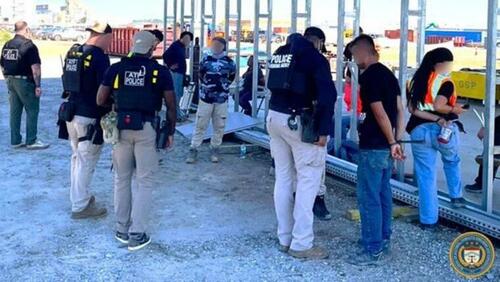
Now we learn that South Korean companies have been using sloppy visa practices for workers sent to the US to build advanced manufacturing sites, according to FT, citing Seoul-based executives and industry groups.
Within the industry, it’s an “open secret” that Korean conglomerates used the B-1 visa, which allows entry into the United States for business purposes – but does not allow the holder to work for payment. The companies are also abusing the Electronic System for Travel Authorization (ESTA) which allows for short-term business visits.
ICE released video of Korean workers in Georgia’s Hyundai/ LG plant being rounded up. Stunning to say the least. pic.twitter.com/79BJQEGn2d
— Jake Kwon (@therealjakekwon) September 6, 2025
“The business community, the Korean government and diplomats have been well aware of this problem all along,” one industry exec told the Times. “We are very worried that ICE can target other Korean facilities too because they have been following the same practices and have similar problems.”
According to a South Korean official, the companies are an “impossible position,” after successive US governments pushed them to invest billions of dollars to revive American industry while refusing to facilitate short-term working visas for the projects to be completed on time.
South Korea’s government said its citizens’ rights must not be violated in the course of Korean businesses’ work in the US, noting ‘many’ of its nationals had been detained after an immigration raid at a Hyundai Motor facility in Georgia https://t.co/vO1jyRWPWN pic.twitter.com/nsilxUlyi2
— Reuters (@Reuters) September 5, 2025
“The US government is two-faced,” said Chang Sang-sik, head of research at the Korea International Trade Association. “It is asking Korea to invest more in the US, while treating Korean workers like criminals even when it is well aware that they are needed for these projects to happen.”
Or, they could hire Americans?
Of note, South Korea has a free trade agreement with the United States dating back to 2012, however it has no country-specific scheme for working visits – unlike FTA countries such as Canada, Australia and Singapore. The official said Seoul has repeatedly brought up the issue over the past two decades, however various US administrations have told them to pound sand – as the scheme would have to be endorsed by Congress.
The issue grew in salience during the presidency of Joe Biden, when South Korean companies attracted by generous federal subsidies from the administration’s flagship Inflation Reduction Act, as well as additional state and county-level inducements, pledged tens of billions of dollars to build factories producing chips, batteries and electric vehicles. -FT
According to Jonathan Cleave, managing director for Korea at Intralink – which provides support for foreign investment projects in the United States, the Biden admin actually told them to “Hire American,” however in practice, the American authorities – “and Georgia in particular,” had “turned a blind eye” to Korea’s shoddy documentation, often for short-term “bursts” of construction activity – which was “part of an understanding that the practice was necessary for projects to be completed on time.”
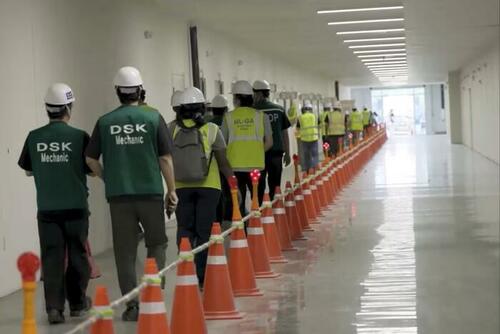
An executive from one of the companies building the raided battery plant in Ellabell told the Times: “We need to send our workers to install new equipment and supervise the project. We can hire US workers once the plant is built, but if the US wants us to hire American workers, our plant should be allowed to be built quickly.”
On Sunday, President Trump wrote on Truth Social that foreign companies investing in the US need to ““LEGALLY bring your very smart people, with great technical talent, to build World Class products,” adding “But we do have to work something out where we bring in experts so that our people can be trained so that they can do it themselves.”
Yet, according to Chang, “training US workers won’t solve the problem” since Korean companies would still be wary of sharing sensitive technologies with their American workforce. “In the case of chip plants, Korean technicians need to review the adoption of new technologies, repair facilities and make sure that their high-tech facilities are run stably.”
Cleave, meanwhile, says that it’s difficult to find reliable construction workers in the US.
“They need to build a factory very, very quickly, and it’s very difficult to do that with extreme labour shortages in the US where people are willing to jump ship every time someone opens another factory down the road,” he said. “The Koreans don’t need a workforce that’s loyal to the grave, but they want people who will come in and finish a project.“