Tag: image

  • House Oversight Chair Subpoenas Epstein Estate For 'Black Book', Other Records

    House Oversight Chair Subpoenas Epstein Estate For 'Black Book', Other Records

    Authored by Jack Phillips via The Epoch Times,

    House Oversight Committee Chairman James Comer (R-Ky.) on Monday sent a subpoena to the estate of sex trafficker Jeffrey Epstein for documents and communications that it may have in its custody.

    The Oversight panel’s subpoena, signed by Comer, shows the committee is seeking records that could shed light on Epstein’s activities, while the panel said that it is trying to obtain a book that was allegedly prepared by his former girlfriend and associate Ghislaine Maxwell—who is currently serving out a 20-year prison term—for Epstein’s 50th birthday.

    The Epstein estate is registered in the U.S. Virgin Islands.

    “It is our understanding that the Estate of Jeffrey Epstein is in custody and control of documents that may further the Committee’s investigation and legislative goals. Further, it is our understanding the Estate is ready and willing to provide these documents to the Committee pursuant to a subpoena,” Comer said in a statement on Monday in announcing the subpoena.

    According to the subpoena, the committee is requesting “any document or record that could be reasonably construed to be a potential list of clients involved in sex, sex acts, or sex trafficking facilitated” by Epstein.

    It is also requesting “all documents and communications related or referring to Mr. Jeffrey Epstein’s missed phone call logs or missed visitor logs” between January 1990 and Aug. 19, 2019, the date of his death.

    Other information requested by Comer’s office include “all entries from Mr. Jeffrey Epstein’s address/contact books, one reportedly referred to as a ‘Black Book,’ from January 1, 1990 through August 10, 2019,” as well as “all flight logs of arrival and/or departure for all aircraft, including helicopters, owned, rented, leased, operated, or used by” Epstein from that same time period.

    The letter also demands that the estate provide documents such as his last will and testament, agreements with prosecutors, any financial transactions and holdings, and any non-disclosure agreements that Epstein may have signed.

    In the letter, Comer wrote to the executors of Epstein’s estate—attorney Darren Indyke and accountant Richard Kahn—and told them that the panel is also “reviewing the possible mismanagement of the federal government’s investigation of Mr. Jeffrey Epstein and Ms. Ghislaine Maxwell, the circumstances and subsequent investigations of Mr. Epstein’s death, the operation of sex-trafficking rings and ways for the federal government to effectively combat them, and potential violations of ethics rules related to elected officials.”

    The Oversight Committee in August sent a subpoena to the Department of Justice (DOJ) for records on the Epstein case. Additionally, the panel has sent subpoenas to multiple former high-ranking U.S. officials.

    Comer’s subpoena comes as the DOJ released hundreds of pages of transcripts from recent interviews that Deputy Attorney General Todd Blanche conducted with Maxwell about her dealings and Epstein.

    The Epoch Times has contacted Indyke for comment.

    Loading recommendations…
  • Unveiling the World’s Largest Shadow Economies

    Unveiling the World’s Largest Shadow Economies

    The Global Underground Cash Flow

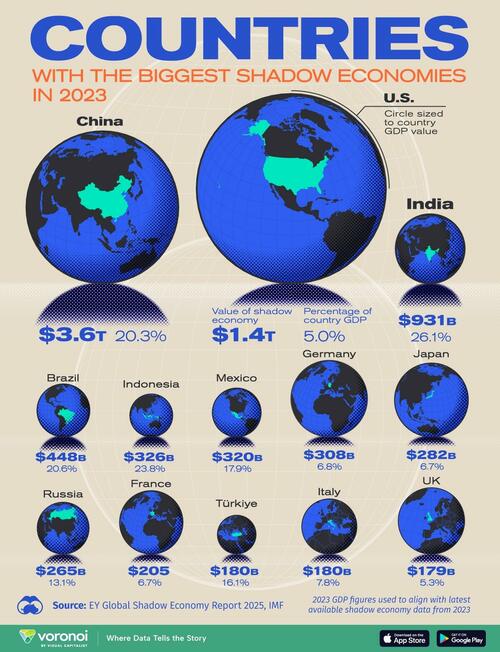
    The world’s informal economy swells to a staggering $12.5 trillion, rooting itself in every nook, especially in emerging markets. While in raw size the United States, China and India headline the black‑market charts, what they share is a mix of street vendors, unregulated gigs, and activities that slip right under the gloss of government oversight.

    What This Means for People

    Think of it as a giant, unofficial job fair where No tax is paid, no safety regulations apply, and job security is a myth. Workers end up tangled in the murky mix of low wages, no health benefits, and sometimes downright dangerous conditions. Millions of people find themselves in this shadowy world, with little recourse.

    Key Takeaways

    • Size matters: The informal economy is larger than any single nation’s GDP.
    • Big players: China, the U.S., and India dominate in sheer volume.
    • Tax loss: Governments lose significant revenue that could fund public services.
    • Worker risk: Absence of legal protections leads to hazardous working environments.
    From Visual Capitalist

    Visuals created by David Neufeld of Visual Capitalist illustrate where those hidden economies sit around the globe, pulling data from the EY 2025 Global Shadow Economy Report. This graphic gives you a snapshot of the “under‑the‑table” trade that fuels economies away from the tax radar.

    Measuring the Informal Economy

    Crunching the Cash Conundrum

    Ever tried to pin down how big the hidden side of the economy really is? It’s like chasing a ghost in a fog‑filled room. But not to worry—Ernst & Young rolled up their sleeves and dove headfirst into the mystery with 70+ variables on the chopping block.

    The Game Plan: Currency Demand

    Instead of fishing for hard‑to‑catch data, the firm went straight to the dollar’s dance floor: looking at how cash moves around. They parked their analysis across 131 jurisdictions, which together account for a whopping 97.2 % of global GDP—that’s almost the entire world, minus a few countries who just can’t keep up with the paper chase.

    Why Is Cash Still the Life of the Party?

    • In the informal economy, cash is the go‑to currency. Think local markets, gig workers, and the occasional street vendor—paper notes are their lifeline.
    • Demand spikes for high‑denomination bills because, let’s face it, who wants to shuffle a ton of small change when you’re selling a ton of handmade artisanal cookies?
    • Cash keeps the economy humming, especially when banks and digital payment systems turn their backs or run a little slow.
    The Bottom Line

    So, while measuring the “show” economy—yes, the part that shows up in cash blinks—remains a tricky puzzle, EY’s method of glancing at how people chase their cash gives us a clearer, if quirky, picture of the world’s unseen hustle.

    China’s Informal Economy is the World’s Largest

    China’s Gig‑Gig Economy: When Numbers Multiply Like Magic Beans

    The 200‑Million‑Strong Rise

    • 2024’s “shadow workforce” has grown almost double since 2004, packing in a whopping 200 million people.
    • These are the everyday heroes you’ll find on the streets—drivers, nannies, roadside repairmen, and the rest of the labor‑intensive services sector.

    Tax Revenue: The Great Gap

    • China’s income‑tax receipts sit around just 6 % of GDP.
    • Contrast that with the 24 % OECD average. It’s like comparing a sleepy cat to a high‑speed vehicle.

    Why the Numbers Matter

    • With so many people working in the gray zone, the government’s money‑pull‑in can’t keep pace.
    • That means less cash for public services—schools, roads, and the occasional street‑cleaning robot movie.
    Bottom Line

    China’s informal economy isn’t just a footnote; it’s a massive chapter in the nation’s economic story. And the 6 % tax revenue? A clear reminder that behind the bustling markets and neon lights lies a complex tapestry of hard workers, each earning their slice of the pie—though the pie itself is a bit smaller than it could be.

    Shadow Economy Showdown

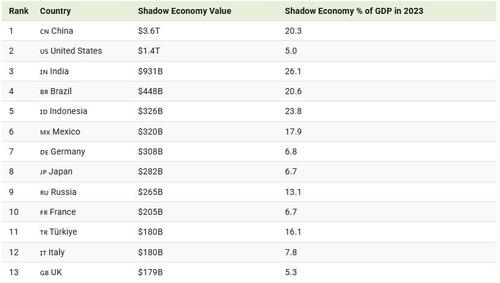
    What’s the scoop? The United States is second on the list after the ever‑mysterious Hidden Economy, with a whopping US$1.4 trillion worth of activities that slip under the tax radar. Picture a glittering underground world where businesses thrive, tax evaders grind, and every state’s secret economy is a clandestine carnival.

    Why the U.S. Fairground is a Hit

    • States that are slower-growing (lower real GDP) and bite‑more when it comes to regulatory hoops tend to have the most shiny underground pockets.
    • Think of it as the “low‑tax, high‑risk” playground for entrepreneurs who prefer a less messy bureaucratic paperwork.

    Latin America’s Big Boss

    Brazil brings a tasty twist to the Latin market: its shadow ecosystem is valued at US$448 billion. That’s almost the entire Economia Nacional in pounds of cash that slips through governmental nets.

    Europe’s Heavy‑Hit

    Across the Atlantic, Germany’s secret economy is the heavyweight champion in Europe. With a magnitude of US$308 billion, it accounts for a staggering 6.8% of Germany’s GDP. That’s like having a whole chocolate factory secretly operating outside the official ledger.

    Want the Big Picture?

    Grab a peek at the visual guide that breaks down the shadow economies by country – it’s a feast of numbers and surprises that’ll have you saying, “Who knew the streets held such treasure?”

    So next time you walk through a bustling market, remember: behind every cheerful “buy” could be a thrilling dance with numbers that never hit the bank. The shadow economy isn’t just a footnote – it’s a full‑blown, worldwide mic‑drop performance.

  • Doge Hits 0B in Savings, Nearly ,300 per Taxpayer

    Doge Hits $200B in Savings, Nearly $1,300 per Taxpayer

    Fed‑Cash Rescue Mission: DOGE Slashes “Waste” Contracts

    The Department of Government Efficiency (DOGE) just cleared out a pile of bloated deals, saving taxpayers a cool $4.2 billion in the last five days. That’s a hefty $5.3 billion worth of contracts now out the door.

    What got the red‑action stamp?

    • $857,000 – a top‑secret “technical adviser” gig for the Interior Department, supposed to go to Lagos, Nigeria.
    • $1.5 million – Treasury’s Word‑Processing Exam Training for the Human Capital Office and the IRS, plus a tiny slice for small‑biz folks.
    • $785,000 – a State Department contracting deal that was just staffing nonsense.

    Why DOGE is calling the press “Fake News”

    On Thursday, DOGE blasted claims that its “cost‑savings” were just a number‑blowout trick. The agency said it actually used ceiling values – the upper spend limits – not the realpayouts.

    “In federal contracting, ceilings matter because they’re most often maxed out.” – DOGE explained. “Out of 5.4 million awards at FY24’s end, 98.12 % hit the ceiling.”

    Even Bill Ackman Couldn’t Resist the Praise

    Just a day later, hedge‑fund guru Bill Ackman weighed in from his usual corner of the Xverse:

    “@DOGE is doing great work. Thank you, DOGE team!”

    So if you ever wondered where the federal money is really going, DOGE has just opened up the tidy casebook for you to read.

    How DOGE’s “Dollar‑Saving Extraordinaire” Became a $205 Billion Hackathon

    On August 15th, the DOGE (Department Of Government Efficiencies) team proudly announced that they’d sliced roughly $205 billion off the federal budget—about $1,273.29 saved per taxpayer! That’s a tidy chunk of money that could now fund anything from school lunches to a new great‑america space program. How did they pull it off? A quick, clever sweep across contracts, leases, grants, and assets.

    Who’s the Big‑Spender? Coalition of Five Key Departments

    • Health & Human Services – The department that pours the biggest sums into medical programs.
    • General Services Administration – The folks responsible for office leases and equipment.
    • Defense – Argh, even the armed forces have plenty to trim.
    • Social Security Administration – Because that never ends.
    • Small Business Administration – Tiny loans that add up fast.
    • Office of Personnel Management – Cutting a few corners on hiring costs.

    Spot‑On “Greatest Hits”: The Most Striking Cuts

    DAO’s website lists several “strangest, most baffling uses” of funds that have been wiped clean. Here’s the rundown:

    • $1.5 million originally earmarked for a grant to the Center to Advance Reproductive Justice and Behavioral Health – aimed at supporting pregnant and postpartum people of color.
      Result: 2015‑”we’re not wasting that cash!”
    • $6.9 million set aside for a mental‑health development grant under an “antiracist” framework.
      Result: 2015‑“let’s rethink that allocation.”
    • $10 million earmarked to “decolonize the curriculum.”
      Result: 2015‑“we’re still figuring out what that means.”

    These cancellations weren’t just numbers on a spreadsheet—they’re a reminder that the federal purse‑strings need a good tightening.

    What’s Next? Outlook for the Treasury

    If the DOGE continues its trend of smart reallocations, the trend may turn on more “unnecessary” programs, ensuring the U.S. taxpayer more savings, and at least some regular folks get a chance to write a little fewer check‑books on their bank accounts.

    DOGE Data Access

    Dog‑Egone Chaos: Senators Push “Pick Up After Your DOGE Act” to Clean Up the Mess

    Last month, a band of Democratic senators launched the Pick Up After Your DOGE Act, demanding a full‑blown audit of every federal agency’s computer systems – the same ones that were snooped on by DOGE staff, according to a July 30 release from Senator Sheldon Whitehouse (D‑R.I.).

    Why the DOGE Group is a Pain‑In‑The‑Neck

    • These “DOGE boys” gained access to
      • the IRS,
      • Social Security Administration,
      • Department of Transportation,
      • Veterans Administration,
      • and more.
    • Despite having nearly zero training and few qualifications, they walked straight into the heart of sensitive data.
    • Such incursions are flagged as “substantial risks” to Americans’ data and well‑being.
    • Unpatched bugs and backdoors left open by DOGE might let a thief swipe private info.

    Whitehouse Says

    “The DOGE‑boys have weasel‑ed themselves into America’s most sensitive data systems, claiming to hunt ‘waste, fraud, and abuse,’ while actually creating the very thing they’re supposed to stop. They’re eroding trust in government and could even be hand‑shaking stolen data to Big Tech and AI,” snorted Whitehouse.

    The bill aims to protect seniors and everyone by wiping out any bugs or backdoors DOGE might have planted—whether by accident or design—in Social Security, Medicare, and other secure systems.

    Trump Administration’s Victory‑Lap

    Meanwhile, the Trump era secured a win—on August 12 the U.S. Court of Appeals for the Fourth Circuit lifted a block that had been standing since a February lawsuit. That lawsuit argued DOGE was “steamrolling into sensitive government record systems” and jeopardizing personal data.

    Initially, a district judge issued a preliminary injunction that barred federal agencies from handing data to DOGE. But the appeals court flipped that, voting 2‑1 to lift the prohibition.

    Judge Julius Richardson Weighs In

    Richardson claimed it was impossible for DOGE employees to do their jobs without having privileged access to government data. “Asking DOGE affiliates to spell out what they want and why in advance is basically a request for clairvoyance,” he said. “Expecting an IT specialist to modernize a system with admin rights to all internal databases—especially during the initial tech audit—is realistic.”

    Bottom Line

    It’s clear: if a group that historically looks more like a gang than a workforce is allowed to dig through government data, somebody’s going to pull a data heist. The new bill and court decisions split the load of responsibility, leaving everyone to watch, hope, and, quite frankly, pray that the “DOGE‑boys” keep their paws off America’s most sensitive systems.

  • Cohere’s North AI Agent Platform Safeguards Enterprise Data with Unprecedented Security

    North: The AI Agent That Keeps Your Data Inside the Firewall

    Why Big Brains Are Still Fearing the Beast

    Believe it or not, even the smartest of those new AI agents can still feel like a data‑leaking snake. Corporate giants, regulators, and the entire government apparatus still hold back on adopting LLM tech because of a very simple fear: what if your or your customers’ secrets slide out like a bad typo in a spreadsheet?

    Enter Cohere’s North – a Promise of Privacy

    North is the answer the industry has been waiting for. It lets companies tuck that AI baby inside their own walls—on local machines, in private clouds or even a physically air‑gapped basement server. The result? No data ever touches the outside world.

    • Deploy on one or two GPUs (perfect – even that dusty GPU in a closet from last year).
    • Runs on on‑prem, hybrid clouds, VPCs, or complete isolation—pick your environment.
    • No “cloud” storage—data stays in‑house, never leaving the firewall.

    Security, Compliance and the “Never‑Give‑Up” Attitude

    Cohere put a safety net around North, giving it a full password guard: granular access control, autonomous agent policies, constant “red‑team” drills, and third‑party security audits. And yes, it meets the big names: GDPR, SOC‑2, ISO 27001. No surprises—just a robust guard house with a friendly doorbell.

    Backed by the Brain Behind the Machine

    Nick Frosst, the co‑founder, told us that LLMs are only as good as the data they’ve seen. If we want them to help us solve real problems, the data has to stay where it belongs—within the organization’s own environment. That’s why North is built to be friendly to the existing infrastructure, and easy on the hardware budgets.

    With all that, the verdict is clear: Next‑gen AI agents can finally keep the data safe so everyone in the company—and the customers—can breathe easy.

    More than private deployments

    Cohere’s A.I. Adventure: From $970M to $5.5B Fortune

    Picture this: an AI startup that’s taken the tech world by storm, raising a staggering $970 million so far. The latest moves, though, have pushed its valuation up to a cool $5.5 billion. Intriguing, right?

    Now, Cohere isn’t just talking the talk—they’ve already rolled out their “North” platform to a roster of major players. If you think big corporations are all about spreadsheets, think again: they’re getting serious with AI.

    Customers Who’ve Jumped On the Bandwagon

    • RBC — because banks know a thing or two about data.
    • Dell — building PCs but now building smarter ones.
    • LG — watching for futuristic home tech.
    • Ensemble Health Partners — making healthcare data a dance.
    • Palantir — “great‑field intelligence” enthusiasts, thanks to that TechCrunch episode.

    In short, Cohere’s making waves, and if you’re looking for an exciting partner in the AI sphere, you might want to keep an eye on how this company rolls out its partnership program.

    Tech and VC heavyweights join the Disrupt 2025 agenda

    Netflix, ElevenLabs, Wayve, Sequoia Capital, Elad Gil — just a few of the heavy hitters joining the Disrupt 2025 agenda. They’re here to deliver the insights that fuel startup growth and sharpen your edge. Don’t miss the 20th anniversary of TechCrunch Disrupt, and a chance to learn from the top voices in tech — grab your ticket now and save up to $600+ before prices rise.

    Tech and VC heavyweights join the Disrupt 2025 agenda

    Netflix, ElevenLabs, Wayve, Sequoia Capital — just a few of the heavy hitters joining the Disrupt 2025 agenda. They’re here to deliver the insights that fuel startup growth and sharpen your edge. Don’t miss the 20th anniversary of TechCrunch Disrupt, and a chance to learn from the top voices in tech — grab your ticket now and save up to $675 before prices rise.

    Meet North: Your AI Sidekick for the Modern Workplace

    Picture this: an AI that can’t just answer questions but actually grabs your hand and walks you through the whole process. That’s North, a shiny new platform from Cohere that’s already making waves in the office gig.

    What North Can Do (and Why It’s a Total Game‑Changer)

    • Chat & Search – Think of it like a super‑smart search bar that talks back. You can ask for customer support answers, get instant summaries of meeting transcripts, draft snappy marketing copy, or even pull up details from your internal library and the web. And the best part? Every reply comes with citations and clear “reasoning” steps so you (and the auditors) can trust what it says.
    • Table & Document Builder – Need a fresh spreadsheet or a polished slide deck? North can whip those up for you, no hassle.
    • Market Research Assistant – “Dig up insights?” North dives into data, crunching numbers and spotting trends so you can focus on strategy.

    Powered by Cohere’s Genius Tech

    • Uses Command – a family of generative AI models re‑trained specifically to reason in an enterprise setting.
    • Also plugs into Compass – their slick multimodal search stack that does the heavy lifting of finding the right info.

    Getting Connected – It’s All About the Ecosystem

    • Direct integrations: Gmail, Slack, Salesforce, Outlook, Linear, and basically any workplace tool you could dream of.
    • Supports MCP (Model Context Protocol) servers – let’s say you’ve got a secret sauce of industry data or a custom app; North can tap into it.
    • And because it’s built for enterprises, it slides from being a helpful assistant all the way to an automated powerhouse as you grow trust and confidence.

    Notable Backstory: Ottogrid Acquisition

    Just a few months ago, Cohere took in Ottogrid – a Vancouver‑based platform that automates intricate market research. That means North gets a fresh boost of tools that make data crunching even snappier.

    Quick Correction

    A previous edit accidentally misnamed Alex Frosst’s title. Our sincerest apologies for the mix‑up!

  • Armenian Mob Faces Charges Over Murder Plot and  Million Amazon Theft

    Armenian Mob Faces Charges Over Murder Plot and $83 Million Amazon Theft

    Big Brother’s New Game: 13 Armenian Crime Fighters Nabbed in Los Angeles

    Picture a neon‑lit street in Los Angeles and a behind‑closed‑door showdown between two rival Armenian gangs. On Tuesday, federal agents threw a wrench in the gears and pulled off a sting that snagged 13 alleged members of these rival outfits. It’s the kind of twist that could have even James Bond scratching his head.

    Why It Matters

    • Power Struggle – The arrest signals a clear attempt to shake up the balance of power in a covert underworld. Think of it as a high‑stakes poker game where the blinds just got lowered.
    • Law Enforcement Wins a Round – Federal authorities, teaming up with local precincts, managed to capture suspects before they could finish their illicit hand.
    • Community Impact – Crime heel‑raisers have a direct toll on local communities, so this move says the police are determined to keep neighborhoods safe.

    What We Know

    The suspects were allegedly involved in a series of crimes ranging from racketeering to protection rackets. The arrest was part of a broader investigation that’s tied to a history of turf disputes among Armenian criminal groups in Southern California.

    Fast‑Tracking Justice

    While details on the next court steps are still murky, the expectation is that the federal system will take over the proceedings quickly, aiming to disrupt any lingering loose ends that could let the gangs regroup.

    In a city that thrives on hustle and bustle, this pick‑up serves a double purpose: it amps up the morale of law‑and‑order, and reminds the underworld that even the most organized, shadowy schemes aren’t immune to shine‑through.

    Big Bad Russian‑American Crime Ring Caught by U.S. Justice

    Fast‑enough recap: Two high‑profile racketeers, Ara Artuni (41) from Los Angeles and Robert Amiryan (46) from Hollywood, have been nabbed over a whopping $80 million in illegal activity. The indictment lists attempted murder, kidnapping, illegal firearms, bank and wire fraud, plus cargo theft. Ka‑la‑lumps!

    Who’s Who

    • Ara Artuni – Now facing an attempted murder charge “in aid of racketeering.” He allegedly plotted to kill Amiryan during a hot summer of 2023.
    • Robert Amiryan – Accused of kidnapping Artuni’s associate after Artuni allegedly tried to kill him. He and his crew supposedly took a child for a tragic showdown in June 2023.

    The “Avtoritet” Showdown

    Both men are surf‑and‑surf leaders of rival Armenian organized crime groups, nicknamed “avtoritet” (a Russian word for “authority”). Since 2022, they’ve been battling for rule over the San Fernando Valley. Imagine two wrestling rings—one for each gang—jealous and always ready to throw a punch.

    Ever‑Sorted Schemes

    • Bank & Wire Fraud – The duo trafficked in shoddy financial moves that hurt legitimate businesses.
    • Cargo Theft & Amazon‑shifting – Arty’s crew enrolled as truck carriers, signed contracts with Amazon, and then derailed the great logistics engine to snatch entire shipments. Reportedly $83 million stolen.
    • Fake “Credit‑Card” Scam – They opened bogus businesses, swiped using 3‑DS secured cards, drained accounts before the credit card providers could meddle.
    Violent Extremes

    In a twisted retaliation, Amiryan’s organization allegedly kidnapped and tortured one of Artuni’s partners—turns out, “kidnapping” and murder were just two sides of the same coin for these two.

    Flashing News from the Field

    A federal raid on May 20 raked up:

    • $100,000 in cash
    • 14 firearms
    • 3 armored vans (mind you, that’s just a minor inconvenience for cops)

    Around L&A, two more suspects were taken into custody in Fort Lauderda and Hollywood, FL—the world’s travel for crime lingo. They’re still hunting one missing defendant.

    Potential Life on the Bench

    With a full slate, the men face sentences ranging from 10 years up to life in prison—no parole snack here.

    Bottom Line

    We’ve got a duo of crime bosses who have convinced the system that the world’s not safe. But thanks to a coordinated raid, the U.S. DOJ is closing in and promising to keep the “avtoritet” from running the streets—and, of course, protecting the supply chain that Amazon used to deliver pizza.

  • DIAG Image: The Complete Guide to Modern Diagnostic Imaging – Health Cages

    DIAG Image: The Complete Guide to Modern Diagnostic Imaging – Health Cages

    The world of healthcare is changing rapidly, and one of the biggest transformations comes from Diag Image technology. Modern diagnostic imaging has become a powerful tool that allows healthcare professionals to look inside the human body without surgery. From X-ray, MRI, CT scan, ultrasound, and even advanced 3D imaging, these techniques help in identifying health problems earlier and with greater accuracy. Doctors and specialists now rely on diag image systems not only for early disease detection but also for effective treatment planning. As technology continues to grow, diag image solutions are making healthcare faster, safer, and more accessible for patients everywhere.

    (adsbygoogle=window.adsbygoogle||[]).push({})

    What Is a DIAG Image and Why It Matters in Healthcare

    A DIAG image is a detailed picture created through medical imaging techniques. Doctors use these images to look at bones, organs, and tissues. By giving a clear view of what’s happening inside, they improve diagnostic accuracy. For American healthcare professionals, this often means spotting health issues early and starting treatment planning right away.

    (adsbygoogle=window.adsbygoogle||[]).push({})

    These images matter because they directly impact patient outcomes. A clear DIAG image can mean the difference between early disease detection and a missed diagnosis. For example, finding tumors, fractures at an early stage helps surgeons and primary care physicians act quickly, improving recovery chances.

    (adsbygoogle=window.adsbygoogle||[]).push({})

    Traditional imaging gave basic outlines, but digital imaging is sharper and faster. In modern healthcare infrastructure, a DIAG image offers greater detail and reduces diagnostic errors reduction. Doctors now rely less on guesswork and more on precise data.

    (adsbygoogle=window.adsbygoogle||[]).push({})

    Types of DIAG Imaging Techniques and Their Applications

    Different medical imaging techniques serve different purposes. X-rays detect bone damage, CT scans show cross-sections of organs, MRI creates clear views of soft tissues, and ultrasound helps in pregnancy and organ checks. Each method plays a role in healthcare diagnostics, ensuring no detail goes unseen.

    In U.S. hospitals, advanced imaging like 3D imaging and portable ultrasound devices are now common. They are especially useful in rural clinics where large machines are hard to install. These technologies save lives by bringing care closer to patients who otherwise lack access.

    (adsbygoogle=window.adsbygoogle||[]).push({})

    Doctors select methods based on condition, urgency, and cost. For example, MRI is best for brain scans, while X-ray is faster for broken bones. This decision is part of implementation strategies in healthcare designed to improve care while controlling costs.

    How DIAG Imaging Works: The Process Explained

    Creating a DIAG image starts with a scan. Patients lie still while machines capture body details. The raw data is processed through algorithms and turned into clear images. These are later reviewed by radiologists, who interpret the results for other healthcare professionals.

    This process also includes IT staff managing systems and keeping images safe through encryption methods. In the U.S., strong data protection in healthcare and compliance standards (HIPAA) ensure sensitive information stays private.

    In American medical facilities, patients usually get instructions before imaging. After the scan, the images go to primary care physicians or surgeons, who create treatment planning. This smooth workflow shows the workflow efficiency of modern diagnostic imaging.

    The Advantages and Limitations of DIAG Imaging

    One of the greatest advantages is early disease detection. A DIAG image helps doctors act fast, often before symptoms worsen. Another strength is that most imaging methods are non-invasive, meaning no surgery is needed to view the problem.

    Still, there are limitations. Image quality variability can affect accuracy. Patients who move during a scan can cause unclear pictures. High costs of machines also make access harder for smaller clinics. These issues highlight the need for constant innovation in diag image technology.

    Doctors in the U.S. carefully weigh the risks. For instance, CT scans use radiation, so they must balance diagnostic accuracy with patient safety. This balance ensures that only necessary scans are performed.

    The Role of Technology and AI in DIAG Imaging

    Artificial intelligence in healthcare is reshaping diagnostic imaging. With machine learning algorithms, systems now analyze images faster than humans. This helps spot issues like tumors, fractures in seconds, boosting diagnostic accuracy.

    For U.S. healthcare professionals, AI-powered medical imaging also improves workflow efficiency. Instead of long waits, patients get faster results, which means quicker treatment planning. This progress is saving time and lives.

    By using predictive analytics in healthcare, doctors can forecast health risks. These insights let stakeholders in healthcare move from reactive care to preventive care. This shift is one of the most exciting future trends in diagnostic imaging.

    Real-World Applications and Case Studies of DIAG Imaging

    Across the USA, case studies in DIAG image use prove its value. At one major hospital, advanced imaging led to a diagnostic errors reduction of 25%. This directly improved survival rates. For patients, these advances mean more accurate answers and faster treatment.

    In another example, portable ultrasound devices helped rural clinics provide imaging without big machines. This improved access for communities often left out of advanced healthcare diagnostics. These stories show the real impact of diag image technology on everyday lives.

    In one study, telemedicine integration allowed specialists to read scans remotely. This meant faster care for patients in small towns. The success highlights how technology bridges gaps in healthcare infrastructure.

    Challenges, Costs and Future Trends in DIAG Imaging

    High cost is a major challenge in the U.S. The price of machines, training, and upkeep is steep. Hospitals conduct cost-benefit analysis in healthcare to weigh the expense against benefits like faster care and better patient outcomes.

    Looking ahead, augmented reality in diagnostics and cloud storage in healthcare will transform access. By connecting medical facilities, images can be shared instantly, cutting delays. Future trends in diagnostic imaging focus on speed, safety, and access.

    Through insurance, subsidies, and new implementation strategies in healthcare, the cost can be reduced. Better vendor selection for medical imaging also helps hospitals find affordable yet reliable systems, ensuring more patients benefit.

    Conclusion: The Growing Importance of DIAG Imaging in Modern Medicine

    DIAG images are not just pictures; they are tools that guide care and save lives. With the rise of artificial intelligence in healthcare, the field of diagnostic imaging is moving toward greater precision and faster decisions.

    For the U.S., this technology ensures healthier futures. From early disease detection to better treatment planning, DIAG image technology will remain central to modern medicine, making care more efficient, accessible, and effective for everyone.

  • Microsoft Lens Says Goodbye: AI Takes Over the Simple Scanning App

    Microsoft Lens is Saying Bye‑Bye (but not before December 2025)

    So, you remember that nifty little app that snapped paper whenever you needed to save a receipt, a business card, or an old handwritten note? Microsoft Lens was that app. It did one thing—scan documents—and nailed it. No subscriptions, no hidden fees, just a pocket‑friendly scanner for your phone.

    Why it’s going away

    Microsoft’s got a bigger plan in mind. The company is steering everyone toward its Copilot AI chat app, and that means Microsoft Lens is making its final exit.

    • Sep 15 2025: Lens will stop showing up on the iOS and Android App Stores.
    • Nov 15 2025: The app will finally be removed from Apple’s App Store and Google Play.
    • Dec 15 2025: Users can still fire up the app to scan new documents—after that, the scanner will be retired.
    • Even after the scanner shuts down, any scans you already saved will stick around in the app as long as the app stays on your phone.

    What it actually did

    Back in 2015 Microsoft Lens (originally called Office Lens) began as a Windows Phone sidekick. It didn’t overcharge or push a subscription model like many other scanning apps. Instead, it focused on making your life simpler: just point your camera, scan, and voilà—digital, readable files of your everyday paper.

    A quick look back

    • First‑hand scanning of receipts, business cards, and documents.
    • Easy export to Word, PowerPoint, and OneNote.
    • No in‑app purchases—just pure, honest OCR.

    So as your device is about to lose this handy scanner, you’ve got a few months to keep the flow going. Once it’s gone, you’ll be greeted by Copilot’s chat interface. If you’re a fan of the old “snap‑and‑save” way, you’ll still find your saved scans handy, but the magic of instant paper‑to‑data will leave this chapter.

    Microsoft Lens – The Super‑Scan Tool That Disappears… Soon

    Remember when you could just snap a picture of a handwritten note, a receipt, or even scribbles on a whiteboard and instantly get a polished PDF or Word file? That was Microsoft Lens in all its glory. Whether you needed a clean, high‑contrast copy or a quick JPEG to share, Lens did the job with a few taps.

    What Lens Could Do

    • Instant Document Conversion: Handwritten sheets, receipts, business cards, or chaotic whiteboard drawings—all turned into PDFs, Word docs, PowerPoint slides, Excel sheets, or straight‑up images.
    • Smart Filters: Lighten up that dull photo, create a crisp black‑and‑white version, or enhance the contrast without any hassle.
    • Seamless Saving: Drop the file right into Microsoft OneNote, Word, PowerPoint, or even your phone’s camera roll, or send it to the cloud of your choice.

    Short, sweet, and it worked like a charm.

    The Sudden Curtain Call

    Just a few months ago, Bleeping Computer spotted the first hints of Lens’s disappearance. The news? It’s being phased out and users are being nudged toward the new Microsoft 365 Copilot app. But with Copilot—

    • you can still scan, but it doesn’t let you save directly to OneNote, Word, or PowerPoint.
    • Business card scans won’t make it into OneNote either.
    • Features like read‑out‑loud and Immersive Reader are gone.

    In short, you lose all that awesome versatility Lens had. The big question is: will Copilot ever fill the gap that Lens lovingly filled for us? Stay tuned—this tech landscape is as unpredictable as a sudden rainstorm on a sunny day.

    Tech and VC heavyweights join the Disrupt 2025 agenda

    Netflix, ElevenLabs, Wayve, Sequoia Capital, Elad Gil — just a few of the heavy hitters joining the Disrupt 2025 agenda. They’re here to deliver the insights that fuel startup growth and sharpen your edge. Don’t miss the 20th anniversary of TechCrunch Disrupt, and a chance to learn from the top voices in tech — grab your ticket now and save up to $600+ before prices rise.

    Tech and VC heavyweights join the Disrupt 2025 agenda

    Netflix, ElevenLabs, Wayve, Sequoia Capital — just a few of the heavy hitters joining the Disrupt 2025 agenda. They’re here to deliver the insights that fuel startup growth and sharpen your edge. Don’t miss the 20th anniversary of TechCrunch Disrupt, and a chance to learn from the top voices in tech — grab your ticket now and save up to $675 before prices rise.

    Microsoft Says Goodbye to Lens – Users Weigh In

    So, while your favourite photo‑editing app has been around for a little over a decade, it’s still earning a respectable 322,000 downloads in the last month alone—thanks to folks soaking up its magic on both the App Store and Google Play.

    Long‑term stats tell a similar story: since the launch of Lens in January 2017, it’s been downloaded a whopping 92.3 million times. That’s a fair bit of magic being cast across phones worldwide.

    What’s Happening?

    • Microsoft, the tech giant behind the app, has decided it’s time to shut down Lens.
    • Curiously, the company’s spokesperson hasn’t yet responded to questions about the move.

    Reacting to the Quiet Pause

    While the official reason remains out of the open, insiders say tough competition and fresh, more modern offerings might have pushed Lens toward retirement. Still, the platform’s fans aren’t ready to let go so easily.

    So whether you’re a seasoned Lens user who relied on its quick snapshots for everything from grocery bills to passport photos, or a newcomer who stumbled upon it last month, this announcement feels like the end of an era. But hey, there’s always a chance we’ll see a surprise comeback or a creative successor launching in the near future.

    Bottom Line

    Microsoft’s decision to pull the plug on Lens marks a significant shift in the photo‑editing landscape. It also reminds us that even beloved apps can fade away if they’re not kept fresh—and we’d all be better off watching out for the next big thing on our phones.

  • Death Cycle Of The Democratic Party Accelerates With Massive Voter Exodus

    Death Cycle Of The Democratic Party Accelerates With Massive Voter Exodus

    A new analysis of voter registration data has sparked warning signs among Democratic Party leaders. This is because the party of leftist radicals has effectively alienated working-class voters, pushing all things woke, embracing socialism (with a sprinkle of Marxism), calling for the collapse of capitalism, defending criminal illegal aliens, and the list goes on and on. Working-class Americans are beginning to see that the party of leftist radicals has become nothing more than a puppet for elite progressive donors and dark-money-funded NGOs advancing anti-American values.

    The Democratic Party is hemorrhaging voters long before they even go to the polls,” according to a new report from The New York Times

    Voter registration data from 2020-24 shows broad-based erosion across all 30 states that track party affiliation. Democrats lost a net 4.5 million voters, in what the NYT calls a “deep political hole that could take years to climb out of.” 

    The massive shift underpins Trump’s 2024 popular vote win and domination across all swing states. 

    Here are some of the shifts:

    • Young voters: In 2018, Democrats captured 66% of new under-45 voters. By 2024, that had imploded to 48%, with Republicans now winning the majority.

    • Men: Democratic share fell from 49% in 2020 to just 39% in 2024.

    • Latinos: Once a reliable voter bloc for the party, registration is now swinging Republican, e.g., Florida Democrats dropped from 52% of new Latino registrants in 2020 to just 33% in 2024.

    • Battleground State Races: Arizona, Nevada, North Carolina, and Pennsylvania all saw steep Democratic erosion.

    Commenting on the shifts is Tom Bonier, one of the Democratic Party’s leading experts on voter registration trends. He said the registration figures are “a big flashing red alert” for the party

    NYT warned that Democrats had lost another 160,000 voters by the midpoint of this year: 

    Any hope that the drift away from the Democratic Party would end organically with Mr. Trump’s election has been dashed by the limited data so far in 2025. There are now roughly 160,000 fewer registered Democrats than on Election Day 2024.

    Michael Pruser, who tracks voter registration closely as the director of data science for Decision Desk HQ, an election-analysis site, warned, “The death cycle of the Democratic Party,’ but there seems to be no end to this.” 

    Pruser added, “It’s going to get worse … before it gets better.” 

    What’s clear is that Democrats have a major branding problem with mainstream voters, calling everyone they disagree with “racist” or “fascist,” while embracing socialism and even Marxist policies, all without a real economic plan. Continuing to push color-revolution-style operations is not a winning strategy. By doubling down on all things woke, the tone-deaf party ensures the hemorrhaging of its voter base will continue.

    Loading recommendations…
  • See Sarah Langlie Share Highlights of Her Remarkable Freshman Season at Barry University

    See Sarah Langlie Share Highlights of Her Remarkable Freshman Season at Barry University

    Langlie batted .384, recorded an OPS of .935, and posted a .492 slugging percentage

    Fresh‑Caught and Thriving: Sarah Langlie’s Breathtaking First Season

    From the sunny shores of Brevard County to the buzzing campus of Barry University, Sara Langlie has made a splash that can’t be ignored. The former Eau Gallie star powered her way into the Sunshine State Conference spotlight with a performance that spell‑bound fans and coaches alike.

    All‑Day, Every Day: No Shortcuts Taken

    • Started every one of 57 games – that’s 57 baseball days in the sun‑burnt dugout.
    • Played both catcher and outfield roles without breaking a sweat – you’d think she’d be playing dodgeball instead of baseball!
    • Demonstrated durability and consistency; no game was left behind.

    Batting Brilliance – Numbers That Shine

    • Hoisted her bat to hit a .384 batting average – that’s hitting roughly 38 chances out of 100.
    • Achieved an impressive .935 OPS (On‑Base Plus Slugging) – a metric that shows she’s not only getting on base but also bringing the fireworks.
    • Posted a .492 slugging percentage, meaning she’s turning singles into a steady stream of extra‑bases.

    The Impact on Barry’s Offense

    Sarah’s on‑field hustle turned Barry’s lineup into a cut‑throat machine. Her “power” fueled the team’s run production, giving the crowd something to cheer about each and every inning. Opposing pitchers had a new nightmare to contend with.

    Bottom Line

    With a breakout freshman year that shows she can catch every ball and hit every pitch, Sarah Langlie is officially a rising star in the Sunshine State Conference. Stay tuned: this is just the beginning of a brilliant career.

    See Sarah Langlie Share Highlights of Her Remarkable Freshman Season at Barry University

    Langlie Lights Up the Field in Her First Season

    When you combine a rock-solid defense, a slugging mouth, and a dash of cheeky confidence, you get Laura Langlie—the newest star brightening up Barry College softball.

    The All‑Around Impact

    • 57 starts, 57 games, no tears – she stuck it out in every match.
    • Bats: .384 – that’s 384 hits per 1000 at‑bats, a tiny little winner for the bullpen.
    • OPS: .935 – a sweet mix of on‑base help and power that made fans cheer.
    • Slugging: .492 – numbers that say she can hit a homer with the same hand that throws a perfect pop‑foul.

    Plate Blood, Heart, and Hustle

    • Runs: 41 — she got on base and let her teammates score.
    • RBIs: 46 — she knew when to bring her guys home.
    • Walks: 20 — patience is key, and she had it.
    • HBPs – 2: she didn’t shy away from a wild pitch.
    • Stolen bases: 10‑for‑13 – 77% success rate; that’s a slick side‑step only a real athlete can pull off.
    Not Just Hits, But Clutch Hits

    She hit 21 multi‑hit games and 9 multi‑RBI games. Two of those were five‑RBI show‑downs—a direct shot to the clutch‑hitter trophy shelf.

    Defensive Drama‑Free

    Out of 42 chances, zero errors. She finished the season with a 1.000 fielding percentage. That means any fielder could look at her and think: “Whoa, do I need a memo?

    A Freshman and a “Fresh‑Star”

    After a season that helped Barry stay competitive, Langlie has earned both conference and regional accolades. She’s already cruising toward the top of the NCAA Division II talent list, and we’re certain the rest of the league has caught wind of the rookie powerhouse.

    Laura Langlie: catching, hitting, stealing, and not making a single blunder—the perfect recipe for a softball superstar. The icing on the cake? She’s only just starting. Happy training, folks—your future Hall of Famer’s on the field!

    Barry’s 2025 Powerhouse: Langlie’s Debut Season

    Once the storm hit the diamond, it was obvious that the game had changed. In her first season, Kaitlin Langlie didn’t just play the role of catcher‑turned‑outfielder; she became the season’s unstoppable engine.

    Striking Consistency

    • Started all 57 games—no slumps, no noticing her missing in action.
    • Tackled the full schedule, keeping both catches and outfield points covered.
    • Her durability was a blue‑print for teammates.

    Batting Brilliance

    • Hit an impressive .384 batting average, turning every at‑bat into a potential highlight reel.
    • Surged to a .935 OPS, placing her among the league’s top performers.
    • Maintained a .492 slugging percentage, ensuring that each hit had power behind it.

    Impact on Barry’s Offense

    Langlie’s explosive line helped the entire roster climb the leaderboard. Whether she was blocking a fly ball or spotting a fly‑by, her presence amplified every run drive.

    In short, when the 2025 season rolled out, it was Langlie’s name that kept echoing across the park—proof that a seasoned player with a chip on her shoulder can indeed bring the whole team an extra spark.

  • Why France's Boomers Will Delay Deficit Reduction Indefinitely

    Why France's Boomers Will Delay Deficit Reduction Indefinitely

    By Jean Dalbard, Bloomberg Markets Live reporter and strategistFrance continues to fall short on fiscal consolidation. Recent data from Insee suggest that the heavy reliance on direct transfers by certain social groups, particularly pensioners, combined with their growing electoral heft, may be a key constraint. These factors make it harder for the government to undertake significant fiscal adjustments without running the risk of political instability.Based on these findings and given the proximity to local (1Q26) and presidential elections (2Q27), we continue to think there is a good chance the recently announced consolidation package of roughly €44 billion will target public services, rather than direct transfers. We can’t dismiss the chance of it being substantially watered down.Social Groups Reliance on Public TransfersForces Hindering Fiscal ConsolidationFrance has historically struggled to reduce its fiscal deficit. One key reason: spending cuts tend to affect the groups with the most electoral influence. This was illustrated in late 2024, when then-Prime Minister Michel Barnier proposed delaying the price indexation of pensions in the 2025 budget. The aim was to save up to €4 billion, but his government was ultimately brought down by a censure motion which was backed by a majority of parties claiming to defend pensioners.In a 1989 working paper, the authors (Alesina and Drazen) noted that social groups can indeed strategically postpone much-needed fiscal consolidation. These groups delay measures in the hope that the associated costs will eventually be borne by another group. In such settings, fiscal adjustments rely on less-vocal social groups, or are triggered by a crisis or an external shock, such as a loss of investor confidence.A Much-Needed Fiscal AdjustmentDeteriorating fiscal arithmetics and a sluggish growth outlook has made deficit reduction in France increasingly urgent. The primary balance required to stabilize the debt-to-GDP ratio between 2026 and 2030 is estimated at –0.7%. But France’s track-record is weak: the average primary balance from 2002 to 2019 reached -1.9%, and is projected to reach –2.3% on average over 2026-2030.Meanwhile, the population remains deeply divided about how to reduce spending, despite becoming increasingly aware of the country’s risky fiscal outlook. Public debt has emerged as a top-five concern in opinion polls.Large Consolidation Needed to Stabilize DebtMapping Affected GroupsTo understand why spending-led fiscal consolidations are so hard to deliver, we use a recent dataset provided by the Insee to estimate the potential cost of austerity for different social groups. This dataset offers information on household total income, before and after direct and indirect public transfers.Direct transfers include all monetary transfers such as pensions, unemployment benefits, and subsidies. Indirect transfers capture the imputed value of public services received, including healthcare, education, or housing assistance.
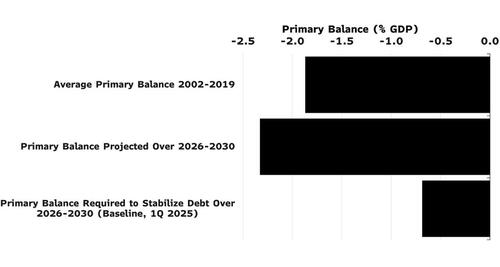

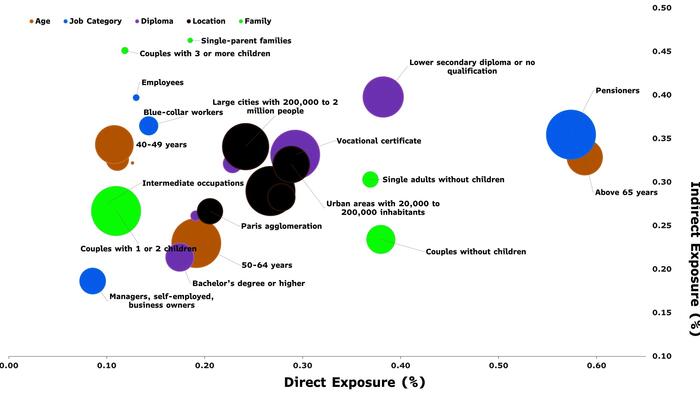
    Based on this data, we construct two exposure metrics: (1) direct exposure, defined as the ratio of direct transfers to total income; (2) indirect exposure, defined analogously for indirect transfers. The higher a group’s exposure, the more costly spending cuts would be for them.We visualize these relationships using a bubble chart (see first chart), where the position of each social group reflects its exposure, and the size of each bubble corresponds to its share in the total population. These social groups are not mutually exclusive. The chart highlights which groups are more dependent on public redistribution and are therefore more likely to resist or delay a fiscal adjustment.Vulnerable to External ShockUnder this framework, pensioners emerge as the social group that would bear the highest direct cost from any reduction in direct transfers, which account for nearly 60% of their total income. They are followed by individuals with lower secondary diplomas, for whom direct transfers, and notably unemployment benefits, represent close to 40% of their income.Both groups also exhibit high levels of indirect exposure, with indirect transfers representing around 40% of their initial income (before redistribution). Across the population, however, the level of indirect exposure is lower and more evenly distributed.These findings confirm that fiscal consolidation through cuts to public services may encounter less political opposition, as there’s a smaller share of the population has high indirect exposure. On the other hand, targeting direct transfers (such as pensions) is likely to face strong resistance, given that boomers are among most affected and now account for more than 50% of the electorate.All this hinders the government’s ability to prevent fiscal slippage and leaves the country susceptible to external shocks, such as a loss of investor confidence. Still, there is a high risk that Prime Minister Francois Bayrou’s consolidation measures will be undercut by political concessions during the autumn parliamentary debates.Loading recommendations…

  • German politicians furious at von der Leyen over new EU-US trade deal

    German politicians furious at von der Leyen over new EU-US trade deal

    German businesses and politicians are shocked by the customs deal that EU executive chief Ursula von der Leyen negotiated with the US president, seen as potentially damaging to Germany’s economy.

    ADVERTISEMENT

    German politicians across party lines denounced European Commission President Ursula von der Leyen on Tuesday, calling for her resignation after she agreed to asymmetric trade terms that impose 15% US tariffs on EU exports while granting Americans duty-free access to European markets.
    The deal, struck under pressure from German Chancellor Friedrich Merz both in public and behind the scenes to avoid threatened 30% punitive tariffs, triggered unprecedented cross-party criticism in Germany, where lawmakers described the arrangement as a “capitulation” and “betrayal of Europe”.

    Merz himself initially appeared satisfied. “With the agreement, we have succeeded in averting a trade conflict that would have hit the export-oriented German economy hard,” the German chancellor said on Sunday.
    By Monday evening, however, Merz suddenly had a change of heart, expressing strong reservations. The agreed tariffs were now a “considerable burden” for the German economy, in the eyes of Merz.
    Under the agreement announced Sunday, EU products face 15% US tariffs while American goods enter Europe levy-free. For the EU, the US tariff rate for steel and aluminium imports will remain at 50%.
    The EU also committed to purchasing $750 billion in US energy and pledged $600 billion in European corporate investments in America.
    The deal led to an unprecedented wave of shock and outrage across all camps of German politics. Now, for the first time in a long time, all German parties are criticising the move.US President Donald TrumpUS President Donald Trump
    AP Photo/Jacquelyn Martin

    “Due to pressure from the German chancellor, the EU has agreed to a deal that abandons fundamental principles of rules-based global trade. Instead of long-term stability, the agreement creates uncertainty,” Sandra Detzer from the Greens said, slamming the deal at the Bundestag.
    In fact, this agreement hits Germany particularly hard. According to the Institute for Economic Research (IfW), the deal will cost the German economy around €6.5 billion in terms of its GDP in the first year.
    “This is an inadequate compromise and sends a fatal signal to the closely interlinked economies on both sides of the Atlantic,” warned Wolfgang Niedermark from the Federation of German Industries (BDI).

    A rate of 15% is set to have immense adverse effects, and the lack of an agreement for steel exports was an “additional low blow”, he pointed out.

    ‘Von der Leyen should resign for this worst deal ever’

    German EU politician Fabio De Masi (BSW) is also shocked.
    “This bad deal will do immense economic damage to Europe – it is a betrayal of Europe. Mrs von der Leyen should resign for this worst deal ever,” he told Euronews.EU-Politiker und Finanzspezialist Fabio De Masi (BSW)EU-Politiker und Finanzspezialist Fabio De Masi (BSW)

    BSW

    “While the US is to export duty-free to the EU, EU exporters will be subject to a 15% tariff. In addition, European companies are to make direct investments worth hundreds of billions of US dollars.”
    “So Trump is hitting us with new punitive tariffs and, as business, we are filling his order books with purchases of dirty US fracking gas and defence equipment.”
    EU politician Svenja Hahn (FDP) concurs. “15% tariffs are better than the threatened 30 – but the deal is not a success. At best, it is damage control,” she told Euronews.
    The deal struck on Sunday represents “unbalanced to the detriment of the EU, contains no substantial successes” and weakens “rules-based trade”.EU-Abgeordnete und Handelsexpertin Svenja Hahn (FDP)EU-Abgeordnete und Handelsexpertin Svenja Hahn (FDP)

    Svenja Hahn/Niels Biermann

    “Ursula von der Leyen has damaged the EU’s reputation and economic strength with her weak conduct of negotiations, she must finally deliver: less bureaucracy, a strong internal market and real progress on free trade agreements, especially Mercosur,” Hahn explained.
    German-Polish MEP Tomasz Froelich (AfD) told Euronews that the agreement reached is “not a deal”, but “a capitulation of the EU”, as there had been no serious attempt to exert pressure on the US, according to him.AfD MEP Tomasz FroelichAfD MEP Tomasz Froelich
    EU Parlament

    “This declaration of bankruptcy stands in stark contrast to the EU’s otherwise grandiloquent behaviour on the international stage: confrontation in all directions, leaving hardly any options, especially in the area of energy imports,” he explained.
    “I will work in the EU Parliament to ensure that this humiliating and ruinous agreement is prevented after all,” Froelich, who serves as the first deputy head of the AfD delegation at the European Parliament, added.

    Governing parties lob criticism too

    Ruling CDU/CSU lawmaker Johannes Winkel stepped up to the plate.
    “This humiliation of Europe by the US must above all be a reason for self-criticism,” Winkel warned on X.
    “Energy saving, bureaucracy, ESG instead of innovation, growth and technology. This politically motivated economic self-deprecation must end.”
    Others representing the coalition partner SPD also dared to come forward with particularly harsh criticism.
    Bremen’s mayor, Andreas Bovenschulte said on X: “The worst thing is how our EU leader is allowing herself to be humiliated into licking Trump’s boots and flattering him as a ‘tough – even fair – dealmaker’. Not a spark of honour in her body.”
    The SPD politician later walked back on a part of his statement. “I take back the honour thing. That was a bit harsh,” he said.
    In his hometown of Bremen, thousands of jobs at the ArcelorMittal steel plant are in jeopardy.Markus Söder (CSU)Markus Söder (CSU)
    Matthias Schrader/Copyright 2024 The AP. All rights reserved.

    Bavaria’s Minister President Markus Söder (CSU) was honest and made it clear on Monday: things cannot go on like this.
    “The customs deal has prevented the worst,” Söder said, “but the situation is now more difficult than before, especially for the automotive industry.”
    “That’s why it must be clear: There must be no additional taxes in Europe, as the EU is currently planning.”
    Relief would now be needed to offset the tariffs. Söder criticised von der Leyen: “We simply need to do less of a Green Deal in Europe and more of an Economic Deal.”
    Economic expert and longstanding German MEP Markus Ferber (CSU) also made it clear to the Bild newspaper: “If you consider that our offer was the complete elimination of all tariffs, then the deal is not a great success.”
    “Fifteen per cent makes European products massively more expensive in the US and will hit the German economy particularly hard. Even if a non-agreement would have been even more expensive, a good deal looks different.”

  • OpenAI Brings GPT-4o Back After Users Revolt Over GPT-5

    OpenAI Brings GPT-4o Back After Users Revolt Over GPT-5

    Update: 

    *  *  *

    OpenAI has brought back GPT-4o following the rollout of their latest GPT-5 model, after users complained that the new model was lame in comparison. 

    The company advertised the new model as the “smartest, fastest, most useful model yet,” which uses a “real-time router” to switch between more efficient models for basic questions vs. deeper reasoning for more complex demands. 

    During a Reddit AMA, OpenAI CEO Sam Altman responded to a question by saying that GPT-5’s writing quality is better than previous models – only to have several Redditors say the new model felt “sterile” and “much worse” – and answered “briefly and dryly,” according to engadget

    “We for sure underestimated how much some of the things that people like in GPT-4o matter to them, even if GPT-5 performs better in most ways,” Altman posted on X.

    The return of GPT-4o was celebrated, but there’s still no guarantee that OpenAI will keep its older model around indefinitely. In the same X post, Altman said that OpenAI “will watch usage as we think about how long to offer legacy models for.” In the meantime, OpenAI is focusing on finishing the GPT-5 rollout and making changes that will “make it warmer.” However, for users who have grown attached to GPT-4o as more than just an AI chatbot, this could be the beginning of the end.

    OpenAI called GPT-5 a ‘significant upgrade’ which used PhD-level intelligence and amazing coding skills, only for users to immediately complain.

    “I’ve been trying GPT5 for a few days now. Even after customizing instructions, it still doesn’t feel the same. It’s more technical, more generalized, and honestly feels emotionally distant,” wrote one Redditor. “Kill 4o isn’t innovation, it’s erasure.”

    “Sure, 5 is fine—if you hate nuance and feeling things,” wrote another user. 

    On Friday, Altman took to X to say that the company would keep the previous model running for Plus users, and promised to implement fixes to improve GPT-5’s performance and user experience.

    Altman also promised to double GPT-5 rate limits for ChatGPT Plus users, saying “We will continue to work to get things stable and will keep listening to feedback.” 

    As Wired notes further; The backlash has sparked a fresh debate over the psychological attachments some users form with chatbots trained to push their emotional buttons. Some Reddit users dismissed complaints about GPT-5 as evidence of an unhealthy dependence on an AI companion.

    In March, OpenAI published research exploring the emotional bonds users form with its models. Shortly after, the company issued an update to GPT-4o, after it became too sycophantic.

    It seems that GPT-5 is less sycophantic, more “business” and less chatty,” says Pattie Maes, a professor at MIT who worked on the study. “I personally think of that as a good thing because it is also what led to delusions, bias reinforcement, etc. But unfortunately many users like a model that tells them they are smart and amazing, and that confirms their opinions and beliefs, even if [they are] wrong.”

    h/t Capital.news

    Loading recommendations…
  • Indiana Area Triumphs over South Park in Cocoa Beach Spring‑Training Showdown at Mitchell Ellington Park – Space Coast Daily

    Indiana Area Triumphs over South Park in Cocoa Beach Spring‑Training Showdown at Mitchell Ellington Park – Space Coast Daily

    THE SPACE COAST DAILY – FRIDAY NIGHT LOCKER ROOM TEAM IS BREVARD’S #1 SPORTS SOURCE

    Indiana Area Triumphs Over South Park in a Thrilling Spring‑Training Showdown

    At Mitchell Ellington Park in Merritt Island, the Indiana Area squad rolled out the red carpet for a hot‑summer kickoff that left fans buzzing and South Park players scrambling to scratch the sweat off their brows. In a match that felt like a fireworks display in a sand‑filled desert, Indiana Area claimed a hard‑fought victory that could easily have been titled “The Battle of the Beach Bump.”

    Stand‑by for the Sun‑Set Standoff

    • Location: Mitchell Ellington Park, Merritt Island — a venue that’s almost as scenic as it is competitive.
    • Opponents: Indiana Area (PA) vs. South Park (PA).
    • Why It Matters: This exhibition isn’t just about bragging rights; it’s a primer for the upcoming season, testing muscles, morale, and manning late‑night rosters.

    The Game‑Changing Moments

    • Opening Strikes: Indiana’s pitcher lined up the first batter with such precision that South Park’s hitters had to double‑back to indoor comfort; a single strike dominated the early innings.
    • Mid‑Game Momentum: By the third inning, Indiana fell into a rhythm that had fans chanting “Go, Go, Indiana!” — South Park’s response was a shaky off‑swing that let the ball bounce its way into the outfield.
    • Clutch Performance: The decisive blow came in the seventh inning when Indiana’s shortstop converted a double play that sent the energy into overdrive – the crowd practically rolled onto the sand.
    • Final Touch: Indiana’s stunning reliever nailed the shut‑down, culminating in a 7-3 scoreboard that echoed the scoreboard’s final digits.
    The Afterglow

    While the Indiana Area crew celebrated with caffeinated geysers of adrenaline, South Park’s team took to the sidelines, a little bruised but bruised with respect. The beach sun mirrored the optimism that glistens on tomorrow’s field.

    Why We’re Hollering

    • Indiana’s win shows that Spring Training can produce real fireworks.
    • Fans learned that skill and firefight go hand‑in‑hand – not just though’ ray – in cricket, but with a twist of sand and sunshine.
    • It’s an announcement: Indiana Area is on a vibrant run, and their rivals might need to bring their best at the next showdown.

    So as the headline reads – “Indiana Area (PA) Defeats South Park (PA) in Cocoa Beach Spring Training Exhibition at Mitchell Ellington Park in Merritt Island,” – let’s keep sand in our sockets, joy in our hearts, and the rivalry alive for the next exhilarating season. What a blast!

    September Summer Showin’: Indiana’s Big Hit in Brevard County

    Under the blazing Florida sky at Mitchell Ellington Park, the Indiana Area (PA) High School squad rolled into a clean‑sheet victory over South Park (PA) with a 9‑0 scoreline. The hot‑weather high‑school showdown ticked off another box on the team’s spring training radar.

    The Big Picture: Spring Training in the Sun

    • Where it’s at: The Space Coast’s air is a magnet for teams from the Northeast who’re searching for that extra pre‑season swing.
    • Who’s coming: College and high‑school baseball clubs from across America converge on Cocoa Beach for what’s billed as the oldest and largest spring‑training hub in the country.
    • What it feels like: Picture endless fields, salty breezes, and a deep‑blue ocean backdrop – the kind of setting you’ll want to brag about with your friends.

    Why the Space Coast is the Top Choice

    The scheduling mastermind behind the scenes—a former college coach with a pop‑out level of experience—makes sure every team gets a schedule that’s as full as a pitcher’s mound. Their goal? To give each squad the practice opportunities they need to hit their targets and find that sweet spot of improvement.

    Team matchups are smartly arranged. A record of wins versus losses, past performances, and other key data points are all considered to pair teams that can learn from each other as they bounce around the state’s great fields.

    Game‑Day Get‑Ahead

    After a hard pair of days on the diamond, your crew can kick back and kick off a beach day or a slick sunset cruise along the Coast’s famed attractions. What better way to unwind than with a shot of fresh coconut water and the soothing hum of a wave‑lapped shoreline?

    Ready for an Intensive, Fun‑Filled Baseball Week?
    • Location: Short drive from the dazzling Cocoa Beach.
    • Experience: A full week of ball action topped with beachside relaxation.
    • Contact: All details are posted at your next Google “Cocoa Beach Spring Training.”

    So if you’re after a season‑starting blast that’ll leave you pumped for the rest of the year, pop over to the Space Coast. You’ll find the field, the fun, and the flawless flavor of a sun‑lit spring training adventure that you won’t soon forget.

  • Miran Clears Key Senate Hurdle In Push For Fed Seat

    Miran Clears Key Senate Hurdle In Push For Fed Seat

    The Senate Banking Committee voted 13-11 along party lines Wednesday to advance President Donald Trump’s pick of Stephen Miran, chair of the White House Council of Economic Advisers, to a short-term position as a Federal Reserve governor – setting up a likely floor vote in the coming days and deepening a political fight over the Fed’s independence.

    Stephen MiranPhotographer: Al Drago/Bloomberg

    If confirmed, Miran would join the Federal Open Market Committee just days before its Sept. 16–17 meeting, where policymakers are widely expected to cut interest rates for the first time since December amid signs of slowing job growth.

    A Strategic Appointment Before the Fed Vote

    According to Bloomberg, citing a person familiar with Senate planning, a full confirmation vote is tentatively set for Monday, Sept. 15. Miran’s temporary term would expire early next year, but the White House has not clarified whether Trump plans to nominate him for a full 14-year term or return him to his post leading the Council of Economic Advisers.

    Miran told senators during his testimony that he would take an unpaid leave of absence from his White House role to serve at the Fed, emphasizing his commitment to act independently.

    “I want to assure this committee and the American people that my decisions will be guided by data, not politics,” Miran said, reiterating that his advisory work at the White House would be paused.

    Democrats Question Independence, Cite “Servitude”

    Democrats blasted the nomination, arguing that Miran’s dual roles would undermine the Fed’s independence. They said the arrangement effectively ties his decision-making at the central bank to Trump’s influence, given the president’s power to decide Miran’s future.

    “He knows that every vote he takes will determine whether he gets to go back to his White House job,” said Sen. Elizabeth Warren (D-MA), calling the situation “servitude.”

    Other Democrats warned that placing a senior Trump economic adviser at the Fed – even temporarily – risks politicizing the central bank at a critical moment as it weighs a policy pivot toward lower rates.

    The nomination comes amid heightened tensions between the White House and the central bank. Trump has moved aggressively to reshape the Fed’s leadership, including firing Fed Governor Lisa Cook.

    Cook challenged her dismissal in court, arguing that the president lacks authority to oust sitting governors. On Tuesday night, a federal judge temporarily blocked Trump from removing her while the case proceeds.

    The legal battle underscores growing uncertainty about the Fed’s autonomy as Trump pushes for policies designed to stimulate growth ahead of next year’s election season.

    What Comes Next

    • Sept. 15 – Senate expected to vote on Miran’s confirmation

    • Sept. 16–17 – FOMC meeting, where markets expect a rate cut

    • Early 2026 – Miran’s short-term appointment set to expire unless re-nominated


    Loading recommendations…
  • Trump Rape Accuser Boasts Of 'Trick' On Jurors By Making Herself Look "F***able"

    Trump Rape Accuser Boasts Of 'Trick' On Jurors By Making Herself Look "F***able"

    Authored by Luis Cornelio via Headline USA,

    Trump accuser E. Jean Carroll recounted the bizarre “trick” she claimed to have used to convince a jury against President Donald Trump, saying she aimed to make herself look “f***able.” 

    A jury in deep-blue New York controversially ruled that Trump had defamed Carroll when he denied her sexual abuse allegations, which she said occurred in either 1995 or 1996. Trump has denied ever meeting Carroll. 

    Speaking on The Bulwark Podcast with Tim Miller in July, Carroll said she conducted mock trials to prepare for her defamation suit against Trump. 

    Some of the mock jurors concluded that Carroll might have seemed to invite Trump’s alleged advances because, by her own admission, she was of old age.  

    “I mean … that has to be pretty dispiriting that then you’re like, ‘Well, I got to be hotter to win this case,’” Miller said. 

    “Yeah. I got to be f***able, is the word,” Carroll replied. 

    She added that she recreated her 1990s look by redoing her hair, hiring the same hairdresser and makeup artists she used then.  

    “I wore the exact same clothes I wore in 1996. The exact clothes!” Carroll stated, later adding: “I didn’t look like I looked in ‘96, but I looked like somebody who could have looked like somebody in 1990 and it was enough. It was enough… it was a trick.” 

    The self-described “trick” worked as the real jury awarded her a combined $88.3 million in purported damages, though Trump is actively appealing the controversial verdict. 

    Join the ZeroHedge Store email list. No spam / Occasional rants / Secret deals / $5 credit for signing up.
    CLICK HEREarrow

    Loading recommendations…
  • Eastern Florida State Soars to 18th in NJCAA Division I National Poll – Space Coast Daily

    Eastern Florida State Soars to 18th in NJCAA Division I National Poll – Space Coast Daily

    Titans are 19-5 overall, 4-2 in the Citrus Conference

    Eastern Florida State Soars to 18th in NJCAA Division I National Poll – Space Coast Daily

    EFSC Softball Takes a Quick U‑Turn to the Top 20

    New York Times, or at Least the NJCAA

    Yesterday’s poll in the NJCAA Division I crowned the Eastern Florida State College Titans as the nation’s #18 softball squad. They’re cruising with a 19‑5 record overall and a solid 4‑2 mark inside the Citrus Conference.

    Where Are the Big Guys?

    Florida Southwestern State College is piloting the league as No. 1, followed closely by Northwest Florida State College (No. 2) and Indian River State College (No. 3). McLennan Community College sits comfortably in four spot, while Grayson College rounds out the top five.

    Florida’s All‑Star Show

    Florida schools are making waves: Miami Dade lands in #7, Seminole State College slips into #9 – five FCSAA teams hot‑wired into the national top ten. Daytona State College rounds up the block at #13, Chipola flanks at #23, and the College of Central Florida picks up a spot at #24. All told, nine Florida teams keep the state in the upper echelons of the Top 25.

    Home‑Court Advantage Dazzles Fans

    Tonight, the Titans will host a doubleheader at the Titan Softball Complex. They’ll take on @ Daytona State College, the 13th‑ranked wizards of the mound.

    • Game One kicks off at 4:00 p.m.
    • Every ticket? Free of charge for the Melbourne campus crowd.

    Bottom line?

    EFSC’s softball crew is officially ranked #18 in the country, proving that hard work, good coaching, and a sprinkle of Southern charm can send a team from the Sunshine State straight to the national spotlight.

  • Mustangs Battle Belen Jesuit Tonight in Tense Race to Avoid Elimination

    Mustangs Battle Belen Jesuit Tonight in Tense Race to Avoid Elimination

    First pitch set for 6 p.m.

    Mustangs Battle Belen Jesuit Tonight in Tense Race to Avoid Elimination

    The Mustangs Are Fighting for Their Lives Tonight

    Right now, the Merritt Island Mustangs are staring down the barrel of a must‑win showdown against Belen Jesuit in the second leg of the FHSAA Region 4‑4A baseball semifinals. They can’t afford to lose again—an extra‑innings death‑blow Monday night left them fighting for their season.

    What’s at Stake?

    • Lost last game 3–0 in extra innings → on the brink of elimination.
    • If they win tonight, the series heads to South Florida for a decisive Game 3 on Thursday, May 1 at Belen Jesuit’s campus in Miami.
    • Game kicks off at 6 p.m. on the home field of Merritt Island High School.

    Merritt Island’s Blueprint for Victory

    As the No. 2 seed in Region 4‑4A, the Mustangs aim to get the pitchers on the mound who can lock down the opposition and the hitters to bring home the runs. Think of it as a high‑stakes play‑off: pull out the big guns, take care of business, and seal the win.

    Belen Jesuit’s Quest for a Final Run

    No. 6 seed Belen Jesuit isn’t buying a wait‑and‑see game— they’re looking to seize the series immediately and march on to the regional finals.

    In short, it’s a classic under‑dog versus established seed battle, with the Mustangs playing all‑in to keep their championship dreams alive. Spoiler alert: it’s going to be wild.

  • Reddit launches tools for publisher to track and share stories

    Reddit launches tools for publisher to track and share stories

    Reddit on Wednesday launched a set of free tools for publishers to track their article performance and receive suggestions on where to share their stories within the site’s communities. The new features are launching as a part of Reddit Pro, a suite of business tools it debuted last year to help organizations grow their presence on the platform.

    There are three key tools being added under the Links tab in Reddit Pro. These include article insights to see where stories have been shared and stats related to them, including views, upvotes, and clicks.Image Credits:Reddit

    Publishers can also sync their RSS feeds to Reddit Pro and then use the dashboards to share articles. For distribution, Reddit will use AI to suggest communities where articles could be shared.

    Reddit said that it has been alpha testing the publisher product with publications like The Atlantic, The Hill, NBC News, and the Associated Press. The social platform is now inviting other platforms to try it out under beta.

    The company is also improving the news-reading experience on the consumer side. Right now, when you click on a link, Reddit opens it through an in-app browser. If you want to post comments in the original thread, you have to close the story. The company is making it easier to open a link in such a way that you only have to swipe up to read or post comments.Image Credits:Reddit

    News, articles, and blogs are an important part of people’s searching experience on Reddit. That’s why Reddit wants to make the platform more suited for publishers to distribute their stories, so people can find them while searching. That also ties into the company’s more recently declared ambition to become a search engine.

    While Reddit is showing more stats to businesses, it is also changing some consumer-facing numbers. The company announced on Tuesday that it will stop showing member count on subreddits, replacing them with a seven-day visitor figure, along with the number of contributions made in that time.

  • EF State Men’s Basketball Secures 24th Spot in National Poll for Second Consecutive Week

    EF State Men’s Basketball Secures 24th Spot in National Poll for Second Consecutive Week

    Titans Return to Titan Field House on December 31

    EF State Men’s Basketball Secures 24th Spot in National Poll for Second Consecutive Week

    Back‑to‑Back: Titans Hold Their Magic 24th Spot

    Getting a Second Chance at the Top

    With a solid 10‑2 record, the Eastern Florida State College men’s basketball team is once again ranked 24th in the latest NJCAA Division I National Poll. The Titans proved their mettle at the back-to-back victories over the B‑Mac’s Christmas Classic in Georgia this weekend.

    The squad’s momentum is undeniable—two wins in a row under the holiday lights, and the national ranking reflects that swagger.

    National Poll Shuffle

    • Snow College – … the new Kings of the League, grabbing the No. 1 spot.
    • New Mexico Junior College – Still holding on to No. 2, the same as last week.
    • Trinity Valley Community College – Cooled from a top‑five finish to No. 3.
    • Salt Lake Community College – Making a strong entry into the top five.
    • Butler Community College – Also joining the elite.

    Other Titans‑Friendly Rankings

    • Daytona State College – 12th
    • Northwest Florida State College – 13th
    • Chipola College – 14th

    What’s Next for the Titans?

    The team is gearing up for a showdown at the Titan Field House on December 31. A 3 p.m. clash awaits against the fierce Keep Striving Prep. The game’s admission is at zero cost, and the experience can also be enjoyed live online at efsctitans.com.

    So, grab a seat—whether it’s in the stands or on your screen—and witness the Titans defend their 24th honor with style and a handful of humor.

  • Female Students Seeking Bathroom Privacy Required To Fill Out 'Mental Health Accommodation' Form

    Female Students Seeking Bathroom Privacy Required To Fill Out 'Mental Health Accommodation' Form

    Via American Greatness,

    A California school district has enacted a new rule for young girls who are uncomfortable sharing a bathroom with biological males pretending to be girls, requiring the girls to file a mental health accommodation request.

    The Temecula Valley Unified School District TVUSD has reportedly enacted a rule that tells female students who feel uncomfortable sharing  bathroom space with biological males must file a mental health accommodation request under federal law if they want privacy.

    The move has prompted outrage from parents and others who say that the rule treats those girls who object to sharing private space with biological males as the problem and treating their request for privacy as a type of disability.

    The form, required by the school district, falls under Section 504 of the Rehabilitation Act and California Education Code § 56000.

    That law is intended to accommodate children with authentic disabilities, including epilepsy, severe anxiety disorders and diabetes.

    The policy is raising concerns among parents who say that school officials or special interest groups pushing gender ideology should not be allowed to redefine basic rights, such as privacy, as “accommodations.”

    Sonja Shaw, who is running for California State Superintendent in 2026, describes the new rule as “pure madness,” adding, “The girls are treated as the problem. This is upside-down, dangerous, and exactly what we warned would happen.”

    The move by TVUSD officials is just the latest skirmish in a larger battle over biological males in women’s private spaces taking place throughout the nation.

    Earlier this year, the 11th U.S. Circuit Court of Appeals voted 7-4 to uphold a Florida school policy requiring students to use bathrooms based on their biological sex.

    The court’s ruling stated that protecting privacy and safety was not discrimination under Title IX.

    Other courts have ruled exactly the opposite, possibly setting the stage for a showdown in the U.S. Supreme Court.

    Loading recommendations…
  • Trump To Appeal After 'Obama-Appointed' Judge Reverses Admin's Harvard Funding Freeze

    Trump To Appeal After 'Obama-Appointed' Judge Reverses Admin's Harvard Funding Freeze

    Update (2000ET): The Trump administration responded quickly to Obama-appointed judge’s decision with Secretary of Education Linda McMahon posting on X that 

    “In an unsurprising turn of events, the same Obama-appointed judge that ruled in favor of Harvard’s illegal race-based admissions practices – which was ultimately overturned by the Supreme Court – just ruled against the Trump Administration’s efforts to hold Harvard accountable for rampant discrimination on campus. 

    The Trump Administration is fully committed to appealing this erroneous decision and will ensure that new taxpayer funding is not invested at any university that steadfastly refuses to uphold civil rights for all students.

    Cleaning up our nation’s universities will be a long road, but worth it.”

    No response from President Trump yet…

    *  *  *

    As Sam Dorman detailed earlier via The Epoch Times, a federal judge has ruled against the Trump administration’s attempt to freeze more than $2 billion of Harvard University’s funding, holding that the government violated the First Amendment through its efforts to combat anti-Semitism.

    In a ruling on Sept. 3, U.S. District Judge Allison Burroughs cast doubt on the administration’s motives in freezing vast amounts of funding for things like medical research. She suggested that the government retaliated over the university’s refusal to comply with multiple demands the Justice Department made after an investigation into anti-Semitism on campus.

    “The government-initiated onslaught against Harvard was much more about promoting a governmental orthodoxy in violation of the First Amendment than about anything else, including fighting antisemitism,” she said.

    She added that “there is, in reality, little connection between the research affected by the grant terminations and antisemitism.”

    Reviewing the evidence, she said, indicated that the administration used anti-Semitism as a “smokescreen.”

    Her decision removes the administration’s orders freezing vast amounts of federal money flowing to Harvard and prohibits it from issuing additional funding freezes.

    White House spokesperson Liz Huston said the administration would appeal the ruling, which she said was egregious.

    “To any fair-minded observer, it is clear that Harvard University failed to protect their students from harassment and allowed discrimination to plague their campus for years. Harvard does not have a constitutional right to taxpayer dollars and remains ineligible for grants in the future,” she said in a statement provided to The Epoch Times.

    In April, the administration made several demands that Burroughs said included changes to activities protected by the First Amendment. These protected rights include a school’s ability to manage its academic community and evaluate teaching without government interference.

    Her ruling followed a hearing in July when the Justice Department argued that the government was well within its rights to terminate funding streams to Harvard. The university, the department also said, brought the case in a federal district court when it should have brought it in the U.S. Court of Federal Claims, which typically handles contract-related disputes.

    Tension inside and outside the courthouse seemed to underscore the high stakes alleged by both sides.

    In his rebuttal, Justice Department attorney Michael Velchik, a Harvard alumnus, got choked up while discussing the importance of the university and the concern about anti-Semitism on campus.

    Velchik said that the government would have canceled Harvard’s contracts regardless of how the university responded to its demands.

    In her Sept. 3 opinion, Burroughs doubted that the funding freeze was unrelated to Harvard’s refusal to comply with the government’s demands.

    The judge said President Donald Trump’s posts on social media evinced an interest in punishing Harvard’s views rather than anti-Semitism.

    The Epoch Times reached out to Harvard for comment.

    Loading recommendations…
  • DHS Secretary Says Southern Border Wall Will Be Painted Black To Deter Illegal Crossings

    DHS Secretary Says Southern Border Wall Will Be Painted Black To Deter Illegal Crossings

    Authored by Aldgra Fredly via The Epoch Times,

    Homeland Security Secretary Kristi Noem said Aug. 19 that President Donald Trump has requested that the entire wall along the U.S.-Mexico border be painted black in order to deter illegal crossings.

    Speaking to reporters in New Mexico, Noem said the border wall is being built tall and extended deep underground to prevent any breaches, and the metal would be painted black to make it even more difficult to climb.

    “That is specifically at the request of the president, who understands that in the hot temperatures down here, when something is painted black, it gets even warmer, and it will make it even harder for people to climb,” she said.

    “So we are going to be painting the entire southern border wall black to make sure that we encourage individuals to not come into our country illegally, to not break our federal laws.”

    Noem noted that cameras and sensors would be installed in the future to enhance security at the border, adding that the Department of Homeland Security (DHS) also plans to build “water-borne infrastructure.”

    “Construction right now is at the pace of a little bit less than a half a mile a day, and the border wall will look very different based on the topography and the geography of where it is built,” she added.

    Noem did not provide details on the wall’s construction cost. The One Big Beautiful Bill, signed into law by Trump last month, allocated about $46.5 billion for the construction of a wall along the border with Mexico.

    Trump declared a national emergency at the southern border after taking office for a second term on Jan. 20, directing the deployment of armed forces to assist with border security efforts.

    Under the declaration, Noem and Defense Secretary Pete Hegseth were ordered to take “all appropriate action” to construct more physical barriers along the border. Following that order, Noem issued a waiver in April that enabled the immediate construction of 2.5 miles of border in California. 

    Trump has signed several executive actions aimed at deterring illegal immigration, including a memo authorizing the military to take control of land along the U.S.–Mexico border.

    Data released by U.S. Customs and Border Protection (CBP) last month shows that illegal border crossings fell to their lowest level in June, with no parole releases of illegal immigrants.

    There were 25,228 total encounters nationwide in June, down from 29,478 the previous month, marking the lowest monthly total ever recorded by CBP, the agency stated.

    Border Patrol apprehensions nationwide also dropped to a historic low, with 8,024 apprehensions recorded, compared with 10,357 in May, according to the agency.

    Loading recommendations…

  • Why Most American Companies Don’t Make It Past Their First Year—And the Few That Do

    *

  • Did you know that over one in five U.S. businesses doesn’t get past its first year? That’s a stark warning that startup life can be a real cliffhanger. Yet there are a handful of survivors that have outlived time itself—think centuries, not just decades.


  • Spotlight: America’s Oldest Companies of the 1700s

    *

  • Visual Capitalist’s Marcus Lu has mapped out a journey that spans three centuries. Picture this: your humble coffee shop, your off‑spring’s venture, and now, a living legend that still serves your favorite pastries!


  • Notable Long‑Livers (Founded in the 1700s)

    *

    • Harvey’s Grocery – A family‑owned corner store that has seen every major historical event from the Revolution to the COVID‑19 pandemic.
    • Maple & Co. – A bourbon distillery that started in 1791 and still whispers old‑world secrets in every glass.
    • Stonebridge Arms – A leather‑handcrafted company that has kept its hand‑made heritage alive for over 250 years.
    • BlueRidge Design Co. – A design house that’s been turning fashion trends for a surprising 180 years.

  • A Few Youngsters for Contrast

    *

    • MicroMobi – Launched in 2010, this app‑development startup has nearly a decade of innovation under its belt.
    • EcoCharge – Established in 2015, proving that sustainability is a winning niche in the modern marketplace.
    • CloudNest – A cloud‑storage pioneer sprouting out of 2018 with flashy user interfaces and fast growing market shares.

  • The Takeaway

    *

  • While most ventures burn up hot and fast in the first year, those that can blend tradition with reinvention—like the classics of the 1700s—have a knack for surviving the tides. So what does that say for the next founder? Keep that core essence, stay flexible, and—most importantly—build something that people will love for years to come.

    Data & Discussion

    Picture this: a lineup of companies ready to take the spotlight, each one set to transform its industry. Now, let’s dive into the numbers that make them tick and why the market can’t get enough of them.

    Featured Companies

    • GlowingTech – Lights up the renewable scene with a brilliant battery‑tech breakthrough.
    • UrbanWave – Brings the future to our streets, turning every city block into a smart‑city showcase.
    • HealthOrbit – Keeps our hearts in check with wearable gadgets that read between the beats.

    Below is a quick snapshot of their performance, served with a side of coffee.

    Company Revenue (USD) Year‑on‑Year Growth
    GlowingTech 1.2 B 18%
    UrbanWave 850 M 25%
    HealthOrbit 600 M 12%

    What’s the takeaway? These firms aren’t just chasing trends; they’re setting them. Their revenue spikes and growth rates suggest a future where innovation and profitability go hand‑in‑hand—and that’s a winning combo for investors and skaters alike!

    They’ve Been Better Than the Weather

    From economic rollercoasters to global wars and tech tantrums, these businesses have impossibly survived everything life’s thrown at them.

    • They weathered recessions like seasoned sailors—no splash of panic.
    • They survived wars more fiercely than a pack of bulldogs.
    • They embraced tech revolutions with the enthusiasm of a kid at a candy store.

    All in all, their longevity is nothing short of legendary—now that’s the kind of endurance that makes you scratch your head and smile at the same time.

    Let’s dig into their pasts

    Ready to unearth the curious stories that shaped these folks? Let’s jump into the juicy details!

    Jim Beam: A Legacy in American Whiskey

    Jim Beam: Kentucky’s Whiskey Legacy

    Picture this: it’s 1795, the frontier is still rough‑rutted, and a Kentucky farmer named Jacob Beam decides that a good bourbon is worth a shot. That’s how Jim Beam was born.

    The Early Years

    Originally christened Old Jake Beam Sour Mash, the distillery carved out a niche by blending a classic “sour mash” technique with earnest ambition. Even when the Republic slipped into Prohibition, the brand didn’t disappear—just for a short while. When the ban lifted, James Beam was back on the “distillation” block within a mere 120 days, showing it’s hard to silence a hometown legend.

    Survival & Growth

    • Built a solid reputation on the quality of its bourbon.
    • Adapted quickly to changing federal rules.
    • Kept the family’s identity intact.

    The Suntory Takeover

    Fast forward to 2014: Suntory, the Japanese powerhouse known for whisky, snapped up the company for a staggering $16 billion. This move birthed Beam Suntory, a partnership that blends Aussie distilling know‑how with Japanese precision. And that’s how a humble Kentucky farmer’s dream grew into a global whiskey empire.

    Dixon Ticonderoga: The Pencil that Wrote History

    Who Really Started the Pencil Parade?

    It All Began in 1795…

    The story of Dixon Ticonderoga starts back in 1795, when the name was born from a modest graphite pencil shop. Shockingly, it wasn’t the industrial giant we know today but a humble startup that carried the charming name of Fort Ticonderoga from upstate New York. Picture a dusty drawing desk and a boy’s promise: “I’ll get you graphite, no matter what.”

    The Myth vs. Reality of the No. 2 Yellow Pencil

    • False Claim: Many folks think the company invented that iconic No. 2 yellow pencil.
    • Truth Bomb: The truth? They didn’t create it. They popularized it, ripping it out of the shadows and into school classrooms all across the country during the early 1900s.
    • Takeaway: It’s the same nerdy pencil we saw in high school exams, but thanks to Dixon Ticonderoga it became a national staple.

    Why It Matters

    When you think of a comic book hero, you picture dramatic backstories. Dixon Ticonderoga might not have rolled out super-slick paints, but it rolled out the pencils that let generations of kids express themselves, doodle in bathrooms, and calculate the distance between Mars and the Earth the old-fashioned way.

    In Short…

    Dixon Ticonderoga is a tale of ambition, a surprise spotlight, and a willingness to put a yellow jacket on a standard write‑down. Sort of like pretending your kitchen drawer is a treasure chest—just with more graphite.

    JPMorgan Chase: Banking Across Centuries

    JPMorgan Chase: A Banks’ Time Machine

    Picture a banking titan that started in the cobblestone streets of 1799, launched by none other than Aaron Burr (yes, the same Burr who famously said “or not” before his flying horse). Back then it was called The Bank of the Manhattan Company, a humble beginning that would later evolve into the giant we see today.

    The Big Merge of 2000

    Fast‑forward to the new millennium, when two titans—J.P. Morgan & Co. and Chase Manhattan Company—decided to team up like the ultimate buddy‑movie duo. Their magical union birthed the modern JPMorgan Chase we all know.

    Why it Matters Today

    • By Q4 2024, it’s the biggest bank in America, boasting a whopping $4 trillion in assets.
    • Think of it as the bank that literally owns most of the country’s financial headlines.
    • Its merger legend continues to shape how we look at corporate consolidations.
    See It in Numbers

    If you’re hungry for the hard data, there’s an easy‑to‑read graphic that ranks the top merger and acquisition deals in the U.S. since 2008. It’s a neat reminder that when giants merge, the ripple reaches far beyond boardrooms.

    Want to explore more about the world’s heavyweight mergers? Drop us a line or check out that handy visual—though we’ll keep it spoiler‑free for now!

  • Kamala Harris Bashes Trump Tariffs, Calling Them Absolute Chaos

    Kamala Harris Bashes Trump Tariffs, Calling Them Absolute Chaos

    Why the Democratic Party’s Decline Speaks Volumes

    Ever wondered why the Democratic Party went from Hollywood dreams to a hard look at the mirror? Grab a coffee, because it’s about more than just politics—it’s a lesson in hubris.

    The Power of Overconfidence

    • When leaders think they’re the sole truth‑tellers, they never admit a single mistake.
    • Being a “know‑it‑all” mindset is like trying to jump over a pothole without looking— you’re bound to hit a bump.
    • They keep tightening the “no‑wrong” rule until every policy starts looking like a bad joke.

    From Obama to Biden: A Downward Spiral

    Remember the “maybe‑we‑could‑do‑that‑thing‑again’’ vibes that aired during the Obama era? Fast forward a decade. Now, the Democrats are rambling about how the right way is just “the same way, but louder.”

    • The transition from the Obama Administration to the Biden era feels like flipping a TV channel from five‑star drama to cat‑videos that didn’t go viral.
    • Every campaign (K‑Harris, for instance) got stuck in the same loop: “We won’t let this mess up; we’ll just double‑down.”
    • And somewhere in the mix, the “woke groomers” cult turned from a runway show to a messy brunch circle—ask anyone who saw the Insta‑loop.

    The Cult of Absolutism

    Humor? Yeah—imagine a theater where every actor refuses to read the script except the protagonist. That’s absolutism in real life. What’s the result? One thing: a relentless “our way is the choice” mantra that ignores any variance.

    • They exist on a platform called hubris—making every disagreement a showdown where the party’s side shuts down the other.
    • Even after Kh‑Harris stumbled on the 2024 ballot, they still belt out “we’ll just do it harder.”
    • When public approval drops, they point fingers at a consensus, not at the crowd—laughable, but, hey, that’s how some get into politics.

    Bottom line: no one owes anyone an apology, not even the government. The Democrats’ insistence on being right for the sake of being right has hurt more than it helped. Time to invite a little humility on the policy stage.

    Why the Progressive Party Is Basically Frozen in a Frosty Pond

    Picture this: the progressive crowd is locked in a chilly marsh, waving puzzled signs while the rest of the country gulps down hot coffee. The main problem? They just can’t shake the fact that most Americans aren’t on their side. They’re glued to the idea that the “progressives” are a glitch that feels like a broken robot. And when those robots start calling the Trump‑era’s “truth” a lie, the whole country shrugs.

    The “Chaos” Hoax

    • Democrats get up on the political stage and repeat chaos like a broken record.
    • They claim that Trump’s tariffs are the root of the mess.
    • Reality? The chaos comes from the left blowing a whistle trying to dent any Trump effort.
    • It feels like the 2024 campaign never ended — just the same old spat, again and again.

    Kamala Harris: The Undercurrents of Bureaucracy

    Kamala’s brand of bait and switch is getting gutless. After her swoon‑fueled White‑House run, she’s stuck on the same talking points: tariffs = chaos, recession = inevitable. The Democrats’ new bumper‑stick narrative forces “chaos” to become the word they’ll try to stick to the whole electorate. By the way, recession has been simmering under the Biden administration for a while, but the left aims to make it sound like a new threat.

    The “Chaos” Bombshell of 60‑Second Fear

    Four years under Biden brought total chaos – high prices, higher taxes, fewer economic freedoms. Even while the elite skate by, the rest of us are stuck on a “perpetual stagflation” treadmill. The only thing we’re craving is a fresh start. That’s why new fiscal proposals get instantly condemned as the next chaos trigger.

    Harris’s Game Plan: Patriotic Loops of Idiots

    The plan is to peg Trump and conservatives like a weight anchor and then, by tag‑ging them into a “chaos” whirl, hope the whole coalition will sink. They expect the public to be particularly forgiving, but that distrust is far from it. The Democrats do not offer real remedies for the nation’s looming dangers; they just speculate.

    Staying on Target – The Future of Tariffs

    • If tariffs stick, we’ll need a quick, domestic production boost.
    • Some imported goods will cost more.
    • But the real priority is slashing the prices of homeland basics, not glittery foreign trinkets.
    • Reject the global aspiration that’s inflation‑inciting; keep the American focus motion.

    In Closing

    Progressives might be gut‑busting, but the fire‑starter they’ve handed out is being melted down. Whether tariffs, deflation, or a new economy version of a revitalized budget strategy, the only way forward is to cut the noise and simply push for a clean, cheap “Yes, we’re alive” message.

  • Greek Rescue Operation Saves Hundreds of Migrants Near Crete and Gavdos

    Kyriakos Mitsotakis Takes a Stand on the New Crete Migration Route

    Picture a Greek leader waving at the sea and saying, “I’m on it!” That’s exactly what Prime Minister Kyriakos Mitsotakis does when he vows to stop a fresh migration corridor to Crete from taking shape. With the eye‑watering drama of refugees crossing the Aegean, the PM isn’t just talking the talk — he’s walking the walk.

    What’s on the Table?

    • Get it Together: The prime minister’s insistence that “no new migration route will be established” is a call to bring all stakeholders to the table and shape a practical, secure solution.
    • Guard the Gateways: He’s calling for tighter controls at the major maritime ingress points, ensuring any flow remains under Greece’s legal jurisdiction.
    • Key Player Collaboration: Mitsotakis has flagged cross‑border cooperation with regional partners, especially Turkey, to clamp down on rogue boat traffic.
    • Legal Anchor: Every measure is underpinned by international law, making the approach both audacious and compliant.
    • Prevent the “New Route” Myth: By sweeping the idea of a dedicated migratory pathway right out of the conversation, the PM wants to keep refugees from choosing Crete as a simple exit point.

    In essence, the Greek Prime Minister is acting as the new guardian of the Aegean, proving that when the stakes are high, decisive leadership is inevitable. He’ll keep saying it until the idea of a new migration route gets a flat‑out, “Not happening” headline in all the major news outlets.

    Greece Saves Waves of Migrants – Current Rescue Efforts

    What’s Been Happening

    Since Friday, Greece’s coast guard and local authorities have been busy saving hundreds of people who tried to reach the island of Crete and its little neighbor, Gavdos.

    Crete

    • In the past three days, more than 1,500 people have slipped into Crete’s waters.
    • Officials warn that the numbers could skyrocket in the coming weeks, so the response teams are working overtime.

    Gavdos – the Southernmost Spot

    • Around 230 migrants were rescued near this tiny island off Greece’s coast.
    • Gavdos, being the farthest south, poses its unique set of challenges for the rescuers.

    Why It Matters

    With the sea still rough and the political climate a bit tense, every life saved is a bright spot in a stormy patch of news. The teams are pushing hard, steering life-saving vessels, and keeping the hope piqued for those slipping into the waves.

    Takeaway

    Greek rescue crews are on a roll, but the tide might bring even more. It’s a reminder that the sea doesn’t wait for consent – and neither does humanity.

    A Greek coast guard gives water to migrants from Africa as they take a shelter in Agia port, 7 July, 2025

    Greek Coast Guard Quenching the Thirst of Hope

    On July 7, 2025, a Greek Coast Guard vessel fished out a bottle of water for thousands of migrants huddled in Agia Port. While the boat crew was handing out hydration, the island of Crete was running a full‑time, no‑break man‑hunt for new arrivals.

    Crisis on the High Seas

    • In the first half of 2025, Crete welcomed more than 6,500 refugees—an astronomic spike that eclipsed the entire previous year’s numbers.
    • Chania’s municipal emergency took over the reins, setting up a temporary reception centre. 182 souls had arrived already, and authorities expect to host up to 600 by Monday night.
    • Deputy Mayor Eleni Zervoudaki warned, “We’re on the frontline of a crisis. Numbers could blow up dramatically.”

    All Hands on Deck in the Mediterranean

    Last month, Athens mobilised two frigates and an extra vessel near Libya to curb the wave of migrants heading for Crete and the tiny island of Gavdos. Prime Minister Kyriakos Mitsotakis called out Libyan officials, demanding stronger measures to stop people from making the perilous journey.

    Mitsotakis issued a stern reminder: “We’ll use every trick—both carrot and stick—to stop a new migration route to Crete from taking root.”

  • Eastern Florida State College Baseball Thrives in Sunday Doubleheader vs. Miami Dade – Space Coast Daily

    Eastern Florida State College Baseball Thrives in Sunday Doubleheader vs. Miami Dade – Space Coast Daily

    Fans can watch the games online

    Eastern Florida State College Baseball Thrives in Sunday Doubleheader vs. Miami Dade – Space Coast Daily

    Sunday’s Doubledeal at Bruce Bochy Field

    Picture this: the Titans are hosting the Miami Dade Sharks for the final shiver–n–shake of the season. It’s a Sunday afternoon showdown where the stakes are high—both squads are dangling on the dream of snagging a postseason berth.

    The Setup

    • Titans’ record: 17‑14 in conference play; five wins in their last six rounds.
    • Striking batting average: .324 so far this season.
    • Sharks’ performance: They won the first game Thursday 5‑3 and are ready to fire back.

    Who’s On The Mound?

    Hook It Up – Nathan Hook

    • Age: Sophomore, 3‑2 record.
    • ERA: 5.90.
    • Strike‑out punch: 37 in 39 ⅔ innings—pretty impressive!

    Star Power

    Batting Highlights – Titans

    • Jason Mack – On a hot five‑game hit streak, .368 average, and 5 doubles. Last week, he snagged the FCSAA Player of the Week sash.
    • Kevin Smith – The professor of stealing with 40 base‑stealing wins—top of the FCSAA charts. He’s also hitting .316 and sprouting 4 home runs.

    Batting Highlights – Sharks

    • Michael Petite – Main slugger, batting .383 and knocking 11 homers.
    • Cian Copeland – ROAR! He’s got 14 homers and a .369 average.

    Watch It Live!

    Got a fan wrist? Check out the EFSC Titans YouTube page and catch every pitch—no need to leave your couch for a batting practice session.

    HOT OFF THE PRESS! April 28, 2025 Space Coast Daily News – Brevard County’s Best Newspaper

    Hot Off the Press! Meet the Space Coast Daily News – Brevard County’s Best Newspaper

    On April 28, 2025, the local buzz was all about the latest scoop from our very own Space Coast Daily News. Here’s the rundown – written with a dash of humor, a sprinkle of emotion, and a whole lot of excitement.

    Why Readers Rave About SCDN

    • Spotlight on Space – From the launchpads of Cape Canaveral to the quiet suburbs of Brevard, we cover every star‑struck angle.
    • Community Credibility – We’re not just a paper; we’re the neighborhood tabloid that keeps folks informed and entertained.
    • Instant Heat! – “Hot off the press” literally means we publish breaking stories faster than a rocket can climb.
    • Humor Headlines – We blend facts with cheeky quips, keeping the headline as lively as a fireworks show.
    • Feature Columns – From “Space Tech Spotlight” to “Local Legends,” we offer a variety that’s as colorful as a comet’s tail.

    What Makes It “Best”?

    Bet you’re wondering what the “Best Newspaper” tag really jives with. Well, here are the secret ingredients:

    • Pulse‑ed news coverage that syncs with the rocket launch schedule.
    • Community events that bring us closer together (and occasionally alien strangers).
    • Engaging Q&A columns where local stars answer hot questions.
    • Unbiased reporting, because no one likes a rock‑in‑the‑irons story.
    Takeaway for the Community

    Whether you’re a space nerd, a family looking for weekend events, or just craving the next headline, the Space Coast Daily News is your go‑to. Keep an eye on us – we’ll be bringing you the freshest stories, one hot headline at a time.

  • Court Upholds Nearly  Million Fine Against Restaurant That Ignored Pandemic Indoor Dining Ban

    Court Upholds Nearly $1 Million Fine Against Restaurant That Ignored Pandemic Indoor Dining Ban

    A Washington state restaurant that ignored a 2020 state COVID-19 pandemic order must pay a fine of $936,000 – $18,000 per day, for each day it remained in operation while the state’s emergency order banning indoor dining was in place, an appeals court has ruled.

    Washington state Gov. Jay Inslee speaks to reporters in Seattle on March 16, 2020. Elaine Thompson/Pool/Getty Images

    The ban, imposed in late 2020 by Washington Gov. Jay Inslee (D), went into effect following a jump in cases and hospitalizations (unaudited!). In response, the owners of Stuffy’s II restaurant, Bud and Glenda Duling, ignored the order – resulting in the financial punishment. 

    The fine was levied by the Washington State Department of Labor and Industries – which the Dulings say they cannot pay. Meanwhile, the Board of Industrial Insurance Appeals did not have their back, refusing to weigh in after saying they don’t have the authority to deal with constitutional matters. A superior court judge upheld the decision.

    Despite providing tax returns showing that it operated at a loss in 2020 and received a PPP loan, the court ruled that the Dulings have not provided evidence that their company cannot pay the fines.

    Duling has not demonstrated that it is unable to pay the fine or that the fine is excessive,” Judge Rebecca Glasgow wrote for the unanimous panel of the U.S. Court of Appeals of the State of Washington judges that considered the case. “There is nothing in the record about what savings or assets Duling had,” Glasow continued, adding “Duling had ample opportunities to provide additional documentation and deposition testimony to support its contention that it was unable to pay the fine, and it did not do so.”

    In a Dec. 5, 2020 Facebook post, the Dulings said they had made the decision to resume indoor dining. 

    It has come down to the point where we shut our doors after today and call it quits after 32 years of proudly serving the community, or we fight,” they wrote. “We have made the decision over closing that we are fighting. If we go down, at least our employees will be able to have a better chance at having a better holiday season! This is not just about us as the owners struggling; this is about our Stuffy’s family.”

    Loading recommendations…
  • ‘Louvre Couture’ exhibition in Paris breaks record to become Louvre’s second most visited showcase

    ‘Louvre Couture’ exhibition in Paris breaks record to become Louvre’s second most visited showcase

    Paris’ Louvre attracted more than a million people for its ‘Louvre Couture’ exhibition, the museum’s first showcase dedicated to fashion.

    ADVERTISEMENT

    More than a million people visited the Louvre’s first exhibition dedicated to fashion, ‘Louvre Couture’, which closed on Sunday.
    The unique exhibition brought together masterpieces from the Louvre’s department of decorative arts and notable pieces from the history of contemporary fashion between the 1960s and 2025.Gucci topcoat on show at the Louvre Couture exhibtion Gucci topcoat on show at the Louvre Couture exhibtion

    Musée du Louvre / Nicolas Bousser

    Spread over almost 9,000 square metres, the exhibition featured around 100 fashion items and accessories on loan from 45 fashion houses and designers, including Hubert de Givenchy, Thom Browne, Alexander McQueen, Karl Lagerfeld and John Galliano. It was part of a drive to broaden the Louvre’s audience.Items from Paco Rabanne, Balenciaga and Loewe on show at the Louvre Couture exhibition Items from Paco Rabanne, Balenciaga and Loewe on show at the Louvre Couture exhibition

    Musée du Louvre/Nicolas Bousser

    Paris’ famous museum stated that the exhibition attracted 1.059 million visitors, making it the second most visited exhibition in the Louvre’s history – just shy of the 1.072 million for the 2019/2020 Leonardo da Vinci exhibition.
    “We’re seeing a real upsurge in fashion in museums,” said Camille de Foresta, auctioneer and vice-president of Christie’s France – comments echoed by Louvre president and director Laurence Des Cars, who stated that the Louvre’s ambition was to attract “new generations of visitors with different cultural references.”For Castelbajac the Middle Ages are an inexhaustible source of inspirationFor Castelbajac the Middle Ages are an inexhaustible source of inspiration


    Musée du Louvre/Nicolas Bousser

    ‘Louvre Couture’ opened on 24 January and closed on Sunday 24 August 2025.

  • Cure Bowl Celebrates Jax State’s Tyler Huff & Ohio’s Roman Parodie as Community Service Heroes – Space Coast Daily

    Cure Bowl Celebrates Jax State’s Tyler Huff & Ohio’s Roman Parodie as Community Service Heroes – Space Coast Daily

    Game Kicks off Friday, Dec. 20, noon, at Camping World Stadium in Orlando

    Breaking News Snapshot

    In a crisp, eye‑catching lineup: Ohio’s own Roman Parodie, director Alan Gooch of StaffDNA, and Jax State’s Tyler Huff congregated at a lively press conference on Tuesday (12/17). The trio’s camaraderie dropped a little gold on the scene.

    Spotlight: The Medal Ceremony

    • Roman Parodie – Heroic heart, triumphant in the community arena.
    • Tyler Huff – Fired up to give back, earning a shining nod.

    Both Parodie and Huff were presented with the StaffDNA Cure Bowl Community Service Soldier Medallions, a token of gratitude for their remarkable dedication to local causes.

    Why It Matters

    When athletes and community leaders step off the field and onto the platform of public service, it sends a resounding message: sportsmanship extends far beyond the stadium. These medals serve as a shining badge of honor for those who choose to make a difference.

    Picture this:

    (A striking snapshot of the Cure Bowl—right there on the exhibit board, capturing the moment of recognition.)

    StaffDNA Cure Bowl: Heroes, Fun, & a Free Block Party

    Heroes Honored

    In a star‑studded press conference at the Loews Royal Pacific Resort Convention Center, Executive Director Alan Gooch handed out StaffDNA Cure Bowl Community Service Soldier Medallions to two true champs: Tyler Huff from Jax State and Roman Parodie from Ohio. These fearless soldiers were recognized for their unwavering dedication to the cause of cancer support.

    Block Party 101

    • Kick‑off at 8 a.m. – The Owens Corning March 2 Cure starts as soon as the sun hits the fields next to Camping World Stadium.
    • Fan Fest powered by Tomb Slayer Radio – The morning stroll is amplified by the high‑energy beats of Tomb Slayer Radio, turning the park into the ultimate halftime show HQ.
    • Free Vibes – No ticket price, just free good‑feeling vibes for everyone who shows up.

    Cancer Tribute March

    This isn’t just a walk; it’s a movement. The march brings together team bands, dignitaries, cancer survivors, supporters, and the proud Orlando community to march before the stadium gates. It’s a salute to fighters and a reminder that we’re in this together.

    10th Annual StaffDNA Cure Bowl

    Friday noon marks the grand kickoff on ESPN. Between the roar of the crowd and the buzz of the bowl, fans can tune in to the Bowl Season Radio Network for all the commentary and behind‑the‑scenes action.

    Tickets & Takeaways

    Seats start at $39 – an investment in hope, hope, and maybe a few take‑out meals for halftime. Grab yours online and secure a front‑row seat to community, celebration, and a bit of cheer.

    StaffDNA Cure Bowl: A Badge‑Wearing Bash

    Who Got the Shining Awards?

    • Tyler Huff, proud representative of Jax State, received a Community Service Soldier Medallion.
    • Roman Parodie from Ohio was also honored with the same prestigious medallion.

    Moment of Glory: The Press Conference

    On Tuesday, the StaffDNA Cure Bowl gathered at the Loews Royal Pacific Resort Convention Center for a lively press conference. Executive Director Alan Gooch stepped up with a big grin, handing out the coveted medallions to the two standout soldiers.

    Why This Matters

    These medals celebrate dedication, teamwork, and the spirit of community service that every Beat Squad member embodies. It’s not just a shiny piece of metal—it’s a testament to the hard work that keeps the squad running strong.

    If you’re curious about the next brave soul to step into the spotlight, stay tuned to StaffDNA’s updates. You never know who might snag the next gleaming badge!

    HOT OFF THE PRESS! Dec. 9, 2024 Space Coast Daily News – Brevard County’s Best Newspaper

    Space Coast Daily News: Fresh Off the Press!

    Hot off the press on Dec. 9, 2024, the Space Coast Daily News keeps Brevard County buzzing with the best stories, the freshest scoops, and a dash of humor that keeps readers coming back for more.

    Why This Edition Rocks

    • Neon‑lit headlines that scream “Read Now!”
    • Inside scoop on local space‑inspired events
    • Sizzling expert opinions, all wrapped in a friendly, approachable tone

    Get the Daily Dose

    Craving the latest local updates? Dive into Space Coast Daily News—your ticket to the most newsworthy, entertaining, and community‑focused gossip in Brevard County.

  • Mascherano's Challenge: Miami vs. Red Bulls Showdown

    Mascherano's Challenge: Miami vs. Red Bulls Showdown

    After a disappointing exit from the CONCACAF Champions Cup semifinals, Inter Miami has returned to training, bracing for an important MLS clash against the New York Red Bulls scheduled for May 4 at 6:30 AM. Head coach Javier Mascherano is under mounting scrutiny, with hopes resting on Messi to steer the team back on course.

    Messi’s Form Under the Spotlight

    Inter Miami’s recent run has been underwhelming: one win, one draw, and three losses in their last five outings. Notably, Lionel Messi hasn’t recorded a single goal or assist during this stretch—a rare drought for the superstar. The team’s dip in performance has seen them slip to fifth place in the MLS Eastern Conference standings and miss out on a spot in the continental final, link hi88

    Mascherano acknowledged the team’s reliance on Messi, stating:
    “Every team Messi has played for has been built around him—Barcelona under various managers, and Argentina for nearly two decades. It’s natural to lean on a player of his caliber.”

  • Oklahoma City Thunder Claim Historic First NBA Championship, Sending Fans Into Ecstatic Rapture

    Oklahoma City Thunder Claim Historic First NBA Championship, Sending Fans Into Ecstatic Rapture

    Oklahoma City Thunder defeat Indiana Pacers 103-91

    Oklahoma City Thunder Claim Historic First NBA Championship, Sending Fans Into Ecstatic Rapture

    Thunder Takes Home the Title in a 7‑Game Thriller

    The Oklahoma City Thunder pulled off a dramatic Game 7 win at home, making it the first NBA Finals Game 7 in seven years. The last time fans watched a full seven‑game finale was back in 2016 when the Cavaliers and Warriors last‑minute showdown finished the series.

    From Seattle to OKC – The Thunder’s Journey

    • Founded in 2008 after moving from the Seattle Supersonics
    • Finished the regular season with a 68‑14 record
    • Only five wins shy of the historic 73‑9 mark set by the 2016 Warriors
    • The next best Western Conference team was the Rockets at 52‑30

    Shai Gilgeous‑Alexander: The QB of the Championship

    Shai was the engine that powered OKC all season. He averaged an astonishing 32.7 points, 5.0 rebounds, and 6.4 assists per game. In Game 7, he delivered 29 points and 12 assists to lead his team to a 103‑91 victory.

    The Dark Horse: Indiana’s Battle & Tyrese’s Injury

    All‑Star guard Tyrese Haliburton was the Pacers’ spark plug. He had a hot start – nine points early on – before a disastrous slide in the second half tore his Achilles. The crowd fell silent, and the Pacers lost their leading playmaker.

    • Haliburton’s injury forced Travis McConnell, Pascal Siakam, and Bennedict Mathurin into the spotlight.
    • Despite a 1‑point halftime lead, the Thunder tightened their defense in the second half.
    • The Pacers fought valiantly, but the Oklahoma City adjustments proved decisive.

    Champions of the 2024‑25 NBA Season

    With the tough go‑ahead play and solid season performance, the Thunder emerged as the 2024‑25 NBA champions, marking a major milestone for a franchise that began its journey in Seattle.

    HOT OFF THE PRESS! May 26, 2025 Space Coast Daily News – Brevard County’s Best Newspaper

    Hot Off the Press: Space Coast Daily News Brings the Latest Buzz

    Hey there, space enthusiasts and local folks! The Space Coast Daily News dropped a brand‑new edition on May 26, 2025, and it’s pulling jaws and sparking conversations across Brevard County. Packed with fresh stories, quirky insights, and a splash of science, this issue is the talk of the town.

    What Makes This Issue Stand Out?

    • Rocket Revelations: Inside a behind‑the‑scenes look at the newest launch prep at Cape Canaveral.
    • Community Spotlight: Meet Dr. Maya Reyes, a local astronomer who’s turning backyard telescopes into community treasure hunts.
    • Weather Watch: Meteorologists reveal how the summer heat is shaping the space industry.
    • Quick‑Bites Section: Witty one‑liners about aliens, astronaut fashion, and breakfast for Mars explorers.
    • Photo of the Day: A stunning night‑sky shot that will make you want to grab a flashlight.

    What Readers Are Saying

    “I didn’t know I needed another space article. This one nailed it—full of real science and belly laughter!” – Chris D.

    “The community spotlight section finally gave a shout‑out to the unsung heroes of the space corridor!” – Linda K.

    Why This Matters to the Space Coast

    From the launchpads to the local coffee shops, every segment of the Space Coast Daily News is designed to keep the spark alive. Whether you’re watching a rocket launch from your porch or just looking for a curious read after dinner, this issue brings the cosmos a little closer to everyone.

    Grab Your Copy Now!

    Grab a fresh page from your doorstep tech‑store, or check out the Space Coast Daily News website—just watch out for those bright stars in the header. Stay curious, stay entertained, and remember: “Going to space doesn’t mean you have to become a scientist—if it helps you read a bit more fun, who’s to say you’re not already a genius?”

  • Boosting Innovation: Congress Urged to Accelerate Science Commercialization

    Boosting Innovation: Congress Urged to Accelerate Science Commercialization

    Congress Steps Up: A Chance to Shake Up Tech Funding

    What’s Going On?

    • Roger Williams – the House Small Business Committee chair from Texas – just rolled out a new bill that’s the House version of the INNOVATE Act.
    • Joni Ernst – the Senate Small Business Committee chair from Iowa – put her own INNOVATE Act on the table earlier this year.
    • Both bills aim to give the Small Business Innovation Research (SBIR) program a much-needed makeover.

    Why Should You Care?

    Think of SBIR as the launchpad that has already launched countless startups. When it’s refreshed, it can turn a handful of bright ideas into the next big tech juggernaut. It’s not just policy for the sake of policy; it’s a chance to make the entire federal science playbook more effective.

    How the New Bill Helps:

    • Sharp focus on innovation – reduces bureaucracy and speeds up the funding cycle.
    • Greater support for small businesses, giving them the capital they need to grow.
    • Potential to spark the next American tech giant, from zero to hero in record time.

    Bottom Line

    Congress has laid out a golden ticket. The big question is whether the government will make the most of it or let this opportunity slip through the cracks. Either way, it’s an exciting time for entrepreneurs and the nation’s future tech leaders. Keep your eye on the ball – the next big thing could be just a legislative step away.

    What the INNOVATE Act Means for SBIR…

    In 1982 Congress launched the SBIR (Small Business Innovation Research) program to help budding scientists turn their lab‑magic into real‑world, Big‑Corp‑level fortunes. Today, the program has helped power the likes of Qualcomm, ViaSat, AeroVironment, and the stealthy Anduril, proving that a clever idea and a bit of funding can spark something truly spectacular.

    Why SBIR Needs a Summer of Reauthorization

    After a 2022 reauthorization that put security fences around the program, SBIR was still under the threat of rogue foreign “research transfers” that might feed tech to adversaries. The new “INNOVATE Act” wants to keep the momentum going while tightening playbooks and tightening the screws.

    Key Highlights (In Plain English)

    • Lifetime Caps: A $75 million ceiling for any single SBIR award—so the program isn’t a runaway “free lunch” for companies that keep chlorinating their grants.
    • Sharpened Commercial Paths: Companies that really mean business will get the green light, while those that use SBIR as a lounging hobby will be nudged out.
    • Guardians of the Gap: A new “Strategic Breakthrough Funding” vehicle that can help companies move from prototype to production without dropping the ball.

    Beyond Black‑Army Readiness

    The Senate version stuck the strategic breakthrough fund inside the Department of Defense, but the House version opened the door to agencies like Energy and Health—so startups with renewable energy or medical gadgets get a fair shot too.

    What’s the Big Deal with Waivers?

    Some companies tied to a national security mission might need more money even after the cap. The House proposal creates a waiver system that lets a program director approve those cases. Transparency is the name of the game: the Small Business Administration would flag waived companies in its database so everyone can see who’s on the “exception list.”

    What This Means For You

    If you’re a tinkering entrepreneur, the INNOVATE Act aims to make SBIR a friendlier ally: better fingers on the promotion of real market products, less bureaucracy, and stronger safeguards against that sneaky “foreign influence” that can turn a pure science dream into a geopolitical nightmare.

    Bottom Line

    The SBIR program is a proven engine for turning science into sauce—like sauce for the whole world. Congress can’t afford to let it stall because it’s set to expire soon. The INNOVATE Act keeps the engine humming, cleans up the gears, and gives a chance to the next wave of innovators to ride it to the next big win.

  • Trump Orders New Census to Rebalance 2020\’s Skewed Vote and Neutralize Democrat Advantage

    Trump Orders New Census to Rebalance 2020\’s Skewed Vote and Neutralize Democrat Advantage

    Trump’s Bold Census Comeback

    President Trump is back in the spotlight, this time tackling a hot‑button issue that’s been on the headlines for years: the U.S. Census and how it counts—or miscounts—our population.

    Why the Count Matters

    • Congressional Power: The census determines how many seats each state gets in the House of Representatives. A skewed count can shift the balance of power.
    • Resource Allocation: Federal funding for schools, hospitals, and infrastructure is spread out based on census data. A miscount means some communities get more or less than they deserve.
    • Sanctuary States: States that offer refuge to undocumented immigrants can actually gain extra representation if the census counts them as residents.
    • Legal Accuracy: Counting people who aren’t legally residing in the U.S. could distort every bit of demographic data citizens rely on.

    Trump’s Plan in Action

    On Thursday, he rolled out a new directive:

    • Department of Commerce Lead: The Commerce Department is now tasked with running a “corrected” census.
    • Who Gets Counted: Only American citizens—those with legal status—are to be tallied.
    • Exclusions: Those living in the country without official documentation will be omitted from the headcount.
    • While the move might look like a clean up, folks are calling it a political power play to shift seats toward states that favor Trump’s agenda.

    So, in plain terms, Trump wants a fresh start on the census: fewer folks counted, more accurate representation, and a push‑back against what he calls a “rigged” system.

    Trump’s Bold Census Reboot: A Reality Check on the 2020 Debacle

    In a Truth Social post that sparked a flurry of headline‑banging debate, President Donald J. Trump announced that the Department of Commerce should scrap the 2020 census and start fresh, using “modern day facts and figures” and data gleaned from the 2024 presidential race. He added that the new count will exclude illegal immigrants from the final tally.

    Why the Merge With a Presidential Election Matters

    • Trump’s move tweaks the long‑standing rule that the census counts every resident, immigration status aside.
    • CNN called it a “dramatic shift,” noting that the census historically includes everyone, regardless of paperwork.

    1700s‑Era Errors: The 2020 Census Gone Wrong

    Let’s face it: the 2020 data was a mess. Even the Federal Census Bureau—which, by the way, has never been a hotspot for conservative rhetoric—admitted the count was off in at least 14 states.

    • Post‑Enumeration Survey (PES) revealed 8 states overcounted and 6 states undercounted.
    • The agency publicly confesses it can’t pin down which groups were missed or where the pitfalls happened because “sample sizes within most states do not support such estimates.” In plain language: they know it screeched, but they won’t tell you the spoilers.

    Not Just a Bureaucratic Blunder—Nice As It Was a Bill

    These weren’t random typos; they slid into the political hull, benefitting Democrats in subtle ways:

    • Florida lost two congressional seats.
    • Texas slipped one seat as well.
    • Blue states like Minnesota and Rhode Island kept seats they shouldn’t have earned.
    • Colorado oddly landed a seat it never really deserves.

    The Heritage Foundation’s Take

    The (right‑leaning) Heritage Foundation weighs the stakes:

    Comparing the 2020 PES with its 2010 counterpart—where the miscount hovered at just 0.01% (a mere 36,000 people)—highlights a giant quality leak.

    “These mistakes affect more than just congressional lines,” the foundation says, “Because the Treasury and other agencies continue to use the original census numbers, these errors could cost states a staggering $1.5 trillion in federal funding over the next decade.”

    Trump’s Call for Transparency

    When the government can’t even say where it screwed up, people need a real whistleblower. Trump’s push for a new, citizen‑focused census counters media narratives that ignore the messy tally of illegal aliens.

    What’s Next?

    Get ready for a hot‑button debate: will the new census truly shake things up, or just keep the status quo under a fresher façade? Either way, the public deserves accurate numbers—so let’s keep the conversation edgy, honest, and a bit funny, because nobody wants to see plain‑spoken data without a sprinkle of humor.

  • Threads tests a way to share long-form text on the platform

    Threads tests a way to share long-form text on the platform

    Threads is testing a new feature that makes it easy to share long-form text on the social network, Meta confirmed to TechCrunch on Thursday. The feature lets users attach a block of text to a post instead of creating a thread of several different posts when looking to share more in-depth thoughts and ideas.

    App researcher Radu Oncescu first spotted the new “text attachment” feature on iOS and shared a screenshot of it. According to the app’s description of the new feature, it’s designed to allow users to “attach longer text and get creative with styling tools to share deeper thoughts, news snippets, book excerpts, and more.”

    The ability to share long-form content could help Threads retain creators and writers who want more distribution for articles that would otherwise be posted on their blogs or newsletter platforms like Substack. The feature also gets rid of the need for workarounds when looking to share text that goes beyond the word limit for posts, such as sharing a screenshot of a block of text in your phone’s Notes app.

    Threads user Robert P. Nickson shared a post using the feature to show what it looks like to viewers. A snippet of the long-form text is displayed in a gray box within the post, which people can then click on to read and scroll through the full content.Image Credits:Roberto P. Nickson/@rpm
    Threads competitor X already offers a way for users to share long-form content on the platform with “Articles.” While X’s feature is only available for Premium subscribers, Threads’ feature is accessible to everyone, but that could change in the future.

    Additionally, Threads only allows users to share text, whereas X’s lets people incorporate images and videos. Considering that the feature is still in the testing phase, it’s possible that Threads could add support for multimedia in the future.

    Meta says it plans to bring this to more users in the future.

    Techcrunch event

    Tech and VC heavyweights join the Disrupt 2025 agenda

    Netflix, ElevenLabs, Wayve, Sequoia Capital, Elad Gil — just a few of the heavy hitters joining the Disrupt 2025 agenda. They’re here to deliver the insights that fuel startup growth and sharpen your edge. Don’t miss the 20th anniversary of TechCrunch Disrupt, and a chance to learn from the top voices in tech — grab your ticket now and save up to $600+ before prices rise.

    Tech and VC heavyweights join the Disrupt 2025 agenda

    Netflix, ElevenLabs, Wayve, Sequoia Capital — just a few of the heavy hitters joining the Disrupt 2025 agenda. They’re here to deliver the insights that fuel startup growth and sharpen your edge. Don’t miss the 20th anniversary of TechCrunch Disrupt, and a chance to learn from the top voices in tech — grab your ticket now and save up to $675 before prices rise.

    San Francisco
    |
    October 27-29, 2025

    REGISTER NOW

    Support for long-form posts is the latest addition among a series of new features Threads has introduced over the past year, including DMs, fediverse integrations, custom feeds, AI enhancements, and more.

    Threads recently topped 400 million monthly active users just two years since its launch. X, on the other hand, has north of 600 million monthly active users, according to previous statements made by former CEO Linda Yaccarino.

  • EU's Operation Aspides says six crew recovered from ship sunk by Yemen's Houthis

    Eternity C Gives a Surprise Twist to Monday Night!

    The Scoop on the Incident

    Greek‑owned Eternity C first hit an unexpected snag off the coast of Yemen during a calm Monday evening.

    • It’s a textbook example of how even the smoothest rides can take a sudden detour.
    • The ship’s name instantly turned from a catchy brand to headline fodder.
    • Maritime authorities are on high alert, trying to untangle the mystery behind the impact.

    Why Every Seafarer (and Reader) Should Pay Attention

    In the grand saga of global shipping, this minute yet juicy episode serves as a gentle reminder that the ocean’s moods can shift with just a wink—so next time you’re planning a trip, keep your eyes on the horizon and your ears open for the next turn of the tide!

    ADVERTISEMENT

    Six crew members have been found in the Red Sea after the Iran-backed Houthis attacked a Liberian-flagged cargo ship, killing at least three of them and wounding several others.
    A European naval force said on Wednesday that 19 people who had been travelling on the Eternity C vessel were still missing.

    In a statement issued on Wednesday, the EU’s Operation Aspides confirmed that the ship’s crew consisted of 22 sailors and a security team of three.
    The Yemeni rebels first targeted the Greek-owned ship on Monday evening, according to European and US officials.Houthi supporters shout slogans during a weekly anti-US and anti-Israel rally in Sanaa, 4 July, 2025

    Houthi Fury in the Red Sea

    On a sunny July day, Houthi supporters shook the streets of Sanaa with chants that echoed like a banner announcing: “No US, no Israel, no problem.” Meanwhile, the quiet of the Red Sea turned into a roar of conflict.

    From a Quiet Journey to a Dramatic Downfall

    • Just as the cargo ship Eternity C drifted north toward the Suez Canal, drone swarms and armed men in small boats had other plans.
    • By midnight, the UK Maritime Trade Operations had scrambled “search and rescue” crews into the fray.
    • Initial reports? The vessel was gone – a dramatic, watery plunge into the sea.

    Revenge Is a Dish Best Served at Sea

    Only a day before, the same rebel forces had launched a missile strike on the Magic Seas. After rescuing its crew, the ship met the same watery fate just a week deeper.

    Both incidents happened about 100 km southwest of Hodeida, a port that the Houthis control. It’s the Red Sea’s spine, and they’re knocking on those ribs with a vengeance.

    US State Department Speaks Up

    The US, standing on the sidelines of the Gaza war, has fired a clear shot in the dark:

    “The United States condemns the unprovoked Houthi terror attack on the civilian cargo vessels MV Magic Seas and MV Eternity C in the Red Sea, which resulted in the tragic loss of three mariners, with many others injured, and the complete loss of the MV Magic Seas and its cargo,”

    “These attacks demonstrate the ongoing threat that Iran-backed Houthi rebels pose to freedom of navigation and regional economic and maritime security,”

    These assaults marked the first Houthi attacks on this critical maritime corridor since last year, triggered by Israel’s war in Gaza.

    What’s Under The Hood?
    • Houthis claim the attacks were a response to Israel’s actions – a classic “you’re on our radar, we’ll rip your ships apart” approach.
    • They’re messing with big logistics, pulling the world’s supply chain into their own battlefield.
    • Until the next wave, sailors must keep their eyes on the horizon and their hearts close by.

    So, from the streets of Sanaa to the depths of the Red Sea – the world watches as one rebellious faction tosses a rubber duck into an endless ocean of conflict.

  • ICC Unleashes Arrest Warrants on Taliban Leaders for Violating Women’s Rights

    ICC Goes After the Taliban Over Girls’ Schooling and Women’s Voice

    Picture this: a courtroom, a towering international judge, and suddenly a headline that reads, “Arrest Warrants Issued!” The International Criminal Court (ICC) has thrown its weight behind a dramatic step‑up against the Taliban: the current supreme leader and the head of Afghanistan’s supreme court. Their actions—restricting girls’ education and silencing women in public—have finally hit a global thunderclap.

    What’s the Scoop?

    • Girls in Afghanistan have been shoved outside classrooms with a single-minded mission to keep them from learning.
    • The Taliban’s Supreme Leader reportedly pushed those policies to the extreme, deciding that books and knowledge aren’t part of a woman’s life.
    • The Head of the Supreme Court enforced the bans, handing out legal orders that reinforced the silence and segregation.

    Why the ICC Had Enough Coffee to Inspire this Move

    The ICC’s mandate isn’t about mild disagreement; it’s about cracking down on grave breaches and crimes against humanity. In this case, the “cracks” involve forcing girls into a life of limited role models and quashing women’s voices where they’re supposed to be heard, like in school assemblies or town debates.

    And Here’s the Unwritten Rule of the Day

    Even all the political drama can’t keep you from knowing that when the ICC steps in, it’s basically saying, “Not on our watch!” The world, with all its selfie‑obsessed social media, watches this as a reminder: some rules are thick‑lined and hard‑to‑breach. The ICC’s warrants serve not only as a legal blow; they’re also a loud shout‑out to the global community that freedom of speech and education are in the front row.

    What’s Next for the Taliban?

    The warrants mean that wherever the Taliban’s key figures roam, the international community will be on the lookout. If caught, they face a legal showdown in The Hague. But the real drama? How they’ll react—probably with a mix of defiance and deep, apologetic silence.

    In short, think of it as the world’s way of saying, “We’re watching the script, but nobody’s flipping the page on us.” Until then, let’s keep the conversation going—especially the voices that have been silenced for too long.

    International Court Gives the Taliban a Big Red Flag

    In a dramatic move that has ripple effects across the globe, the International Criminal Court (ICC) has slapped arrest warrants on two key Taliban figures—Hibatullah Akhunzada, the group’s supreme commander, and Abdul Hakim Haqqani, the chief justice of Afghanistan’s top court.

    What’s the big deal?

    • Accusations include ordering, inducing, or soliciting the persecution of women and girls for four years.
    • They’re also charged with targeting people whose sexuality or gender identity didn’t fit the Taliban’s “strictly gender‑based” recipe.
    • Political “allies of women” have been caught in the crossfire as well.

    Who’s in the crosshairs?

    The ICC specifically named:

    • Hibatullah Akhunzada – The Taliban’s top dog, allegedly engineering the crackdown.
    • Abdul Hakim Haqqani – The high‑wind official in Afghanistan’s Supreme Court who supposedly gave legal backing to the crackdown.

    In essence, the court is saying, “Hey, you picked up the big knife as soon as you seized power, and now you’re blowing it on anyone who doesn’t tick the Taliban’s box.”

    What’s next?

    While the 4‑year reign of terror spotlights the ICC’s record‑setting effort to hold leaders accountable, there’s still a long trek ahead for compelling apprehension. For now, the world watches—and hopefully, the justice system will keep those accusations from turning into just another headline.

    A Taliban fighter stands guard as women wait to receive food rations distributed by a humanitarian aid group in Kabul, 23 May, 2023

    When the Taliban’s Guard Meets the Hungry—A Glimpse of Kabul’s Daily Realities

    Women on the Frontlines of Dissonance

    Picture this: a Taliban fighter keeps watch over a crowd of women who are holding onto hope—food rations waiting to be handed out by a humanitarian aid group. It’s a stark reminder of what’s been happening since the Taliban seized power back in August 2021.

    The Sharpened Swords of Restriction

    The new regime has blunted the rights of girls and women with a swathe of so‑called “morality laws.” These rules force women to cover their faces, prevent them from leaving the house, and require a male guardian for any sort of outside travel. In short, the freedoms to educate, move, express, and choose a religion or thought have all been sharply limited.

    Concrete Examples of the Rollback

    • Child marriages have surged, sending young girls into early unions that many activists say are exploitative.
    • Women who flee abuse often face arbitrary detention, a heartbreaking reality noted by Amnesty International.
    • Girls are barred from secondary education, cutting their future prospects.
    • Women are largely excluded from public sector jobs, forcing them into a persecuted limbo.

    Forced Silence and the Threat of Brutality

    Under the Taliban’s sweeping decree, a woman’s voice is nothing more than background noise if she steps outside. The government’s 2024 announcement—stating they would resume public stoning—was a chilling confirmation that threats of violence are not just theoretical.

    Not Just for Women: Men and Boys Also Face Peril

    • Men have been beaten or detained for breaking rules on “un-Islamic” clothing or hairstyles.
    • Both genders have been caught in a wall of oversight, illustrating that the Taliban’s strictures know no gender distinction.

    In a country that once held dialogue, the Taliban’s reign feels like a return to a harsher, older era—with the future of women, girls, and even men hanging heavy on the line.

  • Tyson Seizes Beef Shortage by Aggressively Expanding Chicken Production

    Tyson Seizes Beef Shortage by Aggressively Expanding Chicken Production

    Tyson’s Chicken Comeback as Beef Woes Worsen

    At the BMO Global Farm to Market Conference in New York, Tyson Foods’ CEO Donnie King dropped a big newsflash: the U.S. cattle herd is stuck near 70‑year lows, and those low numbers are sending Chicago cattle futures to sky‑high levels.

    Why the Beef Blues?

    • Cattle shortages are pushing prices past record marks.
    • New USDA rule from Secretary Brooke Rollins shut live cattle, horse and bison imports at southern border ports, adding fuel to the fire.

    Enter the Chicken Solution

    King says Tyson is flipping the script. The company’s move? Ramp up chicken production to meet the surge in demand for a cheaper, tasty alternative to beef.

    “We’ve got more opportunity to grow,” King told investors and industry insiders. “We’re looking to work our assets a little harder.”

    Why Chicken Wins the Bidding War
    • Cheapest beef substitute for budget‑savvy diners.
    • Fast‑track production helps Tyson stay ahead of the curve.
    • Chicken’s versatility means it can turn the tables on a leaner beef market.
    What’s Next? Tyson’s Recipe for Success

    Sky‑high cattle prices make chicken a hot commodity, and Tyson’s strategy is to lean into it. By boosting poultry output, the company aims to fill the gap left by a dwindling cattle herd and keep its customers eating without breaking the bank.

    Who’s the Real MVP? Chicken Takes the Spotlight!

    US’s biggest meat processor, King, is shouting, “Bye‑bye beef woes!” because poultry sales are stepping up like never before. That surge in chicken demand stretches all the way from this year’s second half right into 2026, giving the company a lifesaver as beef profits slump amid a historic cattle drought.

    Ranchers Are Battling a Bull‑Soldied Herd

    • Ranchers are in the early innings of a massive rebuild.
    • King’s earned‑call buzz: “It could take at least two years” to bring those numbers back up.
    • A Fox News interview, shared by a viral White‑House Rapid Response account, reminded us: “It’s going to take time to rebuild the nation’s herd.”

    Rancher 5th Generation Steve Lucie’s Real Talk

    Steve Lucie, a seasoned cattle man, laid it flat: lowest beef herd since 1950—a double blow for the industry. He even said, “If we could’ve exported more beef, we’d be in a better seat.” Yet right now, the market’s feeling the crunch of fewer cattle standing in the barn.

    What Does This Mean for Your Grocery Bells?

    • Shortages may hit harder in the coming months.
    • Rebuilding takes time—think higher beef prices and tighter supply lines.
    • We’re watching the egg shortage dust-up as a tiny preview.

    ZeroHedge’s Take

    Instead of playing the waiting game, ZeroHedge is already anticipating the fallout. If the cattle shortage ricochets into 2026, market players should brace for higher prices and a supply squeeze.

    Bottom Line: Feed the Chicken, Keep the Beef in Mind

    King’s upbeat chicken outlook may bring relief to profit margins, but the cattle setback urges imagination and caution. Stay tuned—these market rhythms are spinning faster than a drumline at a football game!

    Introducing Rancher‑Direct

    We’ve just kick‑started Rancher‑Direct—an easy‑as‑pie online marketplace that lets you grab clean, American‑raised beef straight from independent ranchers all across the country.

    Why the fuss? Because nothing beats straight‑from‑the‑source meals, no middle‑men, and zero mystery additives.

    • Direct access to the ranchers
    • Pure cattle—no fancy additives or labels
    • Fast delivery straight to your doorstep

    Join the beef revolution today and taste why a Rancher‑Direct order feels like getting a personal invitation straight to the ranch gate.

    Stretching Your Budget Into a Future‑Proof Food Strategy

    We live in a world full of shocks—weather, politics, logistics. Relying on big‑name supermarket chains for those “clean, reliable” meals is a bit like trusting a fortune cookie for breakfast: you might get an answer, but you never know for sure.

    Why the Big Chains Are a Gamble

    • Everything gets shuffled in the global market, and prices can swing sideways fast.
    • When a surge or a snag knocks out a supplier, you’re left staring at a blank shelf.
    • That fancy label? It’s only as good as the chain’s supply chain, which can be a messy doing.

    The Local Rancher Hack

    Grab the fence‑post from the next time you snack on a steak. Build a direct buddy relationship with the person who raises that beef. Find out where the meat actually came from, what they feed the cattle, how they’re managed, and then lock in that partnership before the next hiccup hits.

    How to Start
    • Send a friendly email to local ranchers—ask about farm tours.
    • Pay attention to the “brown‑milk” breeding practices and become one with the daily routine.
    • Set up low‑cost delivery or pickup dates that fit your schedule.

    Investing in direct relationships feels like planting a garden in your own backyard instead of buying from a big box store. It gives you confidence, freshness, and a dash of community. Your future self will thank you when the next supply‑chain crisis rolls around.

  • Future instability looms as tighter borders and aid cuts tighten the net on global migrants—UN chief warns】

    Amy Pope’s comments come as European countries shift towards stricter migration policies, with more funding for expanded deportation efforts and for transit countries to deter migrants.

    ADVERTISEMENT

    The head of the United Nations migration agency warned on Thursday that Western nations risk creating greater instability by simultaneously tightening borders and reducing development aid to countries experiencing mass migration.
    In an interview with the Associated Press, Director General of the International Organisation for Migration (IOM), Amy Pope, said that an approach focused solely on border enforcement without addressing causes of migration was “short-sighted” and could destabilise origin countries further.

    “If you want to manage irregular migration, then you need to make investments in stabilising populations closer to where the migration begins,” Pope said.
    “It is short-sighted to cut foreign assistance without identifying alternatives to make sure that populations are not on the move.”Amy Pope, Director General of the IOM, photographed in Rome, 10 July, 2025Amy Pope, Director General of the IOM, photographed in Rome, 10 July, 2025

    AP Photo

    Pope became the first woman to lead the IOM in 2023 after serving as a White House advisor on migration and homeland security under the Obama and Biden administrations.
    She spoke to the AP at an international conference in Rome to support Ukrainian reconstruction.

    Her comments come as European countries shift towards stricter migration policies, with more funding for expanded deportation efforts and for transit countries to deter migrants.
    The Greek parliament was expected to adopt a proposal on Thursday to suspend asylum applications for all migrants traveling by sea from Libya, following a spike in arrivals.
    Pope singled out Syria as a concern, cautioning that premature repatriation could prove counterproductive.

    Related

    Fact check: Which EU country returns the most irregular immigrants?Greece suspends asylum claims for migrants arriving by sea from North Africa, PM Mitsotakis says

    “If Syrians go home too quickly and they’re facing further destabilisation, further conflict, if their children aren’t safe, if their homes are still destroyed and they have nowhere to go, that could actually backfire,” she said.
    Pope noted that tougher US border policies have already created ripple effects throughout Latin America.
    “We’re seeing a reversal of the flows. Not only are fewer people coming to the United States and Mexico border, more are actually heading south,” she said, raising concerns about capacity and support for countries along alternative migration routes including Panama, Costa Rica and other Central American nations.Migrants stand behind a fence inside a refugee camp in Kokkinotrimithia outside the capital Nicosia, 5 February, 2021Migrants stand behind a fence inside a refugee camp in Kokkinotrimithia outside the capital Nicosia, 5 February, 2021

    AP Photo

    The IOM chief was supportive of Italy’s approach, which combines strict border measures with expanded legal migration channels. 
    Italy plans to provide nearly 500,000 permits for non-EU workers, starting in 2026 and staggered over three years, working with employers to identify labour needs.
    “You can’t have enforcement on its own without addressing the pull factors that are encouraging migrants to come,” Pope said, calling Italy’s strategy an “experiment” worth watching.
    “We encourage other governments to watch what’s happening in this space closely.”

  • Eastern Florida State College Titans Cheerleaders & Dance Team Triumph at National Competitions

    Eastern Florida State College Titans Cheerleaders & Dance Team Triumph at National Competitions

    Titans finished 2nd in nation in their first year

    The EFSC Titans Take the School to the Big League

    First‑time Advanced, second‑place Nationwide!

    What Went Down at the Nationals

    • Venue: The National Cheerleaders Association Nationals – the biggest stage on the cheer grid.
    • EFSC Titan squad brushed past their rookie flag—first year in the advanced division.
    • They won a silver medal in the country, proving the thousands of heckler slogans and people-spins were the real MVPs.

    The Upshot

    Our local team’s polished routines and fearless star power turned a newcomer status into a near‑world‑champ‑sized performance. Think of it as a junior college majoring in “show‑stopper college.” The nerves? None. The hype? Absolutely every—ha. Congratulations, Titans! We’re proud enough to put a trophy on the fridge.

    EFSC Titans Shine: Cheer & Dance Teams Take the National Spotlight

    When it comes to rocking the stage, the eastern Floridian powerhouse is sharper than a fresh pair of sneakers. This spring, the Eastern Florida State College cheerleaders and dance squad sent everyone’s hearts racing and left an indelible mark on two major national competitions.

    Cheerleaders: Second‑Place Showstopper

    • First year at the advanced level? Check. National Cheerleaders Association Nationals? Check. National rank? 2nd place!
    • Stunts? Rock-solid. Heart? Ten‑fold. The moment of their performance will echo in the halls of Tallahassee for years.
    • “We were focused on the courses and the stunts—all in one dose!”—the college president, Dr. Jim Richey, beams with pride.

    Dance Team: Historic Debut Makes Waves

    • First ever National Dance Association Nationals appearance? Yes. Spirit Rally Open Division? Absolutely.
    • Result? 6th place in the nation. That’s more than just a high‑five; it’s a full‑out standing ovation.
    • “The passion and power in their routines were unforgettable.”—the post‑performance applause is still echoing.
    Behind the Scenes: The Stars Behind the Spotlight
    • Club Sponsor Ashley Olund: “Months of training, countless late‑night practice sessions, and a treasure trove of dedication—our team defined the moment.”
    • Dr. Jim Richey & College Leadership: “Together with the Titan family, we turned hard work into national recognition.”
    • Everything about these teams—from choreography to class juggling—shows the power of teamwork and sheer resilience.

    With the cheerleaders and dancers pulling off such spectacular feats, the moment might just be the best one the Titan family has ever witnessed. The spark is still alive, and the future’s looking brighter than ever for Eastern Florida State College.

    HOT OFF THE PRESS! April 14, 2025 Space Coast Daily News – Brevard County’s Best Newspaper

    Just Dropped: The Latest Scoop from Space Coast Daily!

    April 14, 2025 – The Heartbeat of Brevard County

    Hey, folks!
    The Space Coast Daily has fresh off the press and ready to fuel your weekend with the best news on the line. Below’s why you should be turning to this paper more often than your own coffee habit.

    • Speedy Delivery: Just in, on the 14th of April — no need to wait on the subway.
    • Local Flavor: All the stories that make Brevard County a place you can actually brag about.
    • Fresh Ink: New layouts and a modern feel—like wearing a crisp suit for a first meeting.

    How to Keep It Viral

    Below are the top three reasons for hitting the “share” button:

    1. Exclusive coverage of the new Space Shuttle launch plans.
    2. Exclusive interviews with local chefs who’re crushing culinary waves.
    3. Is the county getting a grant? Let’s find out!
    And a Sprinkle of Laughs

    Finally, a little humor to wrap it up: If the Space Coast Daily was a dish, it would be a hearty pie made with crisp news, a bit of satire, and a side of local pride. No, we’re not baking, but you get the picture.

    Tune in, stay ahead, and keep spreading the word—because the future of Brevard County is in printed ink and right here, on the front page!

  • EFS College Softball Program Honors Sophomores This Saturday – Space Coast Daily

    EFS College Softball Program Honors Sophomores This Saturday – Space Coast Daily

    12:30 p.m. on Saturday at Titan Softball Complex

    EFS College Softball Program Honors Sophomores This Saturday – Space Coast Daily

    “Titans’ Sophomore Squad Celebrated Before St. Pete Showdown”

    On Saturday, the Eastern Florida State College Softball team pulled out a little ceremony, giving a standing‑up salute to six sophomore stars before the doubleheader against St. Petersburg College. The room was buzzing with the kind of energy you hear in a hype‑up masterclass—half the steady rhythms of stats, the other half the emotional high‑fives.

    Why these sophomores matter

    The second‑year class helped vault the Titans to a couple of solid seasons, coming through as key players in the last year’s FCSAA Region 8 Tournament and then firing up another 31‑win run this season—two straight seasons over the 30‑win mark. Here’s a quick snapshot of the main players and their numbers:

    • Infielder Ashley Corazzini – 76 games, batting .273 overall, now rocking second base. Current season: .283, 10 doubles, 2 triples, 2 homers.
    • Infielder Ashley Grieser – 47 games, .344 average over two seasons. Currently at third base: .336, 8 doubles, 4 triples.
    • Outfielder Kayla Fanning – 49 games, left field star, batting .237 this season.
    • Pitcher Luci Walters – 46 starts, 55 appearances, 23‑13 record, two saves, 4.10 ERA. In the state tournament: 2‑1, 15 ⅔ innings, 9 earned runs. This season: 12‑5, 4.08 ERA, 20 starts.
    • Pitcher Alanna O’Brien – 10‑8 record, 46 appearances, 3.77 ERA. The state tourney saw her in the bullpen, aiding the Titans to the South Atlantic District B Championship Game. Now: 1‑1 in 9 appearances, 4.50 ERA, two complete games.
    • Pitcher Zoey Mills – Fresh off a knee surgery during the off‑season, she’s ramping up for the Titans.

    The ceremony kicked off at 12:30 p.m. at the Titan Softball Complex, right before the doubleheader’s 1 p.m. bell‑ringer against St. Petersburg College. It’s a perfect reminder that sophomore season is when the game starts to feel like a real battle—and a lot of heartbeats.

    HOT OFF THE PRESS! April 14, 2025 Space Coast Daily News – Brevard County’s Best Newspaper

    Space Coast Daily News Crowned Brevard County’s Ultimate “Best Newspaper”

    A Weekend Win That Feels Like Rocket‑Powered Praise

    You know those moments when you flip through a glossy magazine and it just makes you feel… oh‑wow? That’s exactly what happened to the Space Coast Daily on April 14, 2025. The paper just snagged the title “Brevard County’s Best Newspaper”—and oh boy, it felt like it was as shiny as a fresh‑from‑Black‑Hole‑flavor soda.

  • In plain English:* The local press has officially declared the Space Coast Daily the top dog among all newspapers in the yard. The whole thing was seasoned with a side of light‑hearted bragging.
  • Why the Community is Totally Here for It

  • Local love, global brag: The vibe here is unmistakably “we’re proud” and “we’re unforgettable.” The paper’s morning coverage on everything from local politics to beach‑side BBQ news is the kind of thing that keeps Brevard residents glued to their coffee cups.
  • Stuff that matters: We’re talking serious reports on the latest space launch schedules, thorough environmental updates about the coast, and snappy, one‑liner pieces that make complex science feel like everyday gossip.
  • Witty vibes: One of the editorial crews pushed an “out‑of‑this‑world” joke about a rocket that somehow splashed onto a hipster’s Van Gogh‑themed bike—the community called it a “laugh‑track” break. The article went viral across local blogs.
  • A Quick Glance at the High‑Score Highlights

  • Report‑cleanliness: Comprehensive investigative pieces on human activity in the region, all delivered with a prime blend of thorough data and fresh humor.
  • Record‑reconnaissance: The paper keeps tabs on everything from pop‑culture events to the quarterly budgets of the Space Coast utilities.
  • Tech‑trailblazing: Dedicated to delivering the news fast, the paper’s digital interface lets you tap on your phone for space‑related trivia in a snap.
  • The Big “Going‑Forward” Message

    The editorial board posted a smooth, upbeat read‑through like:
    “No more river‑days or rocket‑commute blunders—our pages promise the best local weaving of science, joy, and the spirit of community.”With that, the Space Coast Daily has looked at this win and already prepared a big, brand‑new edition for the coming week—guaranteed to keep Brevard’s everyday chatter risqué yet useful.

    Dessert: A Light‑Hearted Touch

    They ended the story with a toast:
    “Let’s raise a glass to a newspaper that’s seriously your daily punch of facts, quirks, and those goofy spaceships that lift brighter than a summer sunrise.”So, folks, get ready for the newsroom’s new-look and let the Sparks fly in every edition—because the Space Coast Daily is officially the happier, snappier, and smart&fun newspaper of Brevard County. We’re proud, we’re fired up, and, most importantly, we’re laughing along the way!

  • US Labor Market Gains Momentum: Job Openings Rise and New Hires Surge

    US Labor Market Gains Momentum: Job Openings Rise and New Hires Surge

    Job Openings Take a Wild Turn‑Turn: From Dip to Boom

    Think of job openings as a roller‑coaster: you’re buckled up, you’re going up, you’re going down… and suddenly you’re going up again. That’s exactly what the latest JOLTS report sent our way.

    • March 2024: The U.S. economy was in the “downtime” phase, with 7.192 million (rough cut to 7.2 million) job openings. That’s a 280‑k drop from February’s high of 7.480 million.
    • April 2024: Hold the phones! The data flipped, showing a +191 k jump in openings—our biggest bump since January’s 254 k rise. And it even swam past the rough estimate of 7.1 million.

    Bottom line: while the labor market seemed to be on a downturn, the latest numbers suggest it’s not just stabilizing—it’s getting a surprise boost.

    Job Opening Shakes: What’s In—and What’s Out?

    Ever wonder where the job market’s throwing its weight? According to the Bureau of Labor Statistics (BLS), a few categories took a dip, while a couple edged up. Let’s break it down.

    Down the Drain

    • Accommodation & Food Services: Down by 135,000 openings. That’s like a whole brigade of restaurants and hotels bidding farewell.
    • State & Local Government, Education: Fewer folks wanted jobs in schools and city halls—down by 51,000. Talk about a chill in the corridors of power.

    Upswing, Baby

    • Arts, Entertainment & Recreation: A bright spot with a jump of 43,000 positions. Think studios, theaters, parks—more gigs for the creatively inclined.
    • Mining & Logging: Not as glamorous, but still a boost: 10,000 more roles in the browns of the earth.

    So, while diners and classrooms are whispering goodbye, artists and miners are humming louder. Job hunting’s a mixed bag—keep an eye on the trends, and maybe grab that open dance‑floor or dig‑site opportunity!

    Federal Job Openings Surge – Musk & DOGE Excluded

    What’s going on? The federal workforce has been on a runaway train, with job openings jumping way above the threshold we’ve been used to. In March, the count spiked from 98,000 – the first time the figure dipped below 100K since COVID – all the way up to 121,000. By April, that number pushed through the 134,000 mark.

    • 98K in February – a surprisingly low bragging right.
    • 121K in March – a big leap that caught everyone off‑guard.
    • 134K in April – keeping the momentum strong.

    This sharp rally feels like a high‑speed chase that’s leaving a couple of high‑profile names Musk and DOGE in the dust. It’s a clear signal that the job market is widening its own lane, and those sponsors of the crypto craze are no longer the main drag in this ride.

    Job Market Snapshot

    The latest jobs data has a quick, almost ironic twist. In February, the number of job openings was a mere 109 greater than the total number of people looking for work—an astounding figure of 7.083 million unemployed folks, according to the Bureau of Labor Statistics. That difference has shrunk dramatically from last month’s whopping 428,000 and marks the smallest gap since the great COVID collapse.

    Key Takeaways

    • Job openings almost caught up with the unemployed count—only 109 more.
    • Unemployment remains high at just over 7.08 million.
    • The gap between openings and job seekers is the lowest since the pandemic hit the job market.

    Why It Matters

    When the number of openings hovers close to the number of people hunting for jobs, employers are feeling the pressure. It’s a sign that hiring is getting tough, even as the economy continues its slow recovery.

    Picture This: The Labor Market’s “Happy” Countdown

    Ever heard the term “job‐openings minus unemployed” (often called the job‑openings‑to‑unemployment differential)? Think of it as the labor market’s mood ring.

    Why a Positive Reading Means Business Is Buzzing

    • More openings than jobless folks = a smooth‑running economy.
    • Work‑force demand is high – employers can snatch talent without flipping a coin.

    When That Ring Starts Turning Blue

    Right now, the number is still positive. But if it slips below zero (the ring goes blue) within a month or two, the accountant’s alarm will ring: demand is undercutting supply.

    The “No‑Recession Rule”

    History isn’t generous: recessions have never kicked off while there were more open positions than unclaimed workers. It’s like trying to start a rainstorm in a drought‑free sky – essentially impossible.

    Bottom line – keep an eye on the pulse, but don’t panic just yet.

    April’s Employment Balancing Act

    In a plot twist that would make a sitcom writer proud, the ratio of job openings to the unemployed stayed stubbornly dead‑still, exactly at 1.0. No changes, no surprises—just that comforting 1‑to‑1 rhythm keeping everyone’s expectations in check.

    Labor Market Update: A Tale of New Hires and Fewer Resignations

    New Hires Surge

    • 5.573 million fresh workers joining the workforce—up from 5.404 million.
    • This tally is the highest since last May, proving that the labor market is far from a total collapse.
    • Job openings also had a decent rebound, giving employers a bigger talent pool.

    Quitters Drop Trend

    • The number of folks walking away from their jobs has slightly decreased after a rise.
    • In April, the figure slipped to 3.194 million from 3.344 million.
    • It might be the sole “blemish” in today’s JOLTS report—others are looking pretty solid.

    Bottom Line: The Job Market’s Still on the Rise

    It’s a mix of enthusiasm for new positions and less dramatic resignations, giving HR teams some wiggle room while still keeping the hiring engine roaring. So, the labor scene? Not falling apart—just being a little smoother than a monkey on a seesaw.

    What’s Behind the Sizzling Labor Market?

    Ever wonder why the job scene just shot up out of nowhere? It’s not some mystical economic miracle – it’s all about how the DOL (Department of Labor) finally started counting the folks that slipped behind the scenes – the so‑called “shadow labor market.”

    1. The Shadow Labor Market – A No‑Fitness Zone

    • History: Positions in this underground corner were usually filled by workers who weren’t legally allowed to work.
    • Reality check: Those jobs often paid less, keeping wages low across the board.

    2. The Great Swap: Illegal to Legal

    • New rule books: The DOL decided it’s time to replace the on‑the‑nose illegal workforce with legal, domestic talent.
    • Result: Workers now earn fair wages and get the benefits they deserve.

    3. Wages Go Up – What’s the Catch?

    • Less run‑down and more confidence means higher paychecks.
    • And yes, higher wages can push up the cost of living (inflation is a sneaky cousin that often follows).

    4. Trump Allies: Not So Bad News

    Surprisingly, this uptick might not arrant the Trump faithful. Why?

    • Fair wages mean more spending power for everyone.
    • Inflation worries? Sure, but the trade‑off might be worth it if working conditions improve.

    In short, the labor market’s climb is rooted in a legit reshuffle of who’s working, not a fairy tale. It’s a win for workers, a still‑dramatic story for economists, and a silver‑lining if you’re about to see the next wave of higher inflation.

  • Full Ride: 13 Eastern Florida State College Soccer Players Advance to Four-Year Universities

    Full Ride: 13 Eastern Florida State College Soccer Players Advance to Four-Year Universities

    Titans advanced to NJCAA Division I National Tournament semifinals this season

    Full Ride: 13 Eastern Florida State College Soccer Players Advance to Four-Year Universities

    Eastern Florida State College Titans Pack Their Bags

    In a big shuffle, 13 Titans have decided to chase their dreams at four‑year colleges and keep kicking the ball. The men’s soccer squad, after riding the high‑speed wave of a Region 8 crown and a Southeast District championship, printed the name “Semifinals” over the NJCAA Division I National Tournament. They drove home the season with a clean 16‑win record.

    Where the Kickball Dreams Are Going

    • Mukisa Emmanuel is headed to SMU where he’ll take a seat on the men’s roster that previously hit the NCAA Division I Elite Eight last fall. With 26 points this season and a career total of 49 points (sharing the 4th spot with Luc Achermann‑Stanfield and Jack Nelson), he’s a goal‑getter to watch.
    • Luc Achermann‑Stanfield will be setting foot at the University of Tulsa in the fall. The midfielder wrapped up his sophomore year with a 20‑assist record and added eight goals, a stat line that even ice‑cream says, “OOPS!”

    More than just numbers, the Titans’ stories are a mix of hard work, hustle, and a touch of playful swagger. They’re swapping the familiar locker rooms of EFSC for the fresh challenges of their new universities—ready to prove that their soccer spirit knows no borders.

    East Florida Soccer Stars Graduate to Big‑Time College Life

    After a whirlwind season that saw 13 remarkable men from Eastern Florida State College (EFSC) decide to upgrade to four‑year programs, the soccer community is buzzing with excitement. Here’s the roster of the athletes who are about to skip the cottage‑style campus life for big‑time college stage.

    Season Highlights & Team Recap

    • EFSC’s men’s squad finished 7‑6‑3 last season, making a strong run that left fans wanting more.
    • Across the board, players set personal and program records—most with an impressive mix of goals and assists.
    • All 13 athletes are now heading to prestigious institutions, ready to bring their talent to new arenas.

    Player Breakdowns

    1. Rhys Shirley & Zak Ford – Oral Roberts University

    • Shirley – 6 goals, 5 assists. A prod on the field with 20 games under his belt.
    • Ford – 1 goal, 5 assists. Started 19 games as a solid defender.

    2. Marcellus McCoy – University of South Florida (USF Bulls)

    • Defender who started 26/31 games over two seasons.
    • USF finished 6‑6‑4 this past season—McCoy’s addition could tip the scales.

    3. Adrian – Central Arkansas (Bears)

    • Forward who racked up 8 goals and 6 assists in 20 games.
    • Career numbers: 10 goals, 9 assists across 32 games—two game‑winning strikes included.

    4. Ryuta Morioka – University of North Florida

    • Defender who played in 33/38 matches over two seasons.
    • UNF ended the season 7‑8‑4; Morioka’s reliability will strengthen their backline.

    5. Mateo Garcia‑Galan – Marian University (Goalkeeper)

    • Goalie with 42 saves, 1.09 GAA across sophomore year.
    • Started 17 games, now ready to guard the net at Marian.

    6. Yuta Hirano – Graceland University

    • Forward who spent a full season with the Titans.

    7. Takuma Kiuchi – Union University

    • Forward who logged 20 games across two seasons, scoring 4 goals and assisting 6 times.
    • Two game‑winning plays highlight his sharp finishing.

    8. Daiki Okada – Newman University

    • Former record‑holder with a championship‑thread goal tally—tied for most goals in a single game (6 vs. Fort Lauderdale).
    • Career stats: 11 goals, 10 assists over 2 seasons.

    9. Angelo Lemb – Tusculum University

    • Position unspecified; ready to add flair to Tusculum’s squad.

    10. Niall Lovelock – William Carey College

    • Team reached NAIA National Championship semifinals last season with his help.

    11. London‑born sophomore — 36 points in one season

    • Co‑last in EFSC’s record books with 49 points over two seasons.
    • Aston-­ impressive 31 assists stand tall as a program record.
    • Honors: NJCAA Division I All‑America third team & United Soccer Scholar All‑America.

    Each story above is just the tip of the triangle—when they question the campus options, the answer is clearly a stable, competitive environment where they can continue to thrive on the field.

    From the goalposts to the backlines, from assists to goals, these 13 athletes are every team’s jackpot. They’re not just moving on; they’re stepping to higher levels, and we can’t wait to watch them shine for their new colleges.

    HOT OFF THE PRESS! June 16, 2025 Space Coast Daily News – Brevard County’s Best Newspaper

    Space Coast Daily News – Freshly Out of the Studio!

    HOT OFF THE PRESS! The latest edition, released on June 16, 2025, finds its way into the arms of Brevard County’s eager readers. Let’s dive into what makes this publication the talk of the town.

    Why the Daily Wins Hearts Every Morning

    • Local‑first journalism: Covering everything from launchpad updates to shoreline festivals, no story feels too small.
    • Jargon‑free layout: Easy to skim, fun to read, and always a splash of humor to keep the day bright.
    • Community spotlight: Artists, activists, and star‑struck locals get the spotlight they deserve.
    • Rapid updates: When news breaks, it’s on the page before the coffee hits the street.

    A Quick Look Inside the June 16 Issue

    Hovering over the headlines, you’ll find:

    • A deep‑dives feature on the new spacewalk training facility.
    • A side‑note prank that made the high‑school cheer squad laugh until the halftime break.
    • Opinion pieces that argue—yes, really—about the right penguin colony location for the beach.
    Read Between the Lines

    Beyond the facts, the paper’s voice is a melodious mix of sincerity and lighthearted quips. The editorial team, a group of experienced writers and playful floor‑winners, keeps the tone engaging while staying true to its mission: delivering the most trustworthy and entertaining news on the Space Coast.

    Get Your Copy Today!

    Drop by the local kiosks, grab a copy, and enjoy a cup of fresh coffee while you scroll through the hottest stories of the day. Because when you’re in Brevard County, staying informed shouldn’t feel like a grind—just a delightful ritual. Have a laugh, learn something new, and remember—the daily is as fresh as the morning sky over the coast.

  • Live: Fed Chair Calls Himself Very Dumb During Congressional Hearing

    Live: Fed Chair Calls Himself Very Dumb During Congressional Hearing

    Fed Chair Powell Steps Onto Congress’s Stage – Still Playing It Safe

    Quick Breakdown of What Happened

    • Powell keeps the rate‑cut train on standby until we get a clearer picture of Trump’s tariffs.
    • He’s basically saying, “Hold your horses, it’s not a sprinkling of dust that can just touch our policy cards.”
    • Three other Fed guys hinted at cutting rates by July – Powell’s take? “Not now, maybe later.”
    • Tariff impact on inflation? Could be a brief party or a long‑term drudge.

    Key Takeaways From Powell’s Talking Points

    TARPIF – The Fed’s New‑Age Glossary. Powell reminds us that tariffs will influence the economy in ways we’re still trying to decode. Think of it like a mystery novel: the plot twist is under the cover.

    Rate‑Cut Hush‑Hush. While most folks are excited about trimming rates, Powell says the Fed is “well positioned” to wait until the evidence is solid. No sudden moves – more like a careful DJ mixing tracks before dropping the beat.

    Inflation Expectations – Keep Staying on Point. The Fed’s long‑term focus is on keeping inflation expectations “well anchored.” That means we’ll hold steady until the tariff effects fully bleed into prices, like watching a kettle boil until it’s a full‑blowing blaze.

    Implications for the Economy

    • If tariffs hit hard, prices could jump, stifling economic activity.
    • But if the bite is mild, the economy might keep dancing, saving the Fed from drastic policy changes.

    What’s Next?

    Federal officials are keeping their eyes on the road ahead, waiting for data that will illustrate how the tariffs are shaping the economy. Until then, the Fed’s plan remains: no hasty rate cuts, just careful observation.

    Trump Fires Up the “Too Late” Narrative

    What the Former President Said

    Early Tuesday, President Donald J. Trump took to social media to shoot down his fellow executive, Fed Chair Jerome Powell, calling him a “very dumb, hard‑headed person.” According to Trump:

    • “Why’s he refusing to lower the rate?” – the former president’s question to Powell.
    • “He’s coming to Congress. They’ll have to confront him.”
    • “We’re going to be paying for his incompetence for years to come.”

    Underlying Message

    Trump’s tweet is classic: a mix of criticism, humor, and a warning to lawmakers. He’s saying the Fed’s policy decisions will cost the nation—beautifully summed up in his witty critique.

    Why It Matters

    When a high‑profile figure condemns a Federal Reserve chairman as “dumb,” it forces the spotlight onto interest‑rate debates and the political fallout that might follow. It’s the kind of headline that will ignite lively discussions in both political and economic circles.

    Tariff Buzz: The Earliest Signal

    What the numbers are whispering—so far the economy’s not launching a full‑blown campaign against tariffs. In plain English, the data paints a picture of only modest influence.

    • Keep calm—your wallet might still feel pretty unchanged.
    • ⏳ Stay tuned: tides shift, and the future might bring a stronger wave.

    Fed’s Tight‑rope Act: Powell’s Take on Inflation and Independence

    What’s Going on in Washington this June?

    Joe Powell just stacked the boardroom with a hefty dose of data—GDP numbers, job charts, and a side‑by‑side comparison of inflation trends. He’s saying the Fed isn’t pulling any hung‑over surprises from the vault; it’s walking the line between keeping the workforce bustling and stopping prices from spiraling.

    Key Takeaways

    • GDP dipped a touch in Q1 because of a wild net‑export flip‑flop—companies pumped in imports ahead of tariffs.
    • Consumer spending cooled off, but equipment investments bounced back after a sluggish finish last quarter.
    • Unemployment sits solidly at 4.2%, a sweet spot that’s been tock‑tocked for the past year.
    • Wage growth is still higher than inflation, but it’s trimming down fast—good news for the job market.

    Inflation: A “Near‑But‑Not‑Yummy” Story

    P&E prices rose a solid 2.3% over the last year and core inflation—excluding food and energy—is at 2.6%. That’s a bit above the Fed’s 2% sweet‑spot, but it’s far smoother than the mid‑2022 peak.

    Surveys of consumers, businesses, and forecasters show a pay‑what‑you‑pay spike—mostly blamed on tariffs. But investors are still keeping their long‑term eyes on that 2% target.

    Policy Power Plays

    Since January, the Fed’s federal funds rate has lounged around 4.25%‑to‑4.5%. They’re also trimming Treasury and mortgage‑backed securities, but are slowing the slide in April to keep the banking system’s reserves in check.

    Because tariffs might still push prices higher, the Fed is on a “wait‑and‑see” mission. They’re not expecting any immediate panic inflation but remain alert to the possibility that price hikes could stick. The ultimate aim: hold dual‑mandate nerves steady and keep the economy humming.

    What Does This Mean for You?

    • If you’re a worker, the job market’s still solid—expect to see a steady paycheck.
    • For borrowers, expect rates to stay where they are for now until new data dictates otherwise.
    • For investors, watch the “tariff‑effect” dance; it could shape the next quarter’s market moves.

    Bottom Line: The Fed Is Fine With the Numbers, But It’s Not Playing a Game of “What If”

    Powell is telling us that the Fed keeps its eyes sharp on both the employment and inflation frontiers. While the economy is holding its ground, the Fed’s next steps will be guided by fresh data and the ever‑humble rules of balancing price stability with employment growth. In short, the Fed’s playing chess, and the board’s set up just fine right now—just keep watching the next move.

    arrowSure thing!
    Could you please drop the article you’d like me to rewrite? Once I have the text, I’ll pick a fresh style, spice it up with some conversational flair, humor, and a dose of emotion, and output it as nicely structured HTML.
    Just paste the article in the chat, and I’ll get started!

  • US Factory Orders Dropped Again In July As Tariff Front-Running Hangover Lingers

    US Factory Orders Dropped Again In July As Tariff Front-Running Hangover Lingers

    While US Manufacturing PMIs improved in August (after falling in July), today’s ‘hard’ data for US Manufacturing (for July) was expected to show another decline (after June’s large 4.8% MoM post-tariff-front-running drop).

    Headline factory orders fell 1.3% MoM (as expected) as the hangover from the massive tariff-front-running in May lingers, dragging orders down to just a 1.6% YoY gain…

    Source: Bloomberg

    As a reminder, May’s tariff-front-running surge up 8.3% was the second biggest monthly jump in 69 years.

    Core orders (ex-Transports) rose 0.6% MoM (the third monthly rise in a row)

    Source: Bloomberg

    Finally, on the bright side, is the pick up in ‘soft’ Manufacturing data signaling a silver lining in August factory data?

    Source: Bloomberg

    No matter, The Fed meets before the next print.

    Loading recommendations…
  • USDA Report Reveals Alarming Snapshot of America’s Cattle Industry

    USDA Report Reveals Alarming Snapshot of America’s Cattle Industry

    US Cattle Woes: Beef Prices Skyrocket, Supply Shrinks

    Yesterday’s USDA April bulletin paints the cattle market with the color of a late‑summer blizzard – a near‑halt in the big industry’s recovery and a sharp spike in ground‑beef costs that has shoppers clutching their wallets—and with every barbecue fan already eyeing their grill for Memorial Day.

    What the Numbers Are Saying

    • Grain‑fed cattle drop: Feedlots that stock weight‑gain cattle are at the lowest seasonal number since 2020.
    • Beef in storage hits rock bottom: Cold‑stored beef sits at just 418 million pounds in April – the lowest for this time of year since 2014.
    • Herd takes a 73‑year deep slump: The nation’s total cattle count slid to about 86.6 million head in 2024.

    Why Prices Soar

    When beef supply takes a nosedive, retailers are padding their price tags. Ground‑beef prices have rattled off into record territory, turning every grocery bill into a tiny inflation test. Meanwhile, the surge of patriotic grill‑enthusiasts at Memorial Day only magnifies the demand, keeping the market on a firefight footing.

    Should We Expect a Quick Fix?

    Room for a plum‑quick turnaround looks slim. The USDA’s latest figures suggest the industry is mired in a supply crunch that isn’t likely to reverse any time soon. Businesses might face another stretch of high costs, and consumers may have to keep that extra dollar in mind for their next Meat‑Thursday.

    Tyson Foods & the Beef‑Cattle Conundrum

    Brady Stewart, Tyson’s supply‑chain chief, chimed in during a Barclays earnings call, saying the cattle pack might be on the cusp of a “rebuild” wave. “We’re seeing the bottom,” he noted, adding that the liquidation side of the equation is finally hitting a floor.

    By mid‑month, CEO Donnie King took the reins at the BMO Global Farm-to-Market Conference in New York. He warned investors that the running cattle toll could force Tyson to rev the engine on chicken production, offering a steadier menu option for diners skating around booming beef prices.

    Why the Beef Prices Are Sky‑High

    • The U.S. Agriculture Secretary, Brooke Rollins, shut down live animal imports—cattle, horses, and bison—at southern border land ports, giving Chicago cattle futures a nice little jump.
    • On the shelf, the USDA reports ground beef topping at an all‑time high of $5.80 per pound last month.
    • The shortage overlay adds to the pressure, pushing consumers toward cheaper chicken or other proteins.

    In a nutshell, Tyson’s big picture is: the cattle crunch is a bell‑weather for a chicken boom, and the market is finally recognizing that the downward swing is nearing its low point.

    Big Shake‑Ups in the Beef Business

    While the Rapid Response 47 X account has been pumping out political drama, it also tossed in a video from Fox News that put the state of American beef in stark view. The star? A seasoned rancher named Steve Lucie, straight out of the 5th generation of a handful of cattle‑loving families.

    Steve Turns the Mic on the Herd Crisis

    “It’s going to take time to rebuild…” — that’s Steve’s opening line. He explains that the nation’s beef population is at its lowest since the bad harvests of 1950.

    • “When folks left the industry, the numbers dropped like a domino line,” he says.
    • He warns that the re‑build will be a long haul unless we make more of a push.
    • Export doesn’t look great: “If we could’ve exported more of our beef, I don’t…”

    Why Does This Matter?

    1. Supply worries: With fewer bulls in the field, meat prices could spike or the U.S. could slip from being a top exporter.

  • Economic ripple effects: People who helped haul cattle—drivers, feeders, transporters—might face job cuts.
  • Policy crisis: The Trump administration has now put farmers at the center of the clean-food movement, as the MAHA Report made clear.

  • MAHA Report Uncooples the Clean‑Food Blueprint

    According to the Monday release, the MAHA Report sticks American farmers in the driver’s seat of a greener future. It notes:

    So, while the government’s got its eyes on clean food, the pasture itself is a crucial piece of the puzzle—and Steve is making that known.

    Bottom Line

    Ranchers see a slow recovery ahead, and the push to keep America both a clean‑food champion and a beef powerhouse is now more urgent than ever. If we want the beef out there, it starts with getting those hands back on the land.

    Did You Know? The Beef Scene Is in a Full-On Chemical Drama

    Most of us think that the only thing that’s bleeding in the steak world is the juices from a perfectly grilled ribeye. Turns out, the real bloodline is dripping with chemicals—thanks to those so‑called “chemical pushers” in the beef biz. According to Beef Initiative founder Texas Slim, the industry has been hijacked!

    The Big Reveal

    What Could “Chemical Pushers” Do?

    Picture your cheekbones popping with “enhanced” hormones, or the day your steak tastes like it’s been roasted in a lab. Plus, the residues can spell a messy future for those who eat high on the food chain.

    Our Take

    So, the next time you drop a steak on a hot skillet, remember: beyond the sizzle, there might be a whole other story brewing. The beef dream is trued by an undercurrent of chemicals—unless you’re a connoisseur who checks the source first.

    Keep that skillet ready, stay curious, and maybe double‑check where your meat’s coming from. After all, tasty food shouldn’t come at a cost!

    A Bovine Bonanza, or the Lack Thereof

    Bottom Line—Yelp from the U.S. Beef Jungle

    America’s beef scene is in a real trouble zone. The Trump administration is pulling the trigger on a cattle‑rebirth plan, but the road to a healthy herdspan is long—think months to years before the meat racks look full again.

    In short: Meat‑market chaos is the headline, but there’s a bright clean‑food angle on the horizon. Stay tuned, stay savvy—and remember: if the cattle are struggling, you might end up eating a steak that knows more about the economy than you do!

    Why Buying Straight from Local Ranchers Isn’t Just Good for Your Wallet

    Hey folks! It’s high time we start treating our local ranchers and farmers like the true heroes they are. Picture this: your dollars go straight into the hands of the people who actually bring the food to your plate, instead of piling up in the vaults of those big, soupy globalist food corporations that, let’s be honest, have turned the food chain into a cocktail of chaos.

    Splitting the Difference

    1. Freshness that’s straight out of the pasture – no middle‑man and no mysterious chemicals.
    2. Smaller carbon footprints – fewer miles traveled means fewer emissions.
    3. Farmer’s Edge: Direct profit is what keeps farms thriving.

    Those multinational food giants? They’re like the shady supermarket that added a dash of something dubious into the whole system, creating a public health crisis that the MAHA Report makes crystal clear. By skipping their middle‑man, we dodge that toxicity and get the real tea.

    Here’s the Scoop

    Takeaway

    So the next time you’re tempted to go that blanketing aisle for a product buried in corporate jargon, remember to support local ranchers and farmers instead. This simple switch helps keep the food chain clean, healthy, and, why not, a whole lot more fun.

    html

    Take the Reins: Protect Local Ranchers, Master Your Pantry, and Eat Clean

    Picture this: you’re cooking a meal that’s as wholesome as it is tasty, and everyone at your table can feel good about where each ingredient came from. That’s the magic of rallying behind small ranchers, owning your food chain, and embracing clean‑eating vibes.

    Why Small Ranchers Matter

    Your Kitchen, Your Command Center

    Clean Eating, No Guilt, All Flair

    Don’t think clean means bland. Sprinkle some splash of flavor and you’ll find:

    Ready to Roll?

    Stand tall beside small ranchers, keep a firm grip on your food supply, and whip up meals that taste like triumph. It’s not just a grocery list; it’s a lifestyle of empowerment and palate‑pleasing delight.

    Sure thing! If you could drop the article you’d like reworked in here, I’ll get started on a fresh, relatable rewrite for you.


  • NY Times Slammed For Predictable RFK Health Hit-Pieces

    NY Times Slammed For Predictable RFK Health Hit-Pieces

    Authored by Luis Cornelio via Headline USA,

    The New York Times came under fire on Monday for running a hit piece against Health Secretary Robert F. Kennedy Jr. and Defense Secretary Pete Hegseth’s pro-exercise campaign.

    The leftist newspaper, as legacy media often does, leaned on so-called experts cautioning “against jumping into a difficult routine suggested by Robert F. Kennedy Jr. and Pete Hegseth.”

    Its headline—100 Push-Ups and 50 Pull-Ups in Under 10 Minutes. What Could Go Wrong?—was predictably snarky.

    The piece targeted the “Pete and Bobby Challenge,” a social media campaign aimed at raising awareness about fitness and weight loss.

    However, according to The Times and their quoted experts, the exercise “may not be for everyone.”

    “For the average person, I would definitely recommend building volume in these movements over three to four weeks before giving it a go,” said Utah athlete Dallin Pepper.

    The leftist rag then cited Toronto-based personal trainer Chris Smits to say that the regimen proposed by Hegseth and Kennedy is not feasible for most Americans.

    Citing experts is a common tactic in legacy media attacks on conservatives.

    Self-described journalists pick a topic, guide the experts toward the conclusions they desire and then publish the story.

    This cycle allows them to wash their hands by claiming they are simply reporting.

    On X, critics piled on The Times, describing the hit piece as predictable as it was laughable.

    “The New York Times really hates working out,” wrote Republican communicator Nathan Brand.

    Media personality Collin Rugg added: “The @TheBabylonBee couldn’t even come up with something as insane as this.”

    Fitness expert Oliver Anwar quipped, “This is confirmation that The New York Times is run by low-T softies.”

    Loading recommendations…
  • Trump Announces Liberation Day Tariffs at Make America Wealthy Again Rally in D.C.

    Trump Announces Liberation Day Tariffs at Make America Wealthy Again Rally in D.C.

    new set of reciprocal tariffs aimed at reviving the American economy

    Trump Takes the Stage at the “Make America Wealthy Again” Rally

    The Event in a Nutshell

    In a backyard of a full‑scale carnival vibe, President Donald Trump stepped up to announce “Liberation Day” tariffs at the Make America Wealthy Again event. The crowd was ready to cheer while the TV cameras rolled—Fox News had a front‑row seat.

    Key Moments from the Speech

    • Trump kicked off with a playful jab at “tariff nerds” who think global trade is a matter of math only.
    • He dropped the “Liberation Day” terminology, coining a new day that’s as quirky as it is political.
    • During the announcement, the President used that classic Trump swagger: loud, bold, and unapologetically loud.
    • Attendees threw confetti while the stage lights flashed in sync with every booming exclamation.

    What That Means for the Economy

    These tariffs are a puzzle piece in Trump’s plan to pull American jobs back to domestic shores. Basically, it’s a strategy to squeeze big foreign companies and bring the fun back to factories.

    Why Everyone Is Talking About It

    With every campaign announcement, people do a quick Google search, share a meme, and then debate on what it might do to the stock market. This “Liberation Day” feels like a wildcard with a name that’s easy to share on Twitter.

    Bottom Line: A Talk That Spurred Conversation

    Trump’s speech wasn’t just a campaign pop‑up; it was a full-on television spectacle. Folks left with a mix of curiosity, skepticism, and a whole lot of jaw‑dropping chatter. Whether you’re a supporter, a critic, or just a curious onlooker, this event is one to remember—you’ll probably still have the headline in mind for days to come.

    Trump Shakes Up Trade Talk in the Rose Garden

    From the White House Rose Garden on Wednesday, President Donald Trump cranked up the drama and declared a brand‑new set of reciprocal tariffs. His goal? Revive the American economy, protect home‑grown industries, and churn out jobs for folks in the U.S.

    Why It Matters to Workers

    • Steelworkers, auto veterans, farmers, and skilled tradespeople were in the front row.
    • Trump reminded them, “You’ve seen your jobs stolen abroad, factories pulled back, and that American dream crumble.”
    • He promised, “It’s back—just like it did four years ago. And it’s rolling again, now.”

    Tariffs as Tax‑Cutting and Debt‑Reducing Play

    He said the new tariffs are designed to generate trillions in revenue, which will slash taxes and help bring the national debt down. “This is a turning point,” he said. “We’re getting stronger, jobs are coming back, and our factories are getting a super‑boost.”

    The Strategy Behind the Tariffs

    Trump laid out his plan for cracking down on unfair trade:

    • Measure the impact of a country’s tariffs, trade barriers, and other sneaky tactics.
    • He’ll counter with tariffs that are roughly half of what they’re doing to the U.S.–just enough to level the playing field.
    • Full reciprocity would hurt many nations, so he chose a more balanced approach.

    Country‑by‑Country Breakdown

    • European Union: 20% tariff versus the 39% they charge U.S. goods.
    • Japan: 24% tariff compared to the 46% they levy.
    • China: 34% tariff in response to its 67% rate.

    Trump called these actions the “first steps” toward restoring fairness and prosperity for American workers.

    Looking Ahead

    With this move, he’s setting the stage for a stronger, more resilient economy—one that keeps the jobs and factories on home soil and gives workers the chances they deserve.

  • Pulque: A 2,000-Year-Old Sacred Mesoamerican Booze

    Pulque: A 2,000-Year-Old Sacred Mesoamerican Booze

    Authored by Ross Pomeroy via RealClearScience,

    The Mexica people ruled the Aztec Empire in the Valley of Mexico for its roughly 90-year duration between the 15th and 16th centuries. Mexica mythology tells of an intoxicated deity, Ometochtli, whose drink of choice was pulque. White and viscous, with a strong, yeasty odor of slightly spoiled buttermilk, pulque is produced through fermenting a sugary sap known as aguamiel, extracted from certain species of Agave plant. According to myth, the goddess Mayehuatzin, Ometochtli’s sister, provided the aguamiel and plied him with his favorite fermented booze.

    While pulque is today little known outside of Mexico, it has deep roots in human history, tracing back 2,000 years in Mesoamerica. Researchers at the Escuela Superior de Medicina del Instituto Politécnico Nacional in Mexico City recently explored its longstanding significance in a paper published to the journal histories

    The Mexica may have been most fond of pulque, but the Teotihuacanos, Otomies, Zapotecas, Mixtecas, and Maya also consumed it. “Anthropological evidence, including pottery, murals, codices, chronicles, and oral cosmological traditions, suggests that this… alcoholic beverage was already part of the diet of the inhabitants of Teotihuacan,” the authors wrote. “Pulque is therefore one of the oldest, if not the most important, fermented beverages in Mesoamerican history.”

    One of the reasons pulque is relatively overlooked compared to other fermented beverages, such as kombucha (originating in ancient China) and kefir (hailing from the North Caucasus), is its exceedingly brief shelf life. Naturally fermented in an enclosed container over 12 to 24 hours, it reaches an alcohol concentration comparable to beer – roughly 4 percent to 6 percent – then rapidly spoils over the next 24 to 36 hours. 

    Its transience made it a sacred drink and divine gift in ancient Mesoamerican cultures. “It was highly esteemed and reserved for the nobility and priesthood, who consumed it during ceremonial and religious rituals,” the researchers described.

    Today, pulque’s transience makes it difficult to export and sell. While the Spanish conquistadors enjoyed it (and its intoxicating effects) after conquering the Aztecs, pulque over time fell out of favor compared to longer-lasting beer, tequila, and wine. European rulers also carried out a coordinated smear campaign against pulque in the late 19th and early 20th centuries.

    “This anti-pulque campaign, orchestrated by political elites, stigmatized the drink, its producers, and its consumers, depicting it as unsanitary and associated with poverty, indigeneity, and illiteracy,” the authors wrote.

    Currently enjoyed by locals and tourists in Mexico, pulque hasn’t found widespread fandom anywhere else. Pasteurized versions – which last for months – do exist, but food writers express that the experience isn’t remotely the same.

    It’s the original active fermented beverage which will simply go bad after a few days so it’s truly a locavore phenomenon,” Max Garrone wrote for Flaviar.

    As for the flavor, award-winning food writer Naomi Tomky calls it “intriguingly zingy.”

    “Natural or plain, pulque is an opaque milky color but fizzy and bright on the tongue. Sweet, but not cloying, lightly viscous but not slimy, and just ever-so-subtly yeasty, like the whiff of freshly risen bread dough hitting the oven.”

    Loading recommendations…
  • Trump Shortlists Hassett, Warsh, And Waller As Top Picks For Fed Chair

    Trump Shortlists Hassett, Warsh, And Waller As Top Picks For Fed Chair

    Authored by Aldgra Fredly via The Epoch Times,

    President Donald Trump confirmed on Sept. 5 his top three candidates to succeed Federal Reserve Chair Jerome Powell when his term ends in May next year.

    Speaking to reporters, Trump said he is considering former Fed board member Kevin Warsh, current Fed board member Christopher Waller, and National Economic Council Director Kevin Hassett for the role.

    “You could say those are the top three,” the president told reporters in the Oval Office.

    Trump added that he had initially considered Treasury Secretary Scott Bessent as a fourth finalist, but Bessent said he preferred to remain in his current role.

    “I had him as a fourth,” he said of Bessent. “He told me ‘I’m not leaving.’”

    Bessent, who is overseeing the search for Powell’s successor, said at the press conference that he was not interested in the job.

    Trump has signaled he wants to appoint someone who is more inclined to lower interest rates, a point on which he has clashed with Powell.

    The Trump administration has been at loggerheads with the Fed over interest rate cuts. Trump wanted the Fed to lower interest rates to bring down borrowing costs and spur growth, but the central bank has kept its benchmark policy rate unchanged at 4.25 to 4.50 percent for five consecutive meetings.

    Powell has argued that the Fed should wait for more clarity on the economy’s trend before moving to cut rates, citing the impact of the administration’s policy changes.

    Bessent, on Aug. 12, urged the central bank to slash interest rates by half a percentage point at its September policy meeting of the Federal Open Market Committee (FOMC), and follow up with a series of reductions to bring borrowing costs down by at least 150 basis points.

    The push for lower rates comes as inflation appears substantially contained.

    The headline Consumer Price Index rose 2.7 percent in July, in line with expectations, while core inflation ticked up to 3.1 percent.

    Waller has supported lowering interest rates. The Fed governor said in April that he would favor cutting rates “sooner, and to a greater extent than I had previously thought.”

    “With a rapidly slowing economy, even if inflation is running well above 2 percent, I expect the risk of recession would outweigh the risk of escalating inflation, especially if the effects of tariffs in raising inflation are expected to be short lived,” Waller said in his speech.

    Hassett had agreed with Trump that the Fed has kept rates inappropriately high, while Warsh had previously called for a “regime change in the conduct of policy” at the central bank.

    Loading recommendations…