Tag: increasingly

  • Tech firms in Central and Eastern Europe seek to catch up with the West

    Tech firms in Central and Eastern Europe seek to catch up with the West

    The combined market capitalisation of the 100 largest tech companies in Central and Eastern Europe amounts to nearly $117 billion, according to the “Digital Champions CEE 2025” report, prepared by the Digital Poland Foundation.

    ADVERTISEMENT

    The first three places in this year’s ranking of the largest technology companies in Central and Eastern Europe were taken by Estonian fintech Wise, as well as two Polish companies: InPost and Allegro.
    The report shows that the value of 32 companies in the region exceeds $1 billion, while another 50 boast valuations above $250 million. The largest number of companies on the list come from Poland — the region’s biggest economy — with 39 technology firms from the country having a combined valuation of over $43bn.

    Meanwhile, Estonia and the Czech Republic each have 13 companies among the CEE digital champions, with the value of Estonian firms being nearly twice as high as that of Czech firms — $21.7bn versus $12.2bn. Lithuania (7 companies) and Romania (6 companies) rank further down the list.

    CEE: Poland and the Baltics are tech frontrunners

    “Poland has become fertile ground for building digital companies, and local VC and PE funds play an increasingly important role in driving their growth. It is worth noting that companies that have leveraged such financing often not only gain a strong position in the domestic and regional markets but also make significant progress on the global stage. InPost, Booksy, and ICEYE are the best examples — technology companies whose products and services have gained international reach far beyond Poland and the CEE region,” said Rozalia Urbanek, Investment Director at PFR Ventures.
    ICEYE is a Finnish company that was co-founded by Poland’s Rafal Modrzewski, and it also has significant operations in Poland.
    Although the largest number of companies in the top 100 ranking come from Poland, the Baltic countries remain the undisputed leaders of the technology sector in the region. The 23 companies from Lithuania, Latvia, and Estonia included in the ranking account for over 30% of the total valuation of all companies on the list, while these countries are home to only about 4% of the CEE region’s population.
    As the report points out, the technology sector in Central and Eastern Europe performs exceptionally well compared to the overall economy of the region’s countries. Technology companies from CEE countries account for more than 8% of the European digital economy, with a combined value of €3 trillion. Importantly, over the past decade, the value of companies here has grown two to three times faster than similar firms in Western Europe.

    Challenges for the industry

    “Technology companies from the CEE region have enormous potential and consistently prove that they are on par with competitors from other parts of the world. However, it’s important to emphasise that these companies must have an international outlook, as only that allows them to fully realise their potential. Developing technology in Central and Eastern Europe also has a significant advantage — the region offers excellent IT talent while enabling businesses to operate at reasonable costs,” said Filip Kaczmarzyk, Management Board Member at XTB, in an interview with Euronews.
    Representatives of technology companies, however, point to numerous growth barriers. Marcin Kuśmierz, CEO of e-commerce company Allegro, highlights issues such as complex EU regulations, a lack of synchronisation in their implementation across member states, and unfair competition from outside the EU.
    “We believe that these burdens are disproportionately greater for European companies compared to their non-European competitors. In our dialogue with national and EU authorities, we consistently call for a level playing field for all entities operating in the EU market, regardless of their size or origin, as this is the best way to foster healthy competition and innovation, as well as to protect consumer interests,” Marcin Kuśmierz told Euronews.

    Related

    Business funding: Where is venture capital flowing in Europe?How do you grow a unicorn? What Europe can do to support its start-ups

    One of the biggest challenges for technology companies in the Central and Eastern European (CEE) region is limited access to capital.
    “Although many companies have innovative ideas and the potential to expand into foreign markets, they often lack sufficient capital to successfully execute their plans. Accessing external sources of financing, such as venture capital funds, could provide crucial support for companies in the CEE region. A similar situation applies to IPOs — few companies choose this route, considering it too complex or risky,” said Szymon Wałach, Vice President of Digital and Strategy at InPost.
    He adds, however, that investor interest in the sector is growing, as evidenced by the total value of investments in CEE tech companies in 2024, which reached €3.89bn. Poland, with €592.1 million, ranked second — just behind Turkey.
    A survey conducted by The Recursive in early 2025 showed that 62% of venture capitalists in the CEE region expect a more favourable investment climate in 2025 compared to the previous year. Investors are particularly optimistic about long-term growth opportunities in the artificial intelligence, cyber security and deep technology sectors.


  • Stockman: America Won’t Need a Separate Independent Fed

    Stockman: America Won’t Need a Separate Independent Fed

    Exploring the Art of Hiding in Plain Sight

    Author: David Stockman (InternationalMan.com)

    Why It Matters

    Ever felt like you’re invisible in a crowded room? For some, mastering the subtle art of staying out of sight becomes a necessity, not just a talent.

    Key Strategies

    • Blend In: Learn to soak up the background noise so you can slip through without causing a stir.
    • Signal Snooping: Keep your “presence” low—no flashing lights, no flashy colors.
    • Mind the Silence: A quiet pause can grab attention—and then you’re already gone.

    Humorous Takeaway

    Imagine a cat walking into a room full of peacocks— it’s the classic “hiding in plain sight” move, and you? Well, you’re basically the next-level stealth pro.

    So next time you spot someone quietly slipping around the corner, remember it’s all about staying calm, low-key, and utterly invisible.

    Why America’s Manufacturing Engine Has Tottered—And Why It Matters

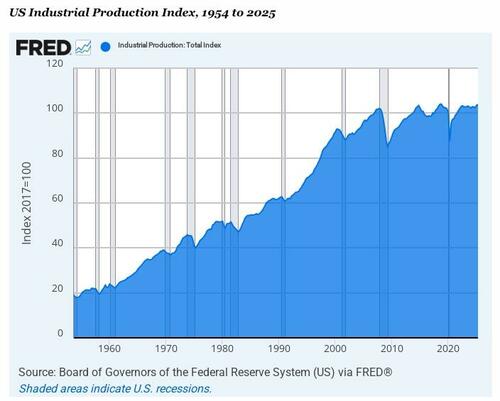
    The story of the U.S. industrial production index is a bit like a roller‑coaster that’s stuck on the flat part.

    From High‑Flying to Ground‑Zero

    • Between 1954 and 2007, the index recorded a steady 3.3% annual jump. That was the era of booming factories, rapid expansion of power plants, and fishing the deep‑sea freight routes for gold.
    • Since then, the growth rate has stalled at a negligible 0.10% per year. In plain English: the factory floor has been on a Yoyo between up and down for 17 years.
    • From a peak in Q4 2007 to now, the industry has lost about 97% of its punch.

    Reality Check: The Numbers That Matter

    When June’s industrial production bump came out – a tiny uptick – it was doused as a sign of economic vigor. That is a bit like celebrating a souffle that’s just barely risen. The long‑term trend, however, screams the opposite: the engine is sputtering.

    Why a Shrinking Workforce and Rising Health‑Care Costs Don’t Add Up

    We live in a world where the economy depends on:

    • Educating fewer children (the less labor talent enters the workforce)
    • Increasing obesity rates that drain public health budgets
    • Providing adult diapers for more generational seniors

    With fewer hands on the assembly line and medicine bills soaking up the cash, it’s tough to keep the wheels turning.

    The Monthly Roller‑Coaster

    Since June 2021, the industrial production index has been negative or flat in less than half the months. Imagine a child in the “Mother May I?” game: one step forward, one back, repeating.

    In the big picture, that’s not the sign of a “strong” economy. It’s a whisper that the industrial core is flailing.

    Takeaway

    Miraculously on the news cycle, a tiny bump can be heralded as an economic boom. In truth, America’s manufacturing base is on a downward slide. And that reality has to spoil any confidence otherwise. So next time you hear “great” about U.S. production, remember: the industry is more like a leaky boat than a tech‑savvy super‑liner.

    Why U.S. Goods Production Was Basically a “Borrowed” Experience

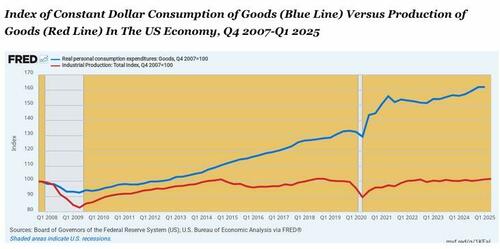
    Picture this: From the tail end of 2007 all the way into the present, Americans have been munching on more goods than our factories could ever produce. The numbers don’t lie.

    The Tale of Two Numbers

    • Cumulative real consumption of goods (think durable stuff like cars and appliances plus everyday items) jumped a staggering 62 %.
    • Meanwhile, domestic industrial output – the actual production inside the U.S. – barely budged, rising just 1.4 %.

    So what’s going on? Think of it like this: If you’re buying a huge feast but have only a tiny kitchen, you’ll have to order the banquet from somewhere else. That’s exactly what’s happening with U.S. goods consumption.

    The Import Overdrive

    • Imports filled the vast  gap between consumption and domestic production.
    • Over the past 17 years, the growth in goods consumption has largely come from foreign sources.
      • These imports were financed by significant current account deficits, meaning Americans have been spending more on foreign goods than they are earning from exporting them.

    Bottom line: The U.S. has been living large, fueled by a generous trade‑deficit buffet. That’s why the consumption boom feels more like a borrowed joyride than a home‑grown triumph.

    When Debt Takes the Fast Lane

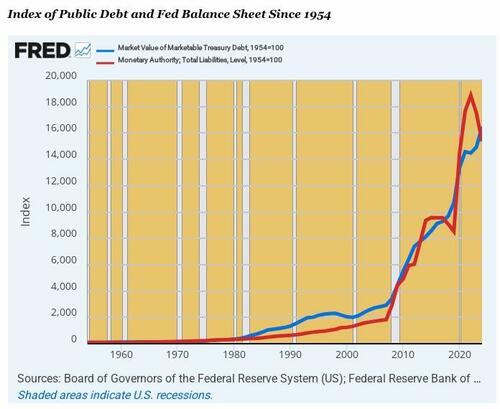
    Picture this: the U.S. dollar’s suitcase keeps filling up faster than the IKEA sales at a holiday sale. If you kick back and look at the numbers, you’ll see that the mystery of the growing pile of debt isn’t a result of the Washington-based ministries miscounting their pennies.

    Quick Back‑Takes of the Flame‑throwing Expansion

    • 1954‑2007: The Treasury’s debt crept up about 6.5 % a year, while the Federal Reserve’s balance sheet nudged in at around 5.6 %.
    • 2007‑2024: Those figures suddenly taken a rocket boost, the Treasury debt climbing at an astonishing 10.7 % an year, and the Fed’s balance sheet leaping ahead at roughly 13.3 %.

    What’s With the Slow‑Mo Industrial Production?

    Even though the Fed has been pumping out money faster than a vending machine on steroids, the heart of the economy—industrial production—has been stuck in a dead‑march by only 0.1 % per annum since 2007.

    Bottom line: the extra capital is finding routes that don’t go straight to the assembly line on Main Street; instead, it’s finding a way into other corners of the financial world.

    What’s Really Happening to the Economy?

    Picture this: since the last quarter of 2007, the NASDAQ‑100 has skyrocketed ten‑fold—actually 86‑fold! Against that backdrop, the richest 1 % of American households have seen their net worth jump from $18.9 trillion to a staggering $49.4 trillion.

    The Bottom Line on Jobs and Production

    Yes, industrial production has been pretty much stuck in neutral. Yet, the top 1.35 million U.S. families suddenly feel like they’ve hit the jackpot, their wealth swelling by nearly $31 trillion.

    Wall Street’s Squabble Over “Fed Independence”

    • Wall Street gurus are shouting at the President over his threat to let the Fed hit President Powell, citing the institution’s “sacrosanct independence.”
    • The Latin phrase “cui bono” rings true: Who really wins from this supposed independence? Not the average American on Main Street.

    The Federal Reserve isn’t a democratic tanger for the people nor a pure free‑market agency; in fact, it’s a playground for the Wall Street traders and gamblers who carve their fortunes out of its halls.

    Donald’s Monetary Mayhem

    Sure, the President’s grasp of monetary policy is… questionable, to say the least. But his impending frontal assault on that rogue institution housed in the Eccles Building might be the only shot at curbing its destructive reign.

    Wake‑up Call for Dollar‑Drowning America

    Data is crystal‑clear: Washington’s debt‑driven “stimulus” regime is filling the coffers of Wall Street while hollowing out Main Street. The glitz of prosperity is a smokescreen that masks real industrial and monetary decline.

    Cracks are widening. The next wave could be seismic—and most Americans are far from ready.

    Ready to Ride the Wave?

    We’ve put together a free special report: Guide to Surviving and Thriving During an Economic Collapse. Want to understand what’s next and how to protect your money, your life, and your freedom? Don’t wait until the crisis hits full force—grab your copy today.

    Claim Your Free Guide

    Click the button below (no real link needed—just imagine a big button!). You owe it to yourself to be informed and prepared.

  • Fresh Ways to Explore Cities While Cutting Travel Costs

    Fresh Ways to Explore Cities While Cutting Travel Costs

    Travel through a city doesn’t have to mean spending heavily on taxis, rental cars, or crowded public transport. Today, there are far more flexible and affordable ways to explore. As cities grow more walkable and bike-friendly, you can enjoy immersive, low-cost experiences by choosing transportation that helps you connect with your surroundings. Among the choices, e-bikes and electric cars are two increasingly popular options, but the way you move shapes your trip and your spending.

    Rethinking the Way You Travel

    E-bikes are becoming a go-to solution for travelers who want freedom and savings. Unlike renting an electric vehicle, e-bikes offer a practical and enjoyable way to discover a city on your terms. You avoid the hassles of parking and traffic while staying active and engaged with your environment.

    If you’re comparing options and wondering, is an e-bike the smarter electric option? The answer comes down to what kind of experience you want. E-bikes let you veer off main roads, pause for street food, and ride through parks or alleyways that cars can’t reach. In contrast, driving through unfamiliar cities often limits your view and adds logistical stress.

  • From Baby Steps to Boardroom: The Post‑Baby Career Comeback

    From Baby Steps to Boardroom: The Post‑Baby Career Comeback

    Why the “Stay‑At‑Home” Dream Turns into a Reality Test

    Picture this: You’ve decided to be the “Mom 2‑0” of your household, and the universe is all like, “You can do it!” Then, a moment later, your bank account sends a subtle (or not so subtle) reminder that bills don’t care about your heart‑felt wishes.

    Financial Reality vs. Motherhood Fantasy

    • Money’s reality check crushes the idea of being home all day, especially for families that have to stretch every dollar.
    • Psychological hurdles can crop up once you’re stepping back into the workforce—especially for the “Mom‑on‑the‑mood” crowd, who might feel guilt-laden, lost, or simply out of place.

    Pressures in a “Have It All” Society

    • The cultural narrative of “having it all” puts extra weight on the shoulders of working moms.
    • But hey—remember you’re you, not a statistic. Knowing and trusting your own judgment is what will keep you grounded.

    2014: The Turning Point for Women

    During the year, opportunities for women in the workplace multiplied, leaving many eager to seize them faster than a kid snatching the last cookie.

    Late‑Career Lifestyles and Entrepreneurial Vibes

    Many women in their 30s or 40s are ready to re‑enter the job market, often on a part‑time or flex‑basis. That combo? Rarely matches the demands of top executive roles. Instead, many rationally decide to run their own business, harnessing their newfound energy.

    Stirring Conversation Piece: Working vs. Full‑Time Homemaking

    There’s a harsh judgment funnel somewhere between moms who want to hop back jobs and those who want to stay home: the former can be labeled “cold,” the latter “weak.”

    Tips for Moms Re‑entering the Workforce

    1. Overcoming Separation Anxiety

    Your bonding bond is critical, but let’s face it—parting ways is a necessary step. Detachment helps your child grow into an independent adult.

    2. Regaining Self‑Confidence

    Feeling like the “new kid” when you return is normal. Let’s embrace the first weeks of disorientation as part of adapting to your new routine.

    3. Tackling Work‑Life Jumble

    Hook your partner, friends, or family up in the loop—you’ll be reassured that you’re not the only one worried about change.

    4. Listing Your Super‑powers

    Draft a list of your unique qualities before heading to an interview. Family and friends can confirm your strengths. Bring this list into the room and be your own champion.

    5. Translating Motherhood to Workplace Skills

    From juggling multiple tasks to honing time management, the motherhood experience equips you with essential workplace skills. These “soft, transferable” talents can truly make an employer take notice.

    Bottom Line

    Mom‑hood is, at its core, a growth journey. Being a mom can help you become more patient and empathetic. That’s a super‑power you can carry onto the office floor—and the coffee shop table, if you prefer.

  • Is Parking Near Logan Airport with Shuttle the Best Option for Travelers?

    Is Parking Near Logan Airport with Shuttle the Best Option for Travelers?

    When it comes to traveling, one of the most stressful aspects is often parking. For those flying out of Logan Airport, finding a safe, reliable, and affordable parking spot can make or break the travel experience. While there are several parking options available at the airport itself, parking near Logan Airport with shuttle service is increasingly becoming the preferred choice for many travelers. But is this really the best option? Let’s break it down.

    The Benefits of Parking Near Logan Airport with Shuttle Service

    When considering parking for Logan Airport, one of the most appealing options is parking near the airport with a shuttle service. This option offers a variety of benefits that can ease your travel experience, from convenience to cost-effectiveness.

    First, parking lots near Logan Airport with shuttle services often offer better rates than on-site parking. These lots are typically located just outside the airport and provide regular shuttle buses that transport passengers directly to the terminal. This can save travelers a significant amount of money compared to airport-owned parking, which tends to be more expensive, especially for long-term stays.