Tag: international

  • Wizz Air halts Abu Dhabi operations as instability threatens profits

    Wizz Air’s decision to end operations out of its hub in Abu Dhabi comes as it aims to focus on its core markets in Central and Eastern Europe.

    ADVERTISEMENT

    Low-cost carrier Wizz Air said on Monday that it plans to suspend all locally based flight operations out of Abu Dhabi as geopolitics and operational developments test its margins.
    Zayed International Airport, in the Emirati capital, has long been overshadowed by its successful Dubai neighbour, the world’s busiest for international travel.

    Wizz Air’s decision to end operations out of its hub in Abu Dhabi, effective from 1 September, comes as it aims to focus on its core markets in Central and Eastern Europe, the Hungarian company said in a post on X.
    The announcement follows last month’s 12-day war between Israel and Iran, which shook the region and sent airlines scrambling amid airspace closures.
    In a statement, Wizz Air CEO József Váradi said the company has had “a tremendous journey in the Middle East”. But, he added, “the operating environment has changed significantly.”
    “Supply chain constraints, geopolitical instability, and limited market access have made it increasingly difficult to sustain our original ambitions,” Váradi said.
    Wizz Air’s Abu Dhabi subsidiary, created in partnership with the government-owned Abu Dhabi Developmental Holding Co., was its first operation established outside of Europe.

    Related

    Wizz Air sees income hit by engine issues and grounded aircraftAirBaltic CEO lauds new Starlink installation despite Musk controversy

    Abu Dhabi’s airport authority didn’t respond to a request for comment. Zayed Airport has been far outshone by Dubai International Airport. Last year, 92.3 million passengers travelled through Dubai, compared to 28.8 million for Zayed.
    Wizz Air’s profits already had been falling before it decided to exit its Abu Dhabi operations and before an unprecedented Iranian strike on a US military base in neighbouring Qatar that shocked travellers in the region. The Arab Gulf states have long been viewed as a safe haven from the violence and instability in the broader Middle East.
    Last fiscal year, Wizz Air reported a 41.5% year-on-year nosedive in net profits — from €365.9 million to €213.9 million — though revenue increased by 3.8% to €5.3 billion.

    Wizz Air said the move would free up resources that would be redeployed to “regions with greater long-term potential for sustainable growth and profitability”.
    The airline’s departure comes as the federation of seven sheikhdoms looks to encourage tourism and for other ways to diversify its economy beyond reliance on hydrocarbons.


  • Trump Criticizes Court Decision To Block Major Arizona Copper Mine Land Transfer

    Trump Criticizes Court Decision To Block Major Arizona Copper Mine Land Transfer

    Authored by Austin Alonzo via The Epoch Times (emphasis ours),

    A federal appeals court has temporarily blocked a land transfer for a major Arizona copper mine, prompting a rebuke from President Donald Trump.

    Campers utilize Oak Flat Campground in the Tonto National Forest, in Miami, Ariz., on June 9, 2023. Matt York/AP Photo

    On Aug. 18, the U.S. Court of Appeals for the Ninth Circuit issued a temporary administrative injunction to halt a congressionally mandated land exchange that would have given control of a large tract of land in Tonto National Forest in Arizona to international mining giants Rio Tinto and BHP.

    The court’s order stated that it was taking no position on the merits of the case but was acting to “preserve the status quo” as it expedites a review of the legal challenge brought by the San Carlos Apache Tribe and other plaintiffs.

    In a post on Truth Social, Trump criticized the delay, saying the project was needed to create 3,800 jobs and secure a vital resource.

    Our Country, quite simply, needs Copper—AND NOW!” he said in an Aug. 19 post.

    “It is so sad that Radical Left Activists can do this, and affect the lives of so many people. Those that fought it are Anti-American, and representing other Copper competitive Countries.”

    The ruling came shortly after Trump met with the CEOs of the two companies at the White House, a meeting that highlighted his administration’s support for the mine.

    The United States Forest Service is listed as a defendant alongside Resolution Copper Mining LLC.

    The appeals court is scheduled to hear arguments for the case in September.

    On July 30, Trump signed an executive order creating a 50 percent tariff on imports of semi-finished copper products and intensive copper derivative products. The same order raised the possibility of further tariffs on imported copper in the future.

    In a statement, Resolution Copper, a joint venture between Rio Tinto and BHP, called the injunction a temporary pause so the court can consider “eleventh hour motions” by the San Carlos Apache Tribe and other plaintiffs.

    We are confident the court will ultimately affirm the district court’s well-reasoned orders explaining in detail why the congressionally directed land exchange satisfies all applicable legal requirements,” the statement said.

    The statement said the proposed mine has the potential to become one of the largest copper mines in the United States, “contributing $1 billion annually to Arizona’s economy and creating thousands of local jobs.”

    In a statement he posted on LinkedIn on Aug. 19, BHP CEO Mike Henry thanked the Trump administration for its “strong leadership to reinvigorate mining and processing supply chains in and for America.”

    The tribal leader at the center of the court case, San Carlos Apache Tribal Chairman Terry Rambler, responded directly to Trump’s comments in a Facebook post, saying that the tribe is “protecting America’s interests.” Rambler stated that the president’s comments “mirror misinformation” from foreign mining interests.

    He said the project was a “rip-off” that would allow companies to extract billions in copper while paying “almost no royalties” to the federal government.

    Rambler’s post also noted that Rio Tinto’s largest shareholder is a company owned by the Chinese government, and he alleged the copper would be shipped to China. The chairman reiterated the tribe’s primary concerns that the mine “will destroy a sacred area, decimates our environment, [and] threatens our water rights.”

    On its website, Resolution Copper listed detailed responses to Rambler’s allegations.

    “While both companies have operations and investors on nearly every continent around the world, Rio Tinto and BHP are committed to being transparent, ethical, and responsible corporations that provide the materials that shape modern society,” a statement posted on an undated “Myths and Facts” page states.

    Rio Tinto is a British and Australian mining company traded publicly on multiple global exchanges. BHP is an Australian company publicly traded on that country’s Australian Securities Exchange.

    The land transfer for the mining project was originally approved by Congress and signed off on by then-President Barack Obama in 2014. Various tribal interests and environmental groups have fought the transfer for years.

    Loading recommendations…
  • EU press for more balanced relationship at scaled-back EU-China summit in Beijing

    EU press for more balanced relationship at scaled-back EU-China summit in Beijing

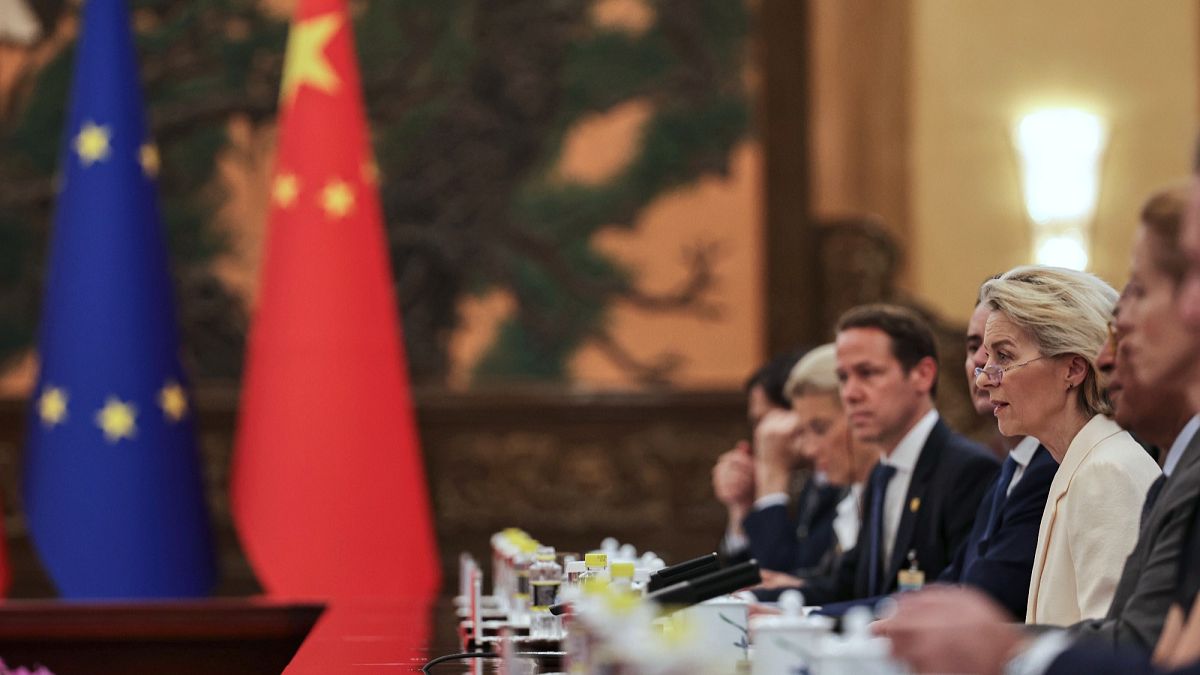
    European leaders demanded a more balanced relationship with China at a summit with President Xi Jinping in the Chinese capital on Thursday, as the bloc runs a massive trade deficit with the Asian giant of around €300 billion.

    ADVERTISEMENT

    European leaders were pushing for rebalancing trade at the EU-China summit with President Xi Jinping on Thursday.
    Focusing their opening remarks on trade, they called for concrete progress to address Europe’s yawning trade deficit with China.

    “As our cooperation has deepened, so have the imbalances,” European Commission President Ursula von der Leyen said. “We have reached an inflection point. Rebalancing our bilateral relations is essential. Because to be sustainable, relations need to be mutually beneficial.”
    Expectations were low for the talks, initially supposed to last two days but scaled back to one. They come amid financial uncertainty around the world, wars in the Middle East and Ukraine, and the threat of US tariffs. Neither the EU nor China is likely to budge on key issues dividing the two economic juggernauts.
    European Council President António Costa called on China to use its influence over Russia to bring an end to the war in Ukraine — a long-running plea from European leaders that is likely to fall on deaf ears.
    He signalled a possible agreement on climate, saying he looks forward to “a strong joint political message” from the summit ahead of annual UN climate talks in November in Brazil. That could follow their talks with China’s Premier Li Qiang later Thursday.
    Xi called on China and Europe to deepen cooperation and mutual trust to provide stability in an increasingly complex international environment, China’s state broadcaster CCTV reported online. They should set aside differences and seek common ground, he said, a phrase he often uses in relationships like the one with the EU.

    Treading carefully not to get too close

    Besides the trade imbalance and the Ukraine war, Von der Leyen and Costa were expected to raise concerns about Chinese cyberattacks and espionage, its restrictions on the export of rare earth minerals and its human rights record in Tibet, Hong Kong and Xinjiang.
    The EU, meanwhile, has concerns about a looming trade battle with the United States.
    “Europe is being very careful not to antagonise President Trump even further by looking maybe too close to China, so all of that doesn’t make this summit easier,” said Fabian Zuleeg, chief economist of the European Policy Centre. “It will be very hard to achieve something concrete.”
    China’s stance has hardened on the EU, despite a few olive branches, like the suspension of sanctions on European lawmakers who criticised Beijing’s human rights record in Xinjiang, a region in northwestern China home to the Uyghurs.

    China believes it has successfully weathered the US tariffs storm because of its aggressive posture, said Noah Barkin, an analyst at the Rhodium Group think tank. Barkin said that Beijing’s bold tactics that worked with Washington should work with other Western powers.
    “China has come away emboldened from its trade confrontation with Trump. That has reduced its appetite for making concessions to the EU,” he said. “Now that Trump has backed down, China sees less of a need to woo Europe.”
    China is the EU’s second-largest trading partner in goods, after the United States, with about 30% of global trade flowing between them. Both China and the EU want to use their economies ties to stabilise the global economy, and they share some climate goals.
    But deep disagreements run through those overlapping interests.

    Division on trade

    China and the EU have multiple trade disputes across a range of industries, but no disagreement is as sharp as their enormous trade imbalance.
    Like the US, the 27-nation bloc runs a massive trade deficit with China — around €300 billion last year. It relies heavily on China for critical minerals, which are also used to make magnets for cars and appliances. When China curtailed the export of those minerals in the wake of US President Donald Trump’s tariffs, European automakers cried foul.
    The EU has tariffs on Chinese electric vehicles in order to support its own carmakers by balancing out Beijing’s own heavy auto subsidies. China would like those tariffs to be revoked.
    The rapid growth in China’s market share in Europe has sparked concern that Chinese cars will eventually threaten the EU’s ability to produce its own green technology to combat climate change.
    Business groups and unions also fear that the jobs of 2.5 million auto industry workers could be put in jeopardy, as well as those of 10.3 million more people whose employment depends indirectly on EV production.
    China has also launched investigations into European pork and dairy products, and placed tariffs on French cognac and armagnac. They have criticised new EU regulations of medical equipment sales, and fear upcoming legislation that could further target Chinese industries, said Alicia García-Herrero, a China analyst at the Bruegel think tank.
    In June, the EU announced that Chinese medical equipment companies were to be excluded from any government purchases of more than €5 million (nearly $6 million). The measure seeks to incentivise China to cease its discrimination against EU firms, the bloc said, accusing China of erecting “significant and recurring legal and administrative barriers to its procurement market.”
    European companies are largely seeing declining profitability in China. But the EU has leverage because China still needs to sell goods to the bloc, García-Herrero said.
    “The EU remains China’s largest export market, so China has every intention to keep it this way, especially given the pressure coming from the U.S.,” she said.
    It was unclear why the initial plan for the summit of two days was curtailed to just one in Beijing.

    War on Europe’s doorstep

    The clear majority of Europeans favour increasing aid to Ukraine and more sanctions on Russia.
    The latest sanctions package on Russia also listed Chinese firms, including two large banks that the EU accused of being linked to Russia’s war industry. China’s commerce ministry said that it was “strongly dissatisfied with and firmly opposed to” the listing and vowed to respond with “necessary measures to resolutely safeguard the legitimate rights and interests of Chinese enterprises and financial institutions.”
    Xi and Putin have had a close relationship, which is also reflected in the countries’ ties. China has become a major customer for Russian oil and gas, and a source of key technologies following sweeping Western sanctions on Moscow. In May, Xi attended a Victory Day celebration alongside Putin in Moscow, but didn’t attend a similar EU event in Brussels celebrating the end of World War II.
    Von der Leyen and Costa will press Xi and Li to slash their support of Russia, but with likely little effect.

    Beyond Beijing and Washington

    Buffeted between a combative Washington and a hard-line Beijing, the EU has more publicly sought new alliances elsewhere, inking a trade pact with Indonesia, heaping praise on Japan and drafting trade deals with South America and Mexico.
    “We also know that 87% of global trade is with other countries — many of them looking for stability and opportunity. That is why I am here for this visit to Japan to deepen our ties,” Von der Leyen said in Tokyo during an EU-Japan summit on her way to Beijing.
    “Both Europe and Japan see a world around us where protectionist instincts grow, weaknesses get weaponised, and every dependency exploited. So it is normal that two like-minded partners come together to make each other stronger.”
    Promoting ties with Europe is one-third of Japan’s new 2025 military doctrine, after sustaining defence links with the US and investing in capabilities at home like missiles, satellites, warships, and drones.