Submitted via American Truckers United,
A Change.org petition, initiated by “Collective Punjabi youth,” has surged to over 2.3 million signatures, imploring Florida Governor Ron DeSantis to grant clemency to Harjinder Singh. Support has poured in from everywhere but the United States, with most signatures originating from India and the global Punjabi diaspora. Framed as a plea for mercy in a “tragic accident,” supporters argue the 28-year-old illegal immigrant from Punjab, India, deserves counseling or community service rather than prison for the deaths of three Americans. Videos and comments pour in from India, Australia, and worldwide, spotlighting Singh’s youth and family struggles, but this swell of support smacks of identity politics over justice. Petitioners, largely from Singh’s ethnic community, seek exemption through cultural ties, ignoring the victims’ grieving families.
NEW: Over 1.65M people have signed a petition to free the illegal immigrant truck driver who made an illegal U-Turn, taking the lives of 3 Americans.
The petition argues that Harjinder Singh should be sentenced to counseling or community service.
Some supporters are leaving… pic.twitter.com/45I0nUFgfv
— Collin Rugg (@CollinRugg) August 23, 2025
Open to the global web, such petitions invite interference in U.S. affairs—with India’s 1.4 billion people potentially amassing a billion votes—the core remains: We prioritize justice for the bereaved.
India has over 1.4 Billion people and
they dont get a say in American Justice https://t.co/o3uCDg1IA7— American Truckers 🚛🦅 (@atutruckers) August 23, 2025
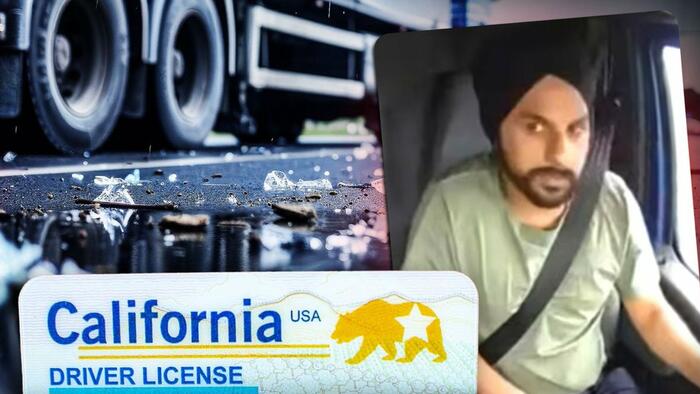
The incident unfolded in the predawn hours of August 12, on Florida’s Turnpike near Fort Pierce. Singh, driving a tractor-trailer, executed an illegal U-turn, transforming his rig into a fatal barrier. A minivan collided with the trailer, killing three innocent Americans instantly. Charged with three counts of vehicular homicide and manslaughter—facing up to 45 years—Singh fled to California but was swiftly arrested before escaping further. Post-accident investigations revealed Singh’s failure on an English proficiency test, underscoring his inability to comprehend critical road signs, a factor in the preventable tragedy. Harjinder Singh knew he had entered the U.S. illegally in 2018, knew he had obtained his CDL through improper means in sanctuary states like California and Washington, and knew he was unable to read essential road signs. He is not innocent; lives were lost while he was committing multiple criminal acts.
American trucking at a crossroads: Deadly crash involving illegal alien exposes true cost of Biden’s border invasion – Blaze Media
Full Story In The Comments pic.twitter.com/lefL3Fu1sY
— American Truckers 🚛🦅 (@atutruckers) August 24, 2025
This case exposes a perilous gap in accountability for immigrant truck drivers in fatal crashes. While Singh was caught promptly, many flee homeward, dodging justice via porous borders and prior lax enforcement. It’s a rampant tactic: Drivers abscond to origins, evading prosecution and denying closure to American victims. Take the heartbreaking case of tow truck driver Troy Caldwell in Kentucky, slain by a distracted semi-driver; the suspect, Shodmon Yuldahev, of Uzbek origin, has an open arrest warrant, and he is still at large. Comparable tales persist: In Colorado, crash victims’ widows demand reforms after foreign truckers flee or receive light penalties. Similarly, in 2019, Rogel Lazaro Aguilera-Mederos, a 23-year-old Cuban truck driver, exhibited outrageous behavior when his semi-truck’s brakes failed on I-70; he passed multiple runaway ramps, leading to a fiery crash that killed four Americans. Convicted of vehicular homicide, he was initially sentenced to 110 years, but a similar massive petition campaign—with over 5 million signatures—led to a reduction to just 10 years by Governor Jared Polis. Where’s the outcry for these American Families who have lost loved ones?
🚨The Lakewood Colorado truck crash should have been a wake-up call for our nation. At the time, the criminal labor dumping scheme and unchecked invasion across our borders went unnoticed by many. Looking back, this tragedy should have SET OFF ALARMS to protect our communities… pic.twitter.com/hatl3eQpsB
— American Truckers 🚛🦅 (@atutruckers) August 24, 2025
The Lakewood, Colorado, crash occurred at a time when the industry and the American people were not yet fully aware of the corruption plaguing the trucking sector. Dispatchers and overseas owners often elude blame, fostering bold illegal operations, knowing that repercussions are slim. In Singh’s scenario, he hauled for White Hawk Carriers, Inc., whose operations halted post-crash due to failure to pay insurance premiums, with the timing being coincidental and not a result of crash-related enforcement. Full accountability demands scrutiny across the industry: Lobbyists advocating weak rules, brokers and shippers skimping on vetting for gains, and profiteers enabling such hazards through the issuance of insurance or loans.
🚨BREAKING: Sec. of Transportation Sean Duffy EXPOSES Scandal! Previous admin handed work permits & CDLs to non-citizens, flooding the market and undercutting American truckers.
This was LABOR DUMPING—plain and simple. ATU believes Hundreds of thousands of our workers suffered… https://t.co/z2NWnPAmbc pic.twitter.com/NOBRQ8CTPX
— American Truckers 🚛🦅 (@atutruckers) June 27, 2025
A firm message is overdue: End impunity. The Biden era’s chaos widened these voids through unchecked borders and recklessness. Under Trump, order returns, seen in paused foreign trucker visas amid outrage. Resistance grows: DHS labels Singh a “significant threat,” rejecting bond. No clemency—justice must endure, untouched by volume or nationalism. Victims merit nothing less. The only way to get this industry back under control is through more accountability and higher standards. Singh will not be the sole target; high confidence suggests these facilitators—the architects of this unjust ecosystem—may soon pen their own clemency pleas as probes deepen under stricter oversight.
American Truckers United delivered a letter to Transportation Secretary Sean Duffy, requesting support for our petition to ban non-domicile CDLs issued to non-citizens and to restrict foreign CDLs. https://t.co/uQv0hwIvmC pic.twitter.com/z71Ba8XnJ6
— American Truckers 🚛🦅 (@atutruckers) June 19, 2025
. . .