Tag: month

  • Iran’s Missiles vs. Israel’s Air Defense: A Tactical Showdown

    Iran’s Missiles vs. Israel’s Air Defense: A Tactical Showdown

    Since the conflict began on Friday, Iran has launched around 370 ballistic missiles at Israel, according to the Israel Defence Forces (IDF). But what kinds of projectiles are being used—and how robust is Israel’s air defence system against potential waves of retaliatory attacks from Tehran?

    ADVERTISEMENT

    US officials estimate that Iran possesses the largest arsenal of ballistic missiles in the Middle East, with over 3,000 units. Some of these high-speed missiles can reach Israeli territory in as little as 15 minutes.  
    However, only medium-range ballistic missiles—those capable of travelling over 1,000 km—can strike Israel from Iran. According to Iran’s semi-official news agency ISNA, the country has nine different missile types with that capability.  

    “Most estimates I have seen put the number of Iranian missiles capable of hitting Israel closer to 2,000,” Dan Caldwell, a former senior adviser to US Defence Secretary Pete Hegseth, posted on X this week.
    While much of Iran’s missile arsenal remains classified, ISNA published a graphic in April last year showcasing some of its key weapons. These included the Sejil, which can reach speeds of over 17,000 km/h and has a range of 2,500 km; the Kheibar, with a 2,000 km range; and the Haj Qasem, with a range of 1,400 km.  
    A recent threat assessment by the US military found that Iran fields a “large quantity” of ballistic missiles, cruise missiles, and drones capable of striking targets across the region. Israel’s Prime Minister Benjamin Netanyahu claimed Iran intends to continue expanding this capacity.  
    In a video statement on Friday, Netanyahu said Iran had accelerated production and was aiming to manufacture 300 ballistic missiles per month—potentially producing 20,000 rockets over the next six years.  

    Israel vs Iran: A military comparison

    According to the latest estimates from SIPRI’s Military Balance, Israel’s defence budget in 2023 was more than double that of Iran—$27.5 billion compared to $10.3 billion.  

    Iran’s missile programme draws heavily from North Korean and Russian designs, and has reportedly benefited from Chinese assistance, according to the Arms Control Association, a Washington-based non-profit. 
    It now has 610,000 active personnel and 350,000 reserves with the addition of the Islamic Revolutionary Guard Corps (IRGC). Iran also has 334 combat-capable aircraft, as well as air defence systems such as the Russian S-300, which has limited capabilities when it comes to defending against ballistic missiles. 
    Israel, for its part, has developed one of the most advanced missile arsenals in the world, combining decades of homegrown innovation with strong support from the US.  FILE - Israeli Iron Dome air defence system fires to intercept a rocket fired from the Gaza Strip, in Ashkelon, 20 October 2023FILE – Israeli Iron Dome air defence system fires to intercept a rocket fired from the Gaza Strip, in Ashkelon, 20 October 2023

    AP Photo

    At the top end of this arsenal are long-range ballistic missiles such as the Jericho II and Jericho III. While the exact numbers are classified, the Jericho II is believed to be nuclear-capable with a range of around 1,500 kilometres, while the Jericho III may be able to reach targets over 6,000 kilometres away, giving Israel a strategic deterrent that extends far beyond its borders. 
    Alongside these long-range systems, Israel has hundreds of short- and medium-range missiles designed for quick, precise strikes. These include the Predator Hawk, which can hit targets up to 300 kilometres away, and cruise missiles such as the Popeye and the Delilah, which are launched from the air or sea.  
    In practice, each incoming missile usually requires its own interceptor missile to neutralise it. For example, if Iran were to launch 100 missiles, Israel would need to fire almost the same number of interceptors to stop them. 
    “The types of interceptors that are required to shoot down ballistic missiles are expensive and difficult to produce in mass quantities,” Dan Caldwell posted on X this week, adding that he think it likely that Israel and the US “are going to have start rationing their interceptors soon (if they haven’t already) – further increasing the effectiveness of even smaller Iranian barrages.”
    Its multibillion-dollar military arsenal also includes around 340 combat aircraft—among them advanced US-made F-35 stealth fighters—46 helicopters, a combined 634,500 active and reserve personnel, and a multilayered air defence system.   
    Approximately 370 ballistic missiles have been launched by Iran at Israel since the conflict began on Friday, claims the Israel Defence Forces (IDF). On Saturday, an Israeli military official said that the country’s air defence shield had an “80 to 90% success rate”, while stressing that “no system is 100% effective”—implying that some Iranian missiles had breached Israeli air defences, Reuters reported.  
    The Iron Dome, Israel’s well-known air defence system, is just one component of a broader system designed to counter a range of aerial threats, from rockets and missiles to drones and aircraft.  
    The first layer, the Iron Dome, intercepts short-range rockets and artillery shells—typically within 70 kilometres—and is primarily used to protect civilian areas.  
    Next is David’s Sling, which targets medium-range ballistic missiles launched from distances between 100 and 200 kilometres.  
    Finally, the Arrow system—comprising Arrow 2 and Arrow 3—provides long-range defence. Arrow 2 is designed to intercept missiles in the upper atmosphere, roughly 50 kilometres above ground and within a 100-kilometre radius. Arrow 3 pushes that boundary into space, capable of intercepting missiles at distances of up to 2,400 kilometres.  
    Israel’s Iron Dome, David’s Sling and Arrow systems are all missile interceptors. This means that they are not designed to launch attacks, but rather to detect and destroy incoming missiles before they reach their targets. 
    In practice, each incoming missile usually requires its own interceptor missile to neutralise it. For example, if Iran were to launch 100 missiles, Israel would likely need to fire almost 100 interceptors to stop them — one for each threat. 
    However, despite all these protection layers, analysts argue that Israel’s decision to target the heart of the Iranian regime is raising the stakes, as the latter could respond by striking other targets in neighbouring countries, thus escalating the conflict in the region, or by attempting to block trade in the Persian Gulf.  
    “If Israel continues to attack its nuclear and military facilities, Iran has a strong incentive to put together a rudimentary nuclear weapon as quickly as it can to deter any further damage of its facilities and demonstrate that it is capable of defending its sovereignty,” senior research fellow at Chatham House Dr Marion Messmer wrote in an analysis.  

  • Trump's Fed Pick Stephen Miran Commits To Central Bank Independence

    Trump's Fed Pick Stephen Miran Commits To Central Bank Independence

    Authored by Andrew Moran via The Epoch Times,

    Stephen Miran, President Donald Trump’s nominee to temporarily serve on the Federal Reserve Board of Governors, committed to preserving the central bank’s independence in testy exchanges with senators.

    Trump announced his nomination of Miran, the current head of the White House’s Council of Economic Advisers, early last month to temporarily fill the seat vacated by Adriana Kugler.

    Appearing before the Senate Banking Committee for his confirmation hearing, Miran expressed the necessity for monetary policy independence as lawmakers centered their questions on the Federal Reserve’s autonomy.

    “In my view, the most important job of the central bank is to prevent depressions and hyperinflations. Independence of monetary policy is a critical element for its success,” he said in his opening remarks on Sept. 4.

    “I will act independently as the Federal Reserve always does,” Miran told senators, adding that he welcomes listening to a diverse array of opinions “to challenge my own views and interrogate them.”

    Democratic senators, including Sen. Elizabeth Warren (D-Mass.), were unconvinced, stating that Miran would serve as a proxy for the president and erode Fed independence.

    Accentuating her point, Warren asked Miran whether he thought Trump had lost the 2020 presidential election and if he believed the Bureau of Labor Statistics’ July jobs numbers had been manipulated.

    Miran replied that President Joe Biden “was certified by Congress” and that the federal agency has struggled with deteriorating data quality.

    “Dr. Miran, you have made clear that you will do or say whatever Donald Trump wants you to do or say,” Warren, the top Democrat on the committee, said.

    “That may work in a political position, but it takes an axe to Fed independence, and will make life far more expensive for Americans.”

    Sen. Andy Kim (D-N.J.) questioned whether administration officials, “formally or informally,” had asked Miran to vote to lower interest rates.

    “No,” Miran answered.

    Miran is likely to be confirmed as Republicans control the Senate Banking Committee and hold 53 seats in the upper chamber. All Senate GOP lawmakers voted to confirm Miran, who served in the president’s first term, to chair the president’s key economic advisory group.

    Still, many of them encouraged Miran to stay committed to doing what he thinks is right rather than following the wishes of politicians.

    “There’s nothing wrong with politicians in Washington offering their opinions. You can’t stop them,“ Sen. John Kennedy (R-La.) told Miran.

    ”But we need a monetary plan that was put together by something other than vodka and darts, and that’s what we have the Federal Reserve for.”

    His ascent to the Fed Board could happen before the Federal Open Market Committee (FOMC) meets on Sept. 16 and 17. Investors overwhelmingly anticipate that monetary policymakers will vote to lower interest rates by a quarter point for the first time since December. The institution has been on hold this year to determine the potential effects of Trump’s sweeping global tariff plans.

    If confirmed, Miran would serve on the Fed Board only until Jan. 31, 2026. Trump could then renominate Miran to complete a full 14-year term or select another individual for the position.

    Miran revealed that he would only be taking an unpaid leave of absence from the White House because his term would only last four months. He noted that he would resign if nominated for a longer term.

    This sparked further scrutiny from Sen. Jack Reed (D-R.I.), who called it “ridiculous.”

    “You are going to be technically an employee of the president of the United States, but an independent member of the board of the Federal Reserve,” Reed said.

    Loading recommendations…
  • Tired of handling all the housework? Meet the app that splits chores and balances the load.

    Meet the App That’s Made Europe Talk

    Since its September 2024 debut, this slick new app has whisked away more than a quarter‑of‑a‑million users in just ten months. That’s a bit like a runaway hot‑dog truck that leaves a trail of satisfied customers in its wake.

    Why All the Glitz?

    • Lightning‑fast Onboarding – Sign‑up takes less time than it takes to brew your morning coffee.
    • Super‑User Features – From custom dashboards to AI‑powered suggestions, the app feels like a personal assistant that’s actually helpful.
    • Community Vibes – Users can connect, share tips, and even challenge each other for fun.

    How the Numbers Stack Up

    25,000+ users in Europe in the first ten months? That’s roughly 2,500 new souls every single month. If you’re thinking about riding the wave, it’s a good sign that the platform’s gaining momentum at a rate that’s nothing short of impressive.

    What Users Are Saying

    • “I never knew an app could make my life easier – this is the real deal!”
    • “Features are on a whole other level; feels like in 2024 we finally have the future in our hands.”

    In short, the app’s rapid rise isn’t just a numbers game – it’s a testament to a product that hits the sweet spot of usability, innovation, and community. Europe’s already buzzing, and the next ten months will likely see even more cheerfully skeptical users jumping on board.

    Meet Accord: The Swedish App That Turns Chore Turf Wars into Team Wins

    Ever had a midnight showdown over who’s supposed to vacuum the living room? If you’re tired of the “you did it again!” drama, Accord’s here to rescue your sanity.

    What Accord Actually Does

    • It’s a digital chore board. Picture a shared playlist, but for laundry, dusting, and grocery runs.
    • Setup is a breeze. Create a “family squad,” add tasks, and tag them off as you go.
    • Automatic tracking. The app tells you who’s been crushing which chores, so no one’s left shouting “I did it last week!”
    • Progress page. See stats and keep the work load balanced—pretty much like a scoreboard for housework.

    Why It’s a Game Changer

    Victor Fredrikson, one of Accord’s founders, calls it “a stress‑busting, harmony‑building sidekick.” The goal? No more arguments, the same old grind, just a well‑organized family routine.

    Research shows the real impact: 79% of European women handle the daily cooking and cleaning, while only 34% of men pitch in. Accord tackles this mismatch head‑on. When chores are split evenly, stress drops, communication improves, and even relationships get happier—no magic spell needed.

    What You’ll Get

    • Multiple languages: Spanish, French, German, English, Swedish—so everyone can join the chore‑battalion.
    • Transparency: Everyone sees a live leaderboard of who’s done what.
    • Less drama: Say goodbye to mutterings and stands—hello to family teamwork!

    Ready to Stop Fighting Over the Fork?

    Download Accord now, add your household tasks, and watch the chaos turn into collaboration. Trust us—your fridge will thank you, and your partner might even smile back when you hand over the cleaning list.

    Gender gap reduced by 60 per cent among users

    From Dad’s Nagging to Household Harmony: How a Student App Is Redefining Family Life

    Picture this: three college kids from KTH Royal Institute of Technology in Stockholm built an app that, in just ten months, attracted over 25,000 European users. And all this teamwork started with a dad’s poor‑man complaint about a messy room.

    It All Began with a Dad’s Complaint

    “Two years ago, I was still crashing at my parents’ place, and Dad kept rattling me to clean up. One day he tossed a curveball: ‘Why don’t you program an app so I don’t have to nag you anymore?’” Frederikson joked.

    Instead of shrugging it off, Frederikson pitched the idea to a classmate the next day, and the seed was planted.

    Finding the Core Problem

    They soon realized that families lack the same kind of workplace structure that companies use – a neat system for organising chores. “Why does this nagging stick around? Where do those arguments come from?” they mused. The answer was simple: a lack of clarity and responsibility.

    Breaking the Gender Myth

    One of the app’s biggest wins is narrowing the gender gap in chores. Before, women did nearly twice as much as men. Now, that deficit has shrunk by 60%. “That’s a massive improvement,” Fredrikson says.

    User Stories: Real-World Impact

    • Lina-Marie Lundqvist – part‑time special educator, mother, and pet owner – swears the app is a lifesaver.
    • She explains, “Now chores are pulled by the calendar instead of my nagging. Everyone knows what’s on their plate.”
    • “I’m no longer the eternal project manager, constantly asking ‘Can you empty the dishwasher?”, ‘Can you do this?’ or ‘Can you do that?’ Kids and partners do their part without me having to point the finger.”

    What It Looks Like in Action

    Families now share a clear distribution of tasks, letting each person take ownership. The result? Safer, happier homes where housekeeping is less an excuse for whining and more an organized, shared commitment.

    Why It Matters

    With an app that’s become “an integral part of” many households, the team proves that a couple of bright minds can turn a sarcastic dad remark into a tangible solution that brings real harmony to families.

    More than a strict 50-50

    Fairness in the Home: It’s All About Talk, Not a 50‑50 Spreadsheet

    Fredrikson from the Accord team laughed when she explained their take on household fairness. “People get rattled thinking we’re chasing the holy grail of equal minutes spent on chores,” she said. “But real fairness is more like a chat over cereal, a clear vision of who’s doing what, and a shared appreciation of the effort each one brings.”

    Beyond the Clock: Energy Matters Too

    • Time vs. Feel. Fairness isn’t just a timer. Fredrikson pointed out that the feel of a task—whether it drains or revives—counts just as much.
    • Effort Points. Introducing a system that lets you rate chores by how taxing they are. “It’s the same as giving someone a break on the dishes if you’re all about cooking,” she explained.

    Like a clever game of “Who’s Chore Worth More?” the app uses energy‑based scoring to balance those draining tasks with the ones that actually energize the household.

    Lundqvist’s Real‑World Test

    Meet Anna, a part‑time worker balancing chores with a full‑time partner. Despite the uneven workload, Anna felt the team spirit through the app’s colorful dashboard.

    She’s so impressed: “When I came home after a long day and saw the laundry folded and the dishwasher empty—no reminder needed—that’s the “hallelujah moment” a teen dreams of.”

    Why Split Isn’t Strict

    Anna says fairness isn’t a maths lesson but something you feel. “It’s about being seen, felt supported, and recognized for the tough bits,” she adds. The dashboard’s color scale literally shows how each catch‑up feels like a signal of mutual respect.

    In short, Accord’s take: Fairness = Conversation + Clear Roles + Feeling Refreshed. No tedious spreadsheets, just a real conversation about chores and a little bit of energy hedging.

  • Core Durable Goods Orders Rise At Fastest Annual Rate in 3 Years

    Core Durable Goods Orders Rise At Fastest Annual Rate in 3 Years

    Amid chaotic swings MoM driven by the variability of Boeing plane orders, analysts expected preliminary July data to show a 3.8% MoM decline (following June’s big plunge, following May’s big surge). The good news is that the actualk print was better than expected (-2.8% MoM) but still in the red for headline orders. This dragged down the YoY headline growth to 3.5% as the front-running of tariffs fades and earlier this month, Boeing Co. reported a fewer orders in July than in June.

    Source: Bloomberg

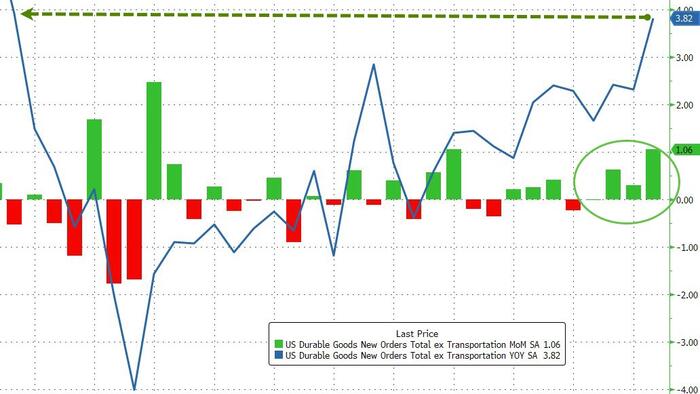
    Under the hood, ex-Transports, durable goods orders rose over 1.0% MoM (the fourth straight month of gains), lifting core orders 3.8% YoY – its strrongest growth since Nov 2022…

    Source: Bloomberg

    Once again, non-defense aircraft orders plunged (while defense aircraft orders rose)…

    Source: Bloomberg

    Capital Goods Orders, non-defense ex-aircraft rose 1.1% MoM (better than expected).

    Non-defense capital goods shipments including aircraft, which feed directly into the equipment investment portion of the gross domestic product report, rose 0.7% after an upwardly revised gain a month earlier. Rather than orders, which can be canceled, the government uses data on shipments as an input to GDP.

    The import/export tariffs – and the frontrunning of such – has clearly sparked chaos in the data.

    Loading recommendations…
  • Let robots free you up to thrive

    Let robots free you up to thrive

     One of the essential strategies in business is that you should never reveal all you know.

    However, we hope in this and future articles to be able to share some useful thoughts on how businesses are emerging successfully from lockdown based on our experience of working with a wide range of clients.
    It’s nearly always true that a crisis forces any organisation to find new ways of doing things – to reduce cost, cope with demand or improve productivity. One clear trend we are seeing is the greater use of digital technology and automation to perform mundane tasks that had been done by often over-qualified personnel.
    Perhaps unsurprisingly those who have been most readily  embracing digital transformation in recent months are either those who are already very tech savvy, such as fintech companies, where they see how further automation can give them a greater competitive edge, or those who have been hardest hit, such as the property rental and hospitality sectors.
    For example, we have one hospitality client running 500 reconciliations a month on average prior to lockdown. When they head back to pre-COVID levels of work, those reconciliations will take a team of 30 people four days to process each month. Once automated, this will reduce to a total of two hours.
    The benefit of these sort of moves is not just cost saving. By getting robots to do what humans had done before, you free up your talent to do what they are best at – growing the business. This has been particularly so during lockdown. Recently staff in reduced teams have had to become involved in dull, repetitive work that they had not signed up for. This was demoralising and did not make best use of their skills. Senior managers as well, including business owners, who, having had to furlough staff, have got involved in mundane processes, leaving them little time to focus on how to best make the business succeed. Automation frees them up to concentrate on what really matters.
    Of course, some of this has got to happen anyway and those who do it early are going to have a competitive advantage. One of the key drivers for embracing automation is the introduction of HMRC’s Making Tax Digital initiative. This will, in time, require all taxpayers to file digitally rather than physically. Elements put on hold by HMRC during lockdown are coming back and VAT, already filing electronically, will be the first change to be a fully digital process. Those companies who are geared up to do this automatically will not only save themselves a huge amount of time but will also benefit from cash flow advantages as payments are made more quickly.
    Crises such as this pandemic can and should serve as a wake-up call, a catalyst to make businesses more efficient and productive. Sometimes they happen at a time when those who respond in the right way gain a significant advantage for the future.
    For those of us old enough to remember the Millennium Bug – a software error that many feared would cause computers to malfunction when we moved into the new millennium – you will recall government advertising campaigns terrifying businesses into upgrading their IT systems. Many did so. Even though when New Year’s Day 2000 had passed the bug was more of a damp squib, it did mean UK business had improved computer systems just as the internet was taking off and the Dot Com boom arrived.
    We are about to see another such technological boost with the greater use of Artificial Intelligence to help businesses gain insights into their customers and find new markets and revenue streams. But only those who are now going through a process of digital transformation will benefit from the dramatic benefits AI will bring. AI can analyse almost everything if you let the bots do the basics.

  • China’s Producer Deflation Plunges to Two‑Year Low in Troubled Trade Climate

    China’s Producer Deflation Plunges to Two‑Year Low in Troubled Trade Climate

    China’s Factory Prices Take the Biggest Dip in Two Years – and It’s Not Because of a Bubble

    Why the plunge matters: When factories drop their prices, the economy’s heartbeat slows. In June, China saw its lowest factory-gate price change in 24 months, a real shocker given how tight the market had been.

    What’s Behind the Numbers?

    • Trade uncertainty: Global trade talks feel like a bad game of “Guess the next move,” leaving manufacturers unsure whether to invest or hold back.
    • Soft domestic demand: Consumers in China are as cautious as a child on a scooter, spilling the brakes on purchases that used to fuel factory sales.
    • Commodity price swings: Ever notice how raw material costs can jump or drop faster than a roller coaster? That’s the kind of volatility factories hate.

    What It Looks Like on the Ground

    Picture this: A factory set to ship out a batch of steel sheets – the price tags suddenly get slapped down because the market’s cooling. The factories scramble to adjust, and the result is a total drop in factory-gate prices that’s bigger than a two‑year roller‑coaster drop.

    How the Numbers Stack Up

    Consumers and businesses alike count on these prices to guide their buying. When they slump, the market feels a bit like a house of cards, though experts say it’s likely temporary.

    Takeaway – The Ups and Downs of Factory Prices

    While the dip in June shows a market easing, it’s a reminder that international trade and domestic spending are tightly intertwined. The factory price slump highlights that both pieces need to stay in sync for a healthy economy.

    Chinese Industrial Prices Take a Dive in June 2025

    What the Numbers Say

    On July 9, the National Bureau of Statistics released a snapshot of China’s price landscape. The producer price index (PPI) for industrial goods slipped by 3.6 % in June, beating the 3.3 % fall seen in May, and marking the steepest yearly drop since July 2023. Meanwhile, the purchasing price index (PPI‑P) plunged a staggering 4.3 % from the previous year, the sharpest slide since August 2023.

    Why the Decline?

    • Energy hiccups – Lower power costs gave the PPI a quick hit.
    • Trade turbulence – Uncertainty surrounding global commerce exerted downward pressure.
    • Weather woes – Hot, wet conditions knocked building‑material costs low.

    Statistician Dong Lijuan highlighted that export‑heavy sectors were hit hardest. Prices for computers, cell‑phones, and other tech gear fell by 0.4 %, while electrical machinery and textiles slid by 0.2 % each. In year‑over‑year terms, tech equipment slipped a solid 2.3 %.

    Factory Activity and Employment

    China’s factories shrank for a third straight month in June, albeit at a slower pace than before. Employment and new export orders remained sluggish. “We anticipate further weakening of demand later this year,” said Zichun Huang of Capital Economics, pointing to a slowdown in exports and diminishing fiscal support.

    Market Reaction

    The stock markets took a cautious stance amid the ongoing U.S. trade uncertainty. Shanghai Composite ticked up by 0.3 % at midday, while Hong Kong’s Hang Seng fell by 0.7 %.

    Consumer Side of the Story

    Though consumer prices rose by a modest 0.1 % from June 2024, the trend of deflation has lingered over the past four months. Economist Duncan Wrigley of Pantheon Macroeconomics cautioned that consumer inflation will hover near zero for the rest of the year, hampered by a protracted property downturn and job‑market jitters.

    Trade tensions between Washington and Beijing are expected to persist. “More flare‑ups are likely and cooling export growth will add to downward price pressure in manufactured goods sectors,” said Wrigley.

    International Trade Insights

    Descartes, a supply‑chain tech firm, reported that U.S. container imports from China totaled about 639,300 20‑foot units in June, a slight 0.4 % rise from May but a sharp 28.3 % drop from June 2024. The company predicts that China’s share of U.S. imports might stay pressured through the second half of 2025, especially with upcoming tariff pauses running out on August 1 and a trade truce set for August 12.

    Bottom Line

    China’s industrial and consumer price indices are taking a hard hit, reflecting weather quirks, energy price shifts, and a shaky global trade environment. While market players hold their breath, the story remains a bumpy ride—just like a rollercoaster with a few drops and turns. Let’s keep an eye on upcoming data releases and trade agreements to see if the currents shift in any direction.

  • Witness a Celestial Parade: Six Planets Align for a Stunning Sky Show

    Mercury Joins the Planetary Party

    Hey everyone! In just a few days, Mercury will be the star that completes the full six‑planet lineup you can see from Earth. Imagine the celestial parade: Mercury, cool and swift, ceding stage to its companions – Venus, Mars, Jupiter, Saturn, and the ever‑mysterious Uranus. All together, they’ll put on a show you won’t want to miss!

    What’s on the List?

    • Mercury – the quicksilver dancer
    • Venus – the glowing bloom
    • Mars – the scarlet warrior
    • Jupiter – the giant with the great storms
    • Saturn – the ringed maestro
    • Uranus – the tilted enigma

    So, grab your binoculars, set a reminder, and get ready to marvel at the entire planetary lineup. It’s going to be a cosmic spectacle!

    Get Ready for This Month’s Ultimate Planet Parade

    Stargazers and early‑bird explorers, buckle up! For a short while, the night sky will turn into a celestial fireworks show – five planets appearing side‑by‑side, all at once. Think of it like a space‑party, but without the neon lights.

    Which Planet Casts Its Spell?

    • Venus – the dazzling “Evening Star” you can spot with plain eyes.
    • Jupiter – the giant that’s so bright you’ll want to brag about it.
    • Saturn – ring‑tastic and ready for a selfie.
    • Uranus and Neptune – the cool kids who’ll need a pair of binoculars or a telescope to show up.

    Why Are We Seeing All These Beaux‑Addons Together?

    Thanks to the fact that the planets orbit the Sun in a relatively flat, disc‑shaped plane, they often line up across the sky. When you look in the same patch of sky at a single moment, you can catch an entire planet parade – a dazzling line of celestial bodies that would make any astronomer’s heart race.

    Getting the View Right

    Seeing the parade is only possible if the planets rise high enough above the horizon. NASA notes that the best odds are when a planet sits at least 10° above the horizon, with anything over still doable if you’re looking closely.

    When’s the Grand Finale?

    For those in the Northern Hemisphere, the planets will light up the sky just before sunrise. According to Carolyn Sumners – vice‑president for astronomy at the Houston Museum of Natural Science – “you’re looking at about an hour before sunrise. Don’t get up any earlier, but you can’t wait much longer, because the sun’s going to steal the spotlight.”

    Make Sure You’re In on the Action

    • Grab an empty phone or notebook – you’ll want to record the moment.
    • Stay close to the horizon; the planets will vanish as soon as the sun climbs higher.
    • Wear a comfy pair of slippers or a cozy blanket – it’s a nighttime event!

    Mark your calendars, set an alarm, and enjoy the cosmic spectacle. This is one of those rare chances where the universe fills the hallway and says, “Look at me! I’m happening, and you can still see me!”

    Rare chance to see Mercury

    Mercury’s Surprise Cameo in August

    Heads up! Starting around August 17, you’ll get a very rare chance to spot Mercury up close. Normally that cheeky planet stays snugly tucked in the Sun’s glare, but for a few nights it will gracefully crawl toward the sky.

    When to Peek

    • Right after sunset – if you’re still on your feet, you might catch a quick wink.
    • Just before sunrise – early‑bird telescopes get the first look.

    It’s like a cosmic game of hide and seek – Mercury slips out of the Sun’s shadow, then dives back in as it keeps orbiting.

    The Planet Parade

    Within the next days, Mercury will push further from the Sun, and together with Venus, Earth, Mars, Jupiter, and Saturn, form a dazzling lineup of six planets. It’s a stellar parade, but it will be the very last one of 2025.

    As the month winds down, Mercury will vanish again, clutching the Sun. But don’t worry, the crescent Moon will swing into the scene, adding a bright, gentle glow to the closing act.

    So grab a telescope, a comfy blanket, and let the night sky put on its final show of the year. It’s a quick, unforgettable moment that’s just too good to miss!

  • More Than 300 Arrested In Washington Amid Federal Crackdown On Crime: Bondi

    More Than 300 Arrested In Washington Amid Federal Crackdown On Crime: Bondi

    Authored by Aldgra Fredly via The Epoch Times,

    More than 300 people have been arrested following the federal takeover of law enforcement at the District of Columbia police department, according to U.S. Attorney General Pam Bondi.

    Bondi said that 68 people were arrested overnight on Aug. 16 after President Donald Trump federalized policing in the nation’s capital. This brings the total number of arrests to more than 300 since the operation began earlier this month.

    “Just last night, our federal and DC law enforcement partners made 68 arrests and seized 15 illegal firearms,” Bondi stated in an Aug. 17 post on X.

    “Homicide suspects, drug traffickers, and more are being charged. I’ll continue to stand with you as we make DC safe again!”

    Those arrested face charges including assault on a federal officer, aggravated assault, felony grand larceny, and driving under the influence (DUI), according to FBI Director Kash Patel.

    Trump announced a federal takeover of D.C.’s Metropolitan Police Department (MPD) on Aug. 11, deploying hundreds of National Guard troops to the nation’s capital to curb crime.

    Bondi then appointed DEA administrator Terry Cole as D.C.’s “emergency police commissioner,” granting him full authority over the MPD.

    Bondi, however, revised the order following a federal judge’s ruling issued in response to legal challenges from D.C. Attorney General Brian Schwalb, who alleged that the federal government violated the Home Rule Act by attempting to replace MPD Chief Pamela Smith.

    In her updated order, Bondi stated that Cole will serve as her “designee” at the MPD, and allowed Smith to remain in charge of its operations. The order will still require D.C. Mayor Muriel Bowser to assist with enforcing federal immigration law and locating illegal immigrants.

    Spokesperson for the U.S. AG’s office, Chad Gilmartin, said the revised order is stronger than the initial one “because instead of requiring D.C. to rescind just one MDP order, @AGPamBondi has now REQUIRED full cooperation with federal immigration authorities.”

    Trump also ordered law enforcement to patrol the nation’s capital around the clock. He invoked Section 740 of the Home Rule Act, which allows the president to control the city’s police department for up to 30 days, with any extension requiring congressional approval.

    Schwalb has accused the Trump administration of infringing on the district’s right to self-governance and abusing its authority under the Home Rule Act by declaring “a hostile takeover” of the MPD.

    “These orders far exceed the President’s limited authority to request services from MPD, which can only be done on a temporary basis, under emergency circumstances, and solely for federal purposes,” his office said on Aug. 15.

    White House spokesperson Abigail Jackson has defended the federal takeover of the MPD, saying it’s necessary “due to the emergency that has arisen in our nation’s capital as a result of failed leadership.”

    “The Democrats’ efforts to stifle this tremendous progress are par for the course for the Defund the Police, Criminals-First Democrat Party,” Jackson told The Epoch Times.

    Loading recommendations…