Tag: Portugal

  • Growth fades in Europe: Is the recovery already running out of steam?

    Growth fades in Europe: Is the recovery already running out of steam?

    The eurozone economy barely grew in the second quarter. Germany and Italy contracted, while Spain continued to shine.

    ADVERTISEMENT

    Europe’s economic momentum nearly stalled in the second quarter of 2025, with growth barely registering and industry output sliding sharply—raising concerns over whether the region’s recovery is already running out of steam.
    According to Eurostat’s second estimate released on Thursday, seasonally adjusted GDP in the euro area rose by just 0.1% in the three months to June, unchanged from the initial flash reading. The wider European Union (EU) grew by 0.2%, also in line with earlier estimates.

    These figures mark a stark slowdown from the robust first quarter, when GDP expanded by 0.6% in the eurozone and 0.5% across the EU thanks to strong export growth.
    In contrast, the United States economy bounced back strongly, posting a 0.7% quarterly expansion following a slight contraction in the first quarter. On an annual basis, eurozone GDP rose 1.4%, well behind Washington’s 2.0% pace.

    Diverging national performances

    Beneath the headline figures, the recovery remains highly uneven across the bloc.
    Spain led the pack with 0.7% quarterly growth, fuelled by strong domestic demand and capital investment. Portugal followed with a 0.6% gain, while France managed a modest 0.3% expansion.
    However, both Germany and Italy, the eurozone’s largest and third-largest economies, slipped by 0.1%.

    For Germany, the contraction reflects continued weakness in investment, particularly in construction and capital goods, while Italian output suffered from subdued consumption and softening industrial activity.
    Ireland saw the steepest drop, with output contracting by 1%.
    Elsewhere in the EU, growth was more robust in Eastern Europe, with Romania and Poland expanding by 1.2% and 0.8%, respectively, helped by resilient domestic demand and inflows from the Next Generation EU (NGEU) programme.

    Related

    Global personal wealth: Which countries have the highest shares in Europe?Tariff revenue fails to curb US deficit as July spending hits record highs

    Industrial downturn clouds outlook

    Adding to the worries, industrial production in the euro area dropped by 1.3% in June, reversing a 1.1% rise in May and missing expectations of a more moderate decline by 1%.
    The fall was broad-based, with capital goods production down 2.2% and non-durable consumer goods plunging 4.7%.
    In the wider EU, output fell by 1%. Among member states, Ireland recorded the largest monthly drop in industrial production at -11.3%, followed by Portugal and Lithuania.
    In contrast, Belgium, France and Sweden posted notable gains.

    US outpaces Europe, but sentiment is shifting

    While the euro area continues to lag behind the US, in terms of both output and productivity growth, Goldman Sachs believes that the sentiment is shifting towards Europe.
    Economists Giovanni Pierdomenico and Sven Jari Stehn note that Germany’s fiscal policy pivot and heightened macroeconomic uncertainty in the US are helping shift investor attitudes.
    Goldman Sachs has upgraded its euro area growth forecast for 2027 by 1.2% since the start of the year, while downgrading its US projection by 1.7% over the same period.
    Portfolio flows into Europe have picked up, and the euro has strengthened notably against the dollar.

    Related

    Warning signs in Europe’s job market: Workers now brace for tariff effectsSpain’s Ibex-35 conquers 15,000 points and reaches the highest level since 2007

    Europe’s long-term challenges and opportunities

    Despite the improved mood, Europe still faces deep structural challenges.
    Elevated energy costs—particularly for gas and electricity—continue to erode competitiveness.
    Low investment in high-growth sectors, regulatory fragmentation, and sluggish productivity gains further weigh on potential.
    In addition, China, once a key export market, has increasingly become a competitor, squeezing Europe’s manufacturing base.
    Yet there are reasons for optimism. Increased public investment, driven by the NGEU programme and Germany’s €500bn infrastructure plan, could support medium-term growth.
    Europe also remains a global leader in pharmaceuticals and has significant untapped potential in capital markets integration, digitalisation and green infrastructure.
    “Europe has opportunities to improve its economic performance through increased public investment, leadership in growth industries such as pharmaceuticals and green technologies, financial market reforms, and further integration of the internal market,” Pierdomenico said.
    Efforts to deepen the single market—spurred by the European Commission’s Competitiveness Compass, informed by the Draghi and Letta reports—are seen as vital steps to unlocking future growth.
    “European policymakers have a window of opportunity to build on this improved macro picture with reforms that lead to a lasting improvement in Europe’s economic performance,” Pierdomenico added.
    Goldman Sachs remains constructive on Europe’s medium-term outlook, forecasting euro area growth above consensus for 2025–2028.
  • Counting the cost: Mass tourism in Europe creates jobs but what is the knock-on effect?

    Europe recorded more than 747 million international tourist arrivals in 2024, a hefty increase on the 416 million reported in 2005, according to UN Tourism data.

    ADVERTISEMENT

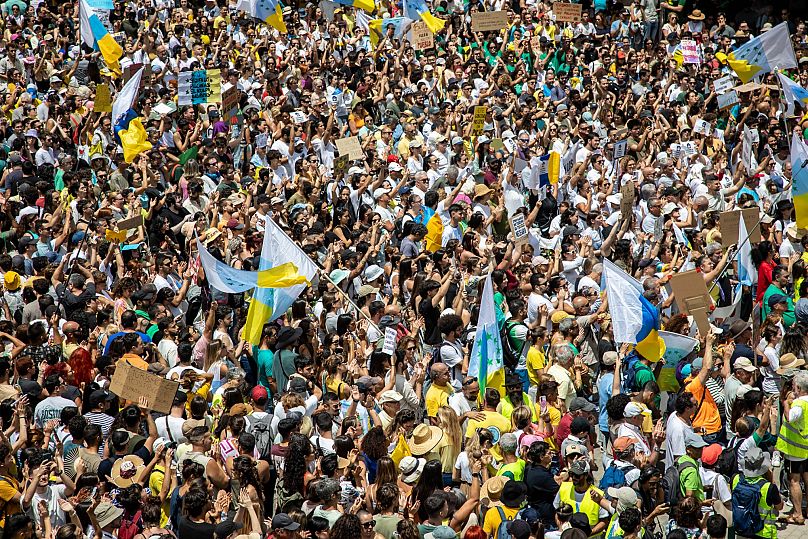
    In Barcelona, Lisbon and Naples, thousands of demonstrators took to the streets on Sunday to call for an end to what they call the “touristification” of their cities. But why are holidaymakers such a source of tension?
    Sandra Carvão, Director of Economic Intelligence, Policy and Competitiveness at UN Tourism, told Euronews that mass tourism has soared in recent years due to “more disposable income among the middle classes in many countries…more accessible travel in terms of air capacity but also in terms of air fares” and “border crossing facilities that have changed radically over the decades”.

    The number of international tourist arrivals has risen from 416 million in 2005 to more than 747 million in 2024, according to UN Tourism.
    Between 2019 and 2024, the number of international tourist arrivals rose by 18.1% in Portugal, 12.3% in Spain and 12.2% in France, according to the UN agency.
    In Italy, on the other hand, tourist arrivals fell by 10.5% over the same period.
    On the plus side, the influx of visitors generates jobs and revenue for tourist regions.
    “It’s an employment-intensive sector, so it creates lots and lots of jobs. More than 50% of these jobs are held by women…more than 80% of tourism businesses are SMEs,” Carvão said.

    In 2023, Spain earned €80 billion from international tourists, according to UN Tourism.
    France earned €61 billion, while Italy and Portugal earned €47 and €23 billion respectively from international tourists in 2023.People gather during a mass demonstration against over tourism in Las Palmas de Gran Canaria, 20 April, 2024People gather during a mass demonstration against over tourism in Las Palmas de Gran Canaria, 20 April, 2024
    AP Photo

    But at what cost?

    Traffic jams, saturated city centres, rising rents: mass tourism is causing a host of problems for local residents.

    The proliferation of short-term furnished accommodation is contributing to soaring property prices, increasingly pricing locals out of the property market.
    Between 2015 and 2023, property prices rose by an average of 48% in the European Union, according to Eurostat data.
    These increases were highest in Hungary (+172.5%) and lowest in Finland (+5%). House prices rose by 105.8% in Portugal, 47.7% in Spain, 31.3% in France and 8.3% in Italy over the same period.
    Other factors are also to blame, such as the rise in construction costs and the increase in rental investment.
    Some municipalities, victims of their own success, have taken the problem head-on. Amsterdam has banned the construction of new hotels and Dubrovnik has limited the number of cruise ships that can dock daily.
    “The sector itself needs to define the carrying capacity in certain destinations,” says Carvão. “In this situation, new technologies help because you can do a lot with tracking people’s movements. You can have more data and you can have better information.”
    “There are policies that involve diversifying demand throughout the year so that fewer people travel at specific times, so there is less pressure on the destination’s resources,” she added.
    Holidaymakers can also take action by choosing less saturated destinations. In fact, 42% of tourists are concentrated in just 10 countries worldwide.

  • Europe\’s Growth Stalls – Is the Recovery Already Exhausted?

    Eurozone Economy: A Mixed Bag in Q2

    When you look at the big picture of the eurozone, you’ll see a story with an HMS—HereSomeMall—tossed in a few surprises. The region barely pulled a growth win in the second quarter.

    Crunchy Breakdown by Country

    • Germany – The powerhouse of Europe slipped into contraction, bringing a sigh that could be heard across the continent.
    • Italy – The last breath of the economy was also a contracting one, leaving some eyebrows raised.
    • Spain – The bright star kept on dazzling, maintaining its positive momentum and pulling a few smiles from business folks.

    What Does This Mean?

    It turns out that the eurozone’s growth curve is more like a gentle undulating beach slope than a steep staircase. While the big players are feeling a bit lurch, Spain’s steady climb offers a morale boost to the region’s overall sentiment.

    Bottom Line for Policymakers

    With shrinking output in Germany and Italy, economic architects have to fine‑tune policies, whereas Spain’s resilience can serve as a model. A push is needed to turn the paragraphs into clear prose on the road to stronger recovery.

    Europe’s Economy Is Taking a Chill Pill in Q2 2025

    According to the latest reading from Eurostat, the euro zone’s GDP barely nudged forward—just a 0.1% jump in the three months ending June. In the broader EU ring, it stood at 0.2%, matching what was first reported.

    Slow‑Mo vs. Fast‑Go

    • First quarter of 2025: euro area GDP raked up 0.6% thanks to an export storm.
    • EU overall: 0.5% rise, powered by another exporting win.
    • Europe’s slowdown punches a face in Q2, with growth barely touching the surface.

    Why It Matters

    Even though the U.S. pulled out a 0.7% quarterly gain after a slight dip in Q1, it still lags behind American growth:

    • Annual eurozone GDP: +1.4%
    • Annual U.S. GDP: +2.0%

    With the European crunch intensifying, many are wondering if the continental comeback is finally hitting a dead stop.

    Diverging national performances

    EU Economy in 2024: A Patchwork of Gains and Glitches

    While the headline numbers paint a rosy picture, the real story under the surface is a bit more uneven. Some countries are dancing and others are stumbling.

    The Standouts

    • Spain topped the charts with a 0.7 % quarterly jump – thanks to a boost from both hungry domestic shoppers and a surge in capital projects.
    • Portugal was close behind, pulling in 0.6 % growth, proving that a little mild weather can still keep the economy humming.
    • France eventually managed a modest 0.3 % expansion, which looks like a polite nod rather than a standing ovation.

    The Downers

    • Germany and Italy, the eurozone’s biggest and third‑largest players, both slipped by 0.1 %—a gentle fall that indicates stubborn lagging in construction and capital goods.
    • Even Italy’s output felt the chill, hampered by sluggish consumer spending and a gentle dip in industry.
    • Ireland hit the hardest, with output shrinking by 1 % — a sizable dip that surely made market analysts squint.

    Eastern Europe’s Surprise

    The East side of the EU turned out to be a bright spot, boasting healthier growth thanks to resilient local demand and a steady flow of funds from the Next Generation EU (NGEU) programme.

    • Romania showed a solid 1.2 % uptick.
    • Poland managed 0.8 % growth.

    What’s Next?

    With these mixed figures, policymakers face a balancing act—boosting the lagging giants while keeping the bright eastern stars on their merry way.

    Stay tuned for more updates and remember – the European economy isn’t a straight line; it’s a rollercoaster of nuance.

    Industrial downturn clouds outlook

    Euro‑Area Industry Takes a Dip: A Rough June 2023

    Industrial output in the euro zone slumped 1.3 % in June, flipping an upswing of 1.1 % from May and falling short of analysts’ more modest 1 % expectation.

    What Went Down

    • Capital goods: Down 2.2 %, a clear sign factories are pausing machinery orders.
    • Non‑durable consumer goods: Plummeted 4.7 %, indicating slower sales of everyday items.

    Across the European Union, production sank by 1 % overall. A few countries felt the pinch more severely:

    • Ireland: Biggest drop at a staggering -11.3 %—raw, brutal.
    • Portugal and Lithuania: Both recorded sizable declines.

    Meanwhile, some nations were more than a little buoyant:

    • Belgium, France, and Sweden each saw a solid uptick in industrial activity.

    Looking Ahead

    As the week wraps up, economists will be watching closely for signs of resurgence—or a deeper slide—as Europe ramps up its recovery strategy.

    US outpaces Europe, but sentiment is shifting

    European Economy Gains Momentum Over the US

    While the euro zone has traditionally lagged behind the United States in output and productivity growth, Goldman Sachs is sounding the alarm that the tides are turning.

    Chief economists Giovanni Pierdomenico and Sven Jari Stehn point to Germany’s new fiscal strategy and the mounting uncertainty in the US economy as key drivers that are nudging investor sentiment from “US‑centric” to “Europe‑centric.”

    • Goldman Sachs Upgrade: The firm recently lifted its 2027 growth forecast for the euro area by a solid 1.2% since the year’s start.
    • US Cutback: Conversely, the US projection was trimmed by 1.7% over the same period.
    • Capital Flows: Portfolio investments flowing into Europe have surged, and the euro has given the dollar a solid repulse.

    Why the Shift?

    Germany’s fiscal pivot appears to be the midwife of this change, while the US feels the chill of tightening macroeconomic uncertainty. Investors are taking notes and diversifying their portfolios, giving Europe a much‑needed boost.

    Related Buzz

    Keep an eye on the following:

    • Warning signs in Europe’s job market: Workers now brace for tariff effects.
    • Spain’s Ibex-35 conquers 15,000 points and reaches the highest level since 2007.

    Shortly, the euro is stepping up, the dollar’s footing is wobbling, and all eyes are on Europe’s economic revival. Stay tuned!

    Europe’s long-term challenges and opportunities

    Europe’s Economic Rumble: Challenges, Glimmers, and a Call to Action

    Stiff Reality Check

    Even though people’s spirits have lifted a bit, the continent is still grappling with stubborn structural hiccups.

    • Fueling the Fire: Energy bills, especially for gas and electricity, are sky‑high, eating into competitiveness.
    • Missing the Growth Beat: Investment in high‑growth sectors lags behind, while fragmented rules slow progress.
    • Productivity Power‑Out: Gains are sluggish, dragging potential down.
    • China’s Newcomer Status: Once a key exporter, China now competes and squeezes Europe’s manufacturing bedrock.

    Sparks of Hope

    But all isn’t gloom. A few bright spots shine through.

    • Public Money Matters: The Next Generation EU (NGEU) programme, paired with Germany’s €500 bn infrastructure push, could boost medium‑term growth.
    • Pharma Power: Europe remains a heavyweight in pharmaceuticals.
    • Untapped Wealth: Massive potential exists in capital‑market integration, digitalisation, and green infrastructure.

    “Europe can level up its economic game by boosting public spend, leading growth sectors like pharma and green tech, revamping financial markets, and tightening the internal market together,” said Pierdomenico.

    Deepening the Single Market

    Crafting a tighter single market is seen as the key to unlocking tomorrow’s growth.

    • European Commission’s Competitiveness Compass is steering policy.
    • These moves draw on the Draghi and Letta reports, giving fresh momentum.

    “Policymakers have a golden window to leap into reforms that secure lasting economic improvements,” Pierdomenico added.

    Goldman’s Take

    Goldman Sachs stays upbeat, predicting that euro‑area GDP will outpace consensus from 2025 to 2028.