Authored by Victor Davis Hanson via American Greatness,
The left weighs in on anything that Trump is against, which drives it to lionize criminals like Abrego Garcia, champion open borders, and oppose increased oil and natural gas production.
And they are against anything Trump is for.
So often, they did not care much about big-city crime rates, supported biological men’s usurpation of women’s sports, and opposed taking out the Iranian nuclear threat.
However, recently, some former and, no doubt, current Trump opponents now seem to support both what Trump is for and what he is against—at least in a few areas.
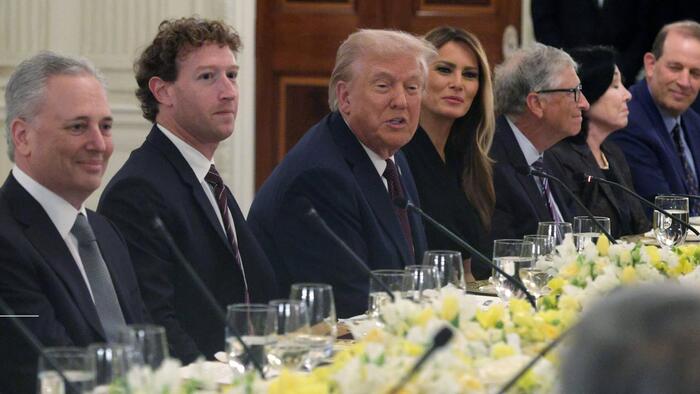
So this past week, Donald Trump hosted some of the richest, most powerful—and most liberal—high-tech CEOs in the country at the White House.

Their shared goal ostensibly is to ensure U.S. dominance in artificial intelligence, robotics, genetic engineering, cryptocurrency, and nearly every other breakthrough field that has both sparked global competition and involves U.S. national security.
In this regard, Trump seems to be channeling Franklin Delano Roosevelt, who, during the early years of World War II, enlisted his ideological foes, mostly the nation’s CEOs, to rearm the virtually defenseless U.S. He tasked them to jump-start the moribund American economy to produce in a matter of months the best and most plentiful ships, planes, vehicles, communications, and new military technologies.
Despite their ideological differences, both FDR and Trump knew that only private enterprise could rearm and reboot the nation, and only if the captains of industry were infused with patriotic zeal, guaranteed freedom to innovate and adapt, and able to make a profit on their investments, would they become partners with and not adversaries of the government.
So last week, Trump assembled Michael Kratsios, the administration’s director of the Office of Science and Technology Policy, along with David Sacks, the billionaire investor and Trump’s cryptocurrency and AI czar. Joining them were Big Tech CEOs like Google’s Sundar Pichai, Arvind Krishna of IBM, former Microsoft CEO Bill Gates, Apple CEO Tim Cook, Meta CEO Mark Zuckerberg, and OpenAI CEO Sam Altman. Elon Musk was not there, though he said he was invited but had a scheduling conflict.
Their joint challenge is to ensure that the U.S. dominates these emerging fields and thereby ensure American prosperity and national security.
A subtext follows that China must not be allowed by hook or crook to steal U.S. research and development breakthroughs and thereby take a lead in these fields. The CEOs are tasked with investing their huge profits inside the United States to ensure jobs for Americans and, to the greatest degree, minimize offshoring and outsourcing whenever possible.
Trump’s duty, in turn, is to reassure the CEOs that under his watch, the government will not pick winners and losers but let them all compete on a level playing field. They will be protected by the government both from European Union ankle-biting regulatory interference and censorship and Washington’s own efforts to micromanage them into stasis. That is the quid. The quo is that the tech leaders must awaken a somnolent U.S. to the technological revolutions underway that will determine the fate of nations in the second half of the 21st century—and then begin producing state-of-the-art products that lead to a more secure and richer U.S.
We should remember what FDR accomplished. World War II broke out on September 1, 1939, when Germany invaded Poland. At that point, the U.S. military was smaller than those of eighteen other nations. The U.S. Army was less than 200,000 soldiers in size, with only 125,000 sailors in the Navy. In contrast, the German military was already over 1.5 million strong. Its soon-to-be wartime ally, Japan, had under arms 2.5 million combatants, and Italy had another 1.5 million soldiers.
On maneuvers, the American army was short on rifles and used broomsticks. Even after Pearl Harbor, the U.S. lacked both the quality and quantity of German planes, tanks, and artillery. The Japanese Navy roughly matched the American but enjoyed advantages since it was not responsible for a two-ocean deployment, as were the Americans in both the Atlantic and Pacific. Its fighters, torpedoes, and destroyers were deemed superior to their American counterparts.
Yet when the war ended four years later, the U.S. military was well over 12 million soldiers in size. Its navy had more ships and tonnage than all the navies of the world combined.
The U.S. Army Air Forces were larger than all the air forces of the world combined. It possessed the most lethal weapons of the war—the atomic bomb, the massive B-29 bomber, and an array of thousands of superb fighter planes. The Navy grew to over 125 fleet, light, and escort aircraft carriers. At the end of the war, American battleships, carriers, submarines, fighter aircraft, and transport vehicles were the most numerous and best in the world. By 1945, the American gross domestic product was likewise larger than all the economies of all the belligerents combined.
How did the U.S. go from an isolationist and disarmed country mired still in the Great Depression to the most powerful and best-armed nation in world history—and in less than four years?
The neo-socialist president Franklin Delano Roosevelt pivoted. He abandoned the New Deal statist control of the economy and instead unleashed the captains of industry to rearm the United States in the way that they thought best.
FDR tasked General Motors president William Knudsen to round up corporate CEOs, allot them areas of industry, and then, with Roosevelt’s blessing, turn them loose.
Roosevelt appointed his former political enemies to a variety of boards—the War Production Board, the Office of Production Management, and the National Defense Advisory Commission. The great corporations responded. Charles Wilson of General Electric, Henry Kaiser of Kaiser Steel, and Henry Ford of the Ford Motor Company quickly built new factories or recalibrated older ones into huge weapons industries.
Soon, Henry Ford was building one B-24 bomber an hour at the huge Willow Run plant in Michigan. Kaiser launched a Liberty cargo ship every few days in his West Coast shipyards. By war’s end, the industrialists had built 300,000 planes and over 14,000 warships and cargo vessels.
Roosevelt’s message to the once-hostile industrialists was simply to employ their initiative, expertise, and resources to outproduce the enemy and to catch up and surpass their head start in the quality of arms. He gave them wide latitude to profit, fast-tracked zoning and building permits, and urged them to use their initiative and coordinate with each other. The only real order was to make better and more plentiful weapons than the Germans, Italians, and Japanese combined.
And they did just that and left a model for our own generation to follow—if it proves as publicly spirited, patriotic, united, and capable as their grandfathers who won the war.

 Florida Fish and Wildlife has issued a reminder that Florida’s 2025 Gulf private recreational red snapper fall season begins on September 1. Fishing is open to those fishing from private recreational vessels or state-permitted charter vessels that do not have a federal reef fish permit.
 Related Story:WATCH: Gov. Ron DeSantis Announces Record Breaking Red Snapper Season in Florida
 Related Story:HOT OFF THE PRESS! August 25, 2025 Space Coast Daily News – Brevard County’s Best Newspaper
