Tag: remove

  • Defence a key priority of Denmark's presidency of the European Union

    Denmark took over the six-month Presidency of the Council of the European Union. During the European Commission’s visit to the new rotating Presidency, Copenhagen reiterated its priorities.

    ADVERTISEMENT

    Security and defence were high on the agenda when Denmark took over the six-month Presidency of the European Union and on Thursday, the 27 members of the College of Commissioners travelled to Aarhus, to mark the start of the new tenure.
    With defence a priority, the Scandinavian country intends to significantly push ahead with rearmament efforts.

    “If we are not prepared to defend our continent, who are we as Europeans?” Danish Prime Minister Mette Frederiksen asked.
    “We need to rearm Europe by 2030 by the latest, and I look forward to the roadmap on how to achieve this goal, so that we can develop common capabilities, strengthen our defence industry, make joint procurements and remove all barriers and obstacles in our way,” she added.
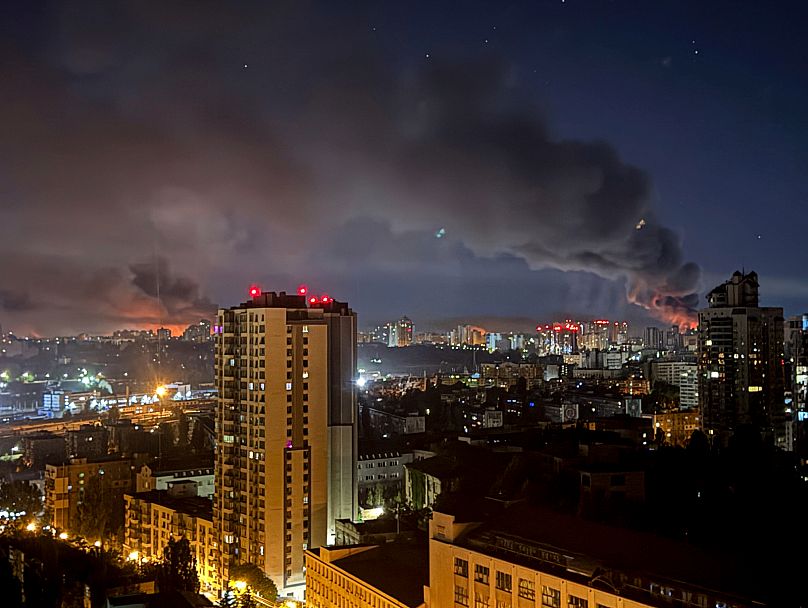
    For the Danish leader, the EU’s security largely depends on Ukraine. “Right now, it is the army in Ukraine that is protecting Europe,” Frederiksen said on Thursday at a press conference attended by Ukraine’s President Volodymyr Zelenskyy.Smoke rises after a Russian strike on Kyiv, 4 July, 2025Smoke rises after a Russian strike on Kyiv, 4 July, 2025
    AP Photo

    She emphasised that Kyiv is part of the European family and therefore called on member states to change their mindset when it comes to military aid.

    “When we deliver arms to Ukraine, instead of seeing it as a donation, we need to think of it as part of our rearmament,” Frederiksen insisted.

    Linking security and migration

    Denmark believes that migration policy is also a question of security. According to the Danish Prime Minister, the European system is failing, and she is calling for the restoration of border controls.
    “On these issues, we now have concrete proposals on the table, proposals that could also pave the way for return centres and asylum procedures outside the EU,” she said.
    Speaking on the Pact on Migration and Asylum, President of the Commission Ursula von der Leyen listed which areas Denmark needs to make progress on.

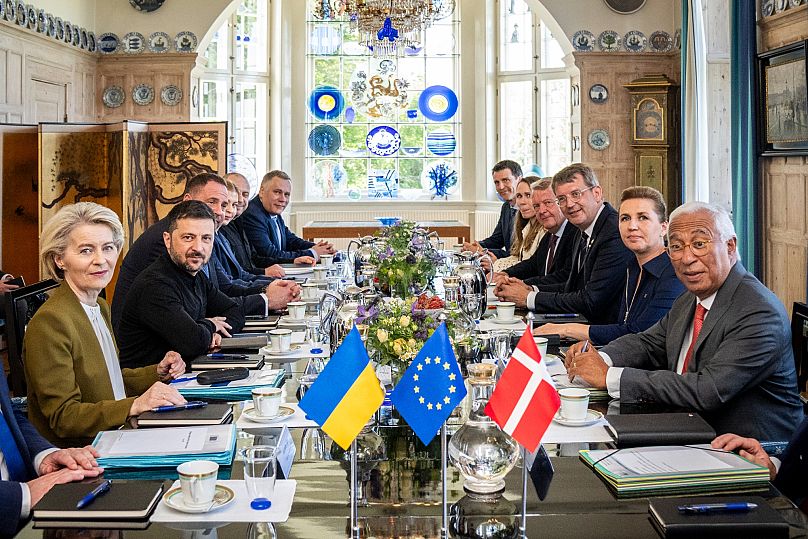
    “Under your presidency, we will be able to make progress on our proposal for a return, on the concept of safe third countries and safe countries of origin,” von der Leyen said.Denmark's Prime Minister Mette Frederiksen, second right, and EU officials attend a meeting at Marselisborg Castle in Aarhus, 3 July, 2025Denmark’s Prime Minister Mette Frederiksen, second right, and EU officials attend a meeting at Marselisborg Castle in Aarhus, 3 July, 2025
    AP Photo

    Responding to trade turbulence

    The Danish Presidency and the European Commission also agreed competitiveness should be another priority for Copenhagen. Here again, Ursula von der Leyen listed the issues on which she hoped developments would be made.
    “We must therefore give a major boost to the European Savings and Investment Union, which will be one of our joint priorities,” von der Leyen said.
    She emphasised that the cost of energy is a key challenge facing the European Union in the face of its international competitors. Von der Leyen said she intends to present “plans to improve the European grid, storage capacity and interconnections.”
    Beyond this six-month roadmap, the challenge for Denmark will be to maintain the unity of the 27 member states, and ensure that the EU speaks with a unified voice to meet the geopolitical, trade and climate challenges.

  • What to Expect After Cryosurgery: Skin Healing Images – Health Cages

    What to Expect After Cryosurgery: Skin Healing Images – Health Cages

    Introduction

    In this blog, we found out about cryosurgery, a treatment that uses really cold temperatures to freeze and remove unwanted bumps or warts on the skin. Cryosurgery is safe and works well. It’s often cheaper and faster than other treatments. Usually, it’s done at the doctor’s office and doesn’t cause many side effects, just some redness or blisters. But, cryosurgery might not be right for everyone, so it’s important to chat with your doctor to see if it’s the best choice for you.

    (adsbygoogle=window.adsbygoogle||[]).push({})

     In this blog, we discuss these topics:

    (adsbygoogle=window.adsbygoogle||[]).push({})

    Cryosurgery

    Imagine having a stubborn bump or wart on your skin. It might be itchy, unsightly, or just plain bothersome. Cryotherapy, also known as cryosurgery, is a treatment that can help! It works by using extreme cold to freeze and destroy those unwanted growths.

    (adsbygoogle=window.adsbygoogle||[]).push({})

    Think of it like this: Cryotherapy is like taking a tiny ice cube that’s way colder than anything in your freezer and applying it directly to the problem area. This intense cold freezes the cells in the bump or wart, causing them to die and eventually fall off.

    (adsbygoogle=window.adsbygoogle||[]).push({})

    Here’s the cool (literally!) part: Doctors can use different tools to deliver this freezing blast. The most common one uses liquid nitrogen, which is incredibly cold – almost -200°C! That’s much colder than dry ice! Other options include carbon dioxide snow, which is still quite chilly at -78°C, or a special mixture of chemicals.

    But why choose cryotherapy over other treatments? There are several reasons:

    • Cost-effective It’s generally cheaper than procedures like surgery or laser treatment.
    • Quick and easy The treatment itself is often done in a doctor’s office and doesn’t take very long, typically just a few minutes.
    • Safe When done by a skilled doctor, cryotherapy has a good safety record with minimal risks involved.
    • Convenient No need for a hospital stay! Cryotherapy is an outpatient procedure, meaning you can go home right after the treatment.
    • Minimally invasive Unlike surgery, cryotherapy doesn’t involve cutting or stitching.
    • Good for certain skin concerns Cryotherapy is particularly effective for treating warts, actinic keratosis (precancerous skin growths), and some types of skin cancer.

    But it’s important to remember that cryotherapy might not be the best choice for everyone. Your doctor will look at things like how big the bump is, where it’s located, and what kind of bump it is to decide if it’s right for you. And there could be some temporary side effects, like redness, blisters, or a little bit of scarring.

    (adsbygoogle=window.adsbygoogle||[]).push({})

    So, if you’re worried about a bump or growth on your skin, talk to your doctor about cryotherapy. It could be just what you need to make your skin smooth and healthy again!

    These are some pictures of skin after cryosurgery

    Signs & Symptoms

    You don’t have to do anything special before. Sometimes, if someone feels a lot of pain, they might put numbing cream on the area for 30–90 minutes before.

    One good thing about this simple, safe treatment is that it can be done quickly at the doctor’s office. For small bumps, they just put on some very cold liquid with a cotton swab, metal tool, or spray, and it only takes about 30 seconds. Bigger bumps might need a bit longer, like 30–60 seconds. Because the liquid is super cold, the treated area looks white like it’s frosty. Most people feel some discomfort during the treatment, but it’s usually not too bad, and there might be a little throbbing afterward.

    Conclusion

    In Conclusion, cryosurgery, also known as cryotherapy, is a cold treatment that effectively removes unwanted skin bumps and warts. It’s affordable, quick, and generally safe, making it a convenient option for many. However, it’s important to consult with a doctor to determine if it’s the right choice for your specific situation. Overall, cryosurgery offers a promising solution for achieving smooth and healthy skin.

    Faq’s

    Q1. What happens to your skin after cryotherapy?

    A1. After cryotherapy, the treated area might look red and form a blister within a few hours. The blister could be clear, red, or purple. You might feel some pain for up to 3 days.

    Q2. How long does it take to heal after cryotherapy?

    A2. If the freezing was strong, a blister might form. If it’s severe, the area might ooze for a few days. It usually takes between one to three weeks to fully heal, depending on where the treatment was done.

    Q3. What shouldn’t you do after cryotherapy?

    A3. Avoid using scented soap, makeup, or lotion on the treated area until it’s fully healed, which usually takes at least 10 days. You might also lose some hair in that area.

    Q4. How do you take care of your skin after freezing treatment?

    A4. You don’t need to cover the treated areas usually. Clean them gently with diluted hydrogen peroxide and water using a cotton ball. After cleaning, apply Vaseline.

    Q5. Does your skin return to normal after cryotherapy?

    A5. Many people let the treated spots heal naturally over the next 3 weeks. It’s common for the skin to change color after cryotherapy. To reduce this risk, follow simple steps to help the wound heal.

    Unlock Your Best Skin: Dive Deeper with Skin Health Blogs: