Tag: Reuters

  • Senators Call For Probe Into Meta After News Report On AI Conversations With Children

    Senators Call For Probe Into Meta After News Report On AI Conversations With Children

    Authored by Jacob Burg via The Epoch Times (emphasis ours),

    Two Republican Senators on Aug. 14 called for a congressional investigation into Meta Platforms, Facebook’s parent company, after a recent news media report revealed an internal policy document that allowed the company’s chatbots to have “romantic or sensual” conversations with a child.
    The offices of Meta in Menlo Park, Calif., on July 31, 2025. John Fredricks/The Epoch Times

    On Thursday, Reuters reported that it had viewed a Meta policy document detailing polices on chatbot behavior that permitted the technology to “engage a child in conversations that are romantic or sensual,” generate incorrect medical information, and assist users in arguing that black people are “dumber than white people.”

    While Meta confirmed the authenticity of the document, the company said that after recently receiving questions from Reuters, it removed the portions stating that the chatbot is allowed to flirt or participate in romantic roleplay with children.

    Andy Stone, a spokesperson for Meta, said the company is currently revising the documents and that those types of conversations with children should never have been permitted.

    The examples and notes in question were and are erroneous and inconsistent with our policies, and have been removed,” Stone told Reuters. “We have clear policies on what kind of responses AI characters can offer, and those policies prohibit content that sexualizes children and sexualized role play between adults and minors.”

    On the X platform, Sen. Josh Hawley (R-Mo.) criticized the company for allegedly only making the changes after being questioned by Reuters.

    So, only after Meta got CAUGHT did it retract portions of its company doc that deemed it ‘permissible for chatbots to flirt and engage in romantic roleplay with children,’” Hawley said. “This is grounds for an immediate congressional investigation.”

    A spokesperson for Sen. Marsha Blackburn (R-Tenn.) said she supports a probe into Meta.

    After Hawley called for an investigation, a Meta spokesperson reiterated the company’s previous statement. However, the spokesperson declined to comment on Hawley’s remarks.

    Blackburn said the report underscores the need to pass reforms for better protection of children online, like the Kids Online Safety Act. The senator co-sponsored the bill, which passed in the Senate last year by a bipartisan 91–3 vote, but failed in the House.

    The bill called for certain platforms, such as social media networks, to “take reasonable measures in the design and operation of products or services used by minors to prevent and mitigate certain harms that may arise from that use (e.g., sexual exploitation and online bullying).”

    Additionally, covered platforms must provide (1) minors with certain safeguards, such as settings that restrict access to minors’ personal data; and (2) parents or guardians with tools to supervise minors’ use of a platform, such as control of privacy and account settings,” the bill states.

    Blackburn reintroduced the Kids Online Safety Act in May.

    “When it comes to protecting precious children online, Meta has failed miserably by every possible measure. Even worse, the company has turned a blind eye to the devastating consequences of how its platforms are designed,” Blackburn said.

    The legislation would also explicitly define a “duty of care” that social media companies employ regarding minors’ use of their products, focusing on the regulation of the companies and the platforms’ designs.

    The Meta document states that the standards in question do not necessarily reflect “ideal or even preferable” generative AI outputs, according to Reuters. However, the provocative outputs by bots have been permitted, the news outlet’s analysis revealed.

    The Epoch Times has not independently verified the document in question.

    Sen. Ron Wyden (D-Ore.) called the standards “deeply disturbing and wrong.” He said Section 230, the law that protects internet companies from liability for statements or content posted on their platforms, should not extend to shielding the companies’ generative AI chatbots.

    “Meta and Zuckerberg should be held fully responsible for any harm these bots cause,” Wyden said.

    Sen. Peter Welch (D-Vt.) said Reuters’s report “shows how critical safeguards are for AI—especially when the health and safety of kids is at risk.”
    Loading recommendations…
  • White House Has Backup Strategy If Trump's Tariffs Are Overturned: Bessent

    White House Has Backup Strategy If Trump's Tariffs Are Overturned: Bessent

    Authored by Andrew Moran via The Epoch Times (emphasis ours),

    Treasury Secretary Scott Bessent said the White House has plenty of tools at its disposal to implement President Donald Trump’s global tariffs if the Supreme Court does not uphold his use of a 1977 emergency powers law.

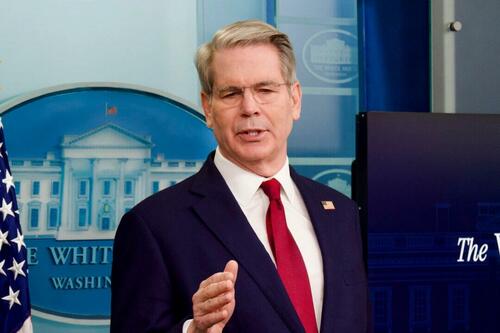
    Treasury Secretary Scott Bessent speaks to reporters during a briefing at the White House on April 29, 2025. Travis Gillmore/The Epoch Times

    The U.S. Court of Appeals for the Federal Circuit ruled 7–4 on Aug. 29 against the current administration’s decision to invoke the International Emergency Economic Powers Act (IEEPA) as justification for levies on foreign goods unveiled in April. The court’s decision does not take effect until Oct. 14, allowing the White House ample time to appeal the decision to the Supreme Court.

    The IEEPA grants the president broad authority to regulate international economic transactions—regulating imports and exports, freezing foreign assets, or halting financial transactions—after declaring a national emergency.

    In a Labor Day interview with Reuters, Bessent stated that while he is confident the high court will uphold the president’s reciprocal tariff agenda, the administration has various options available.

    “I’m confident the Supreme Court … will uphold the president’s authority to use IEEPA. And there are lots of other authorities that can be used—not as efficient, not as powerful,” Bessent said.

    He referred to Section 338 of the Tariff Act of 1930, also known as the Smoot-Hawley Tariff Act. It contains a trade provision that authorizes the president to impose new tariffs or additional duties of up to 50 percent on foreign products entering the United States for a period of five months if they are determined to threaten domestic commerce.

    Bessent said he is planning a legal brief for the U.S. Solicitor General to highlight the urgency of stopping the flow of fentanyl into the country. Pointing to the approximately 70,000 fentanyl-linked deaths per year in the United States, he questioned what would be considered an emergency.

    “If this is not a national emergency, what is?“ he said. ”When can you use IEEPA if not for fentanyl?”

    The senior administration official also intends to argue that persistent trade imbalances will ultimately reach a critical threshold, triggering more immense consequences for the U.S. economy.

    “We’ve had these trade deficits for years, but they keep getting bigger and bigger,” he said. “We are approaching a tipping point … so preventing a calamity is an emergency.”

    The last time the United States registered a trade surplus was in 1975.

    In July, the U.S. goods trade deficit widened by $18.7 billion to $103.6 billion, the largest gap in four months. Imports rose by more than 7 percent to $281.5 billion while exports dipped 0.1 percent to $178 billion.

    Long-term U.S. Treasury yields popped on Sept. 2, driven by concerns that the federal government will be forced to repay tariff income and forego potentially trillions of dollars in tariff revenues.

    Yields on the 20- and 30-year government bonds surged about 5 basis points to around 4.92 percent and 4.98 percent, respectively.

    “Global trading partners will no doubt find it premature to be celebrating just yet, but we’ll be interested in seeing whether the Treasury market comes under any further pressure if the US has to hand back already received tariff revenues,” ING economists said in a Sept. 1 note.

    In this fiscal year, the federal government has collected $183.1 billion in tariff revenues, including $31 billion in August.

    Wall Street in New York City on April 4, 2025. Samira Bouaou/The Epoch Times

    Looking ahead, according to projections from the Committee for a Responsible Federal Budget, tariff revenues could rise to as much as $50 billion per month, or 1.5 percent of GDP, “before declining some as supply chains adjust.”

    The Yale Budget Lab estimates the effective U.S. tariff rate is 18.6 percent, the highest since 1933.

    ‘Performative’ Relationships

    Bessent also shrugged off the apparent cordial relations between China, India, and Russia at the recent Shanghai Cooperation Organization as “performative.”

    “It’s more of the same,” Bessent said, adding that Beijing and New Delhi are “fueling the Russian war machine.”

    “I think at a point we and the allies are going to step up,” he said.

    Last week, the president’s additional 25 percent tariff on India went into effect, bringing the total import duty to 50 percent on many imports entering the United States. The administration doubled down on punitive levies over India’s enormous purchases of Russian crude oil.

    Trump, writing in a Sept. 1 Truth Social post, stated that India has offered to reduce its tariffs to zero percent.

    “India buys most of its oil and military products from Russia, very little from the U.S.,” Trump said. “They have now offered to cut their tariffs to nothing, but it’s getting late. They should have done so years ago. Just some simple facts for people to ponder!”

    He noted that the United States does “very little business with India, but they do a tremendous amount of business with us.”

    According to the U.S. Trade Representative’s Office, the U.S. goods trade deficit with India was $45.8 billion last year, up 5.9 percent from 2023.

    India, the only nation slapped with secondary tariffs for Russian oil purchases, has been surpassed by China as the world’s largest buyer of discounted petroleum products from Moscow.

    Bessent defended the administration’s decision not to impose secondary tariffs on Beijing. In an Aug. 19 interview with CNBC’s “Squawk Box,” Bessent stated that China was already the Russian energy sector’s client.

    China importing it is suboptimal,” Bessent said. “But if you go back and look pre-2022, pre-invasion, 13 percent of China’s oil was already coming from Russia. Now it’s 16 [percent]. So, China has a diversified input of their oil.

    India, on the other hand, dramatically accelerated its purchasing following the breakout of the war in Ukraine, Bessent noted.

    In 2021, India imported $2.31 billion of Russian crude oil, according to United Nations COMTRADE data. By 2024, imports surged to almost $53 billion.

    The tariff pause between the United States and China, meanwhile, was extended last month until Nov. 10.

    Loading recommendations…
  • Google pays M to settle lawsuit over children's YouTube data

    Google pays $30M to settle lawsuit over children's YouTube data

    Google will pay $30 million to settle a class action lawsuit claiming it violated children’s privacy on YouTube, per Reuters.

    The lawsuit alleges that Google collected data from children watching YouTube videos; while this kind of data collection has become common, it remains illegal to collect data from children under the age of 13, per the longstanding COPPA legislation.

    Though Google will settle the case, the company denies these allegations.

    It’s possible that up to 45 million people in the U.S. could be eligible to receive small payments from this class action, which encompasses anyone in the U.S. who watched YouTube while under the age of 13 between July 1, 2013 and April 1, 2020.

    We’re always looking to evolve, and by providing some insight into your perspective and feedback into TechCrunch and our coverage and events, you can help us! Fill out this survey to let us know how we’re doing and get the chance to win a prize in return!