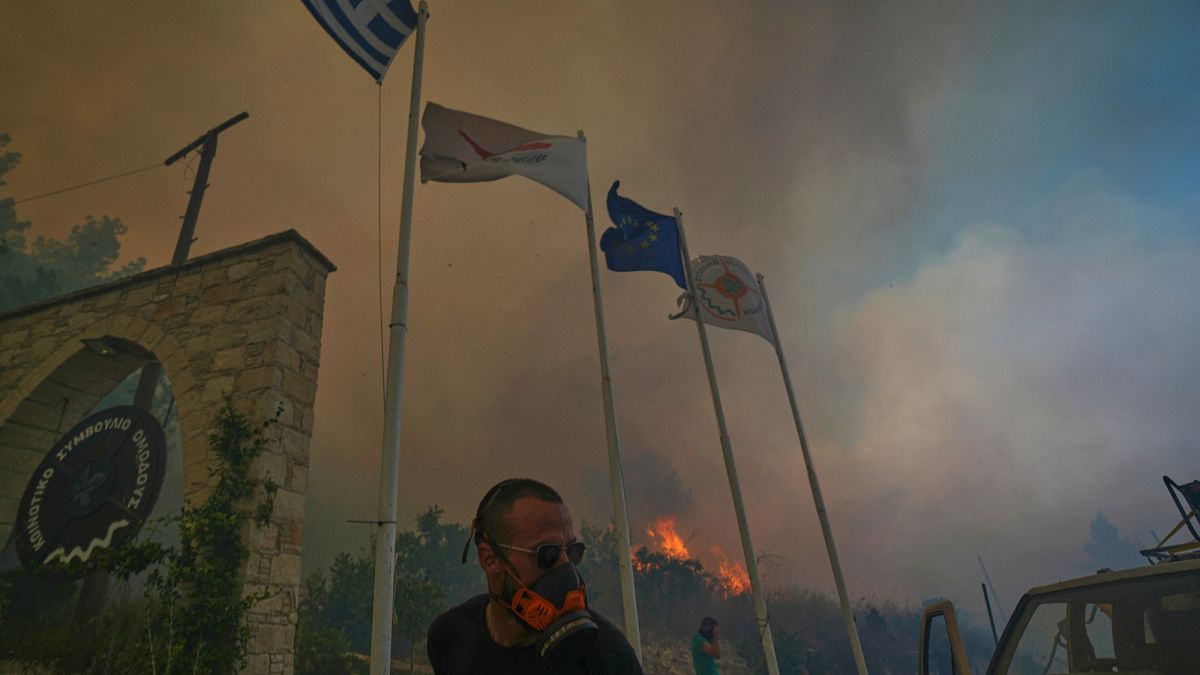
Researchers found that weather conditions which drove deadly fires in Türkiye, Greece and Cyprus were made more intense by climate change. They expect similar results from their ongoing analysis of blazes in Spain.
 ADVERTISEMENT
Weather conditions that fuelled deadly wildfires in Türkiye, Greece and Cyprus were made more intense by climate change, new research has found.
The rapid analysis from World Weather Attribution (WWA) shows that the hot, dry and windy conditions, which drove the spread of blazes in the three countries, were around 22 per cent more intense because of human-caused climate change.
The findings follow data confirming that 2025 has become Europe’s worst year on record for wildfires, with more than a million hectares of land burned. As of 26 August, an area bigger than Cyprus and higher than the total for any other year on record has been ravaged by blazes, according to data from the European Forest Fire Information System (EFFIS).
Researchers warn that the risk of larger, harder-to-control fires will continue to increase if the world continues to burn fossil fuels. These simultaneous blazes are already stretching firefighting resources with more intense events outpacing efforts to adapt.
“These results are concerning. Today, with 1.3°C of warming, we are seeing new extremes in wildfire behaviour that has pushed firefighters to their limit,” says Theodore Keeping, researcher at the Centre for Environmental Policy, Imperial College London.
“But we are heading for up to 3°C this century unless countries more rapidly transition away from fossil fuels.”
Related
Banco de España: How to reclaim money destroyed by wildfires in Spain
Climate change set the scene for deadly wildfires
In June and July, hundreds of wildfires broke out in the eastern Mediterranean.
Türkiye was hardest hit with 17 people killed, among them firefighters who died when winds suddenly changed direction, leaving them trapped by the flames. Two people were killed in Cyprus and one in Greece. Across the three countries, more than 80,000 people were forced to evacuate.
Climate change, researchers say, set the scene for these fires in Türkiye, Greece and Cyprus by influencing the weather in the months, weeks and days leading up to them.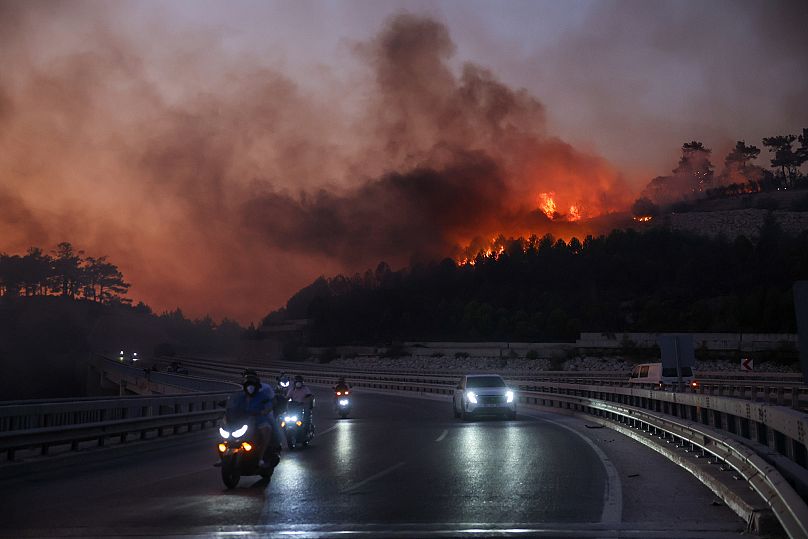 People drive their vehicles past a wildfire raging near Canakkale, northwest Turkey.
Berkman Ulutin/Dia Photo via AP
Total rainfall during winter in the region has decreased by around 14 per cent since the pre-industrial era, before humans began burning fossil fuels. This has led to drier conditions in the summer which, combined with intense dry heat, primed plants to burn.
A week of “highly evaporative” conditions that cause plants to dry out is now around 18 per cent more intense and 13 times more likely due to climate change, the analysis found.
Next, researchers looked at the combination of hot, dry and windy conditions that drove the chaotic spread of the fires. Without climate change, similar events would only occur about once every 100 years. But today, with 1.3°C of warming, they are expected about once every 20 years.
Related
Wildfires devastate nearly 10,000 km2 in 2025 with Spain and Portugal hardest-hitSpanish village reduced to ash as country faces worst wildfire season
These fire-prone conditions were overall made about 10 times more likely and 22 per cent more intense by climate change.
Lastly, they looked at extreme northerly winds known as the Etesian winds. They found an increase in the intensity of high-pressure weather systems, like the one that drove the devastating fires. The findings agree with previous research from the region, which shows that these fire-fanning Etesian winds are becoming stronger.
Europe’s blazes risk overwhelming firefighting efforts
WWA warns that, with hundreds of wildfires occurring at the same time across Europe, firefighting resources are already strained at 1.3°C of global warming.
As of 21 August, the EU Civil Protection Mechanism, which coordinates support during emergencies, had been activated 17 times for wildfires this year, including by Greece, Spain, Bulgaria, Montenegro and Albania over the course of just one week.
“The fire season still has weeks to go in Europe, but it is already the continent’s worst ever recorded with more than a million hectares burned,” says Dr Clair Barnes, researcher at the Centre for Environmental Policy, Imperial College London.
Spain and Portugal have been the hardest hit, together making up around two-thirds of the EU’s total burnt area this year. A sharp increase occurred between 5 and 19 August according to EFFIS data – a period which overlapped with a 16-day heatwave in the Iberian Peninsula.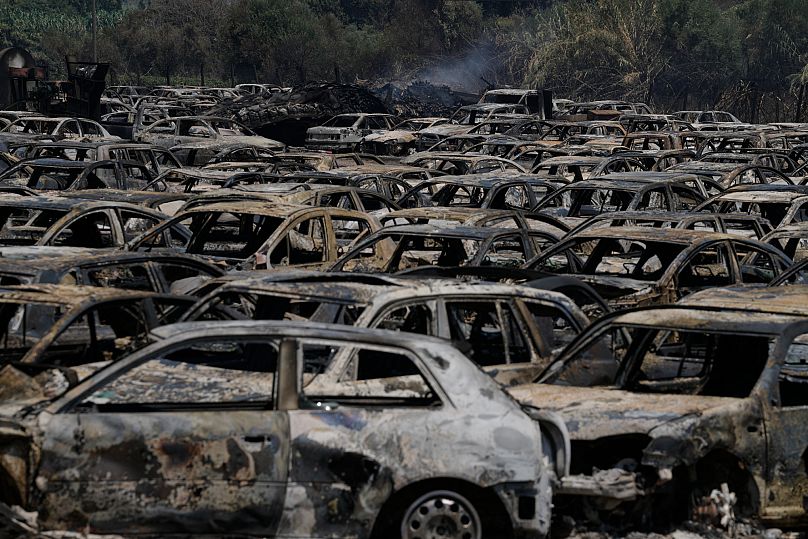 Burned cars are seen at an impound lot in Kato Achaia, during a wildfire near Patras city, western Greece.
AP Photo/Thanassis Stavrakis
Dr Barnes adds that WWA has already started a rapid analysis on the wildfires in Spain, and are expecting to find the fingerprints of climate change there, too.
As the climate warms, researchers say more countries across Europe will need to tackle wildfires that stretch resources. In some places, they say there is a risk that extreme fires could overwhelm efforts to adapt.
In Türkiye, Greece and Cyprus, warming of 2.6°C, which is expected under current global climate policies, would see periods of intense hot, dry and windy conditions become nine times more likely and 25 per cent more intense.
Dr Bikem Ekberzade, researcher at the Eurasia Institute of Earth Sciences, Istanbul Technical University, explains that wildfires in Türkiye peaked unexpectedly in June this year, when the season usually falls within the four weeks from mid-July to mid-August.
“Human ignitions were the primary cause, while meteorological conditions – especially high surface wind speeds – contributed to the rapid spread and severity of the fires.”
Related
What are dry storms? The dangerous weather phenomenon sparking wildfires in a warming world
When vegetation is dry and winds are strong, a single ignition can rapidly turn into a large, hard-to-control wildfire, Dr Ekberzade adds.
“And in a warming world, with more overlap between urban and wildland areas, larger, more severe and fatal fires could soon become the norm.”
Can Europe adapt to increasing wildfire risks?
The study highlights the need for forward-looking efforts to decrease the risk of wildfires starting and spreading.
Currently, strategies in Türkiye, Greece and Cyprus focus on fire suppression with large forces of firefighters and fleets of water bombing planes and helicopters. Nearly 650 firefighters from 14 different countries were deployed ahead of fire season in high-risk areas.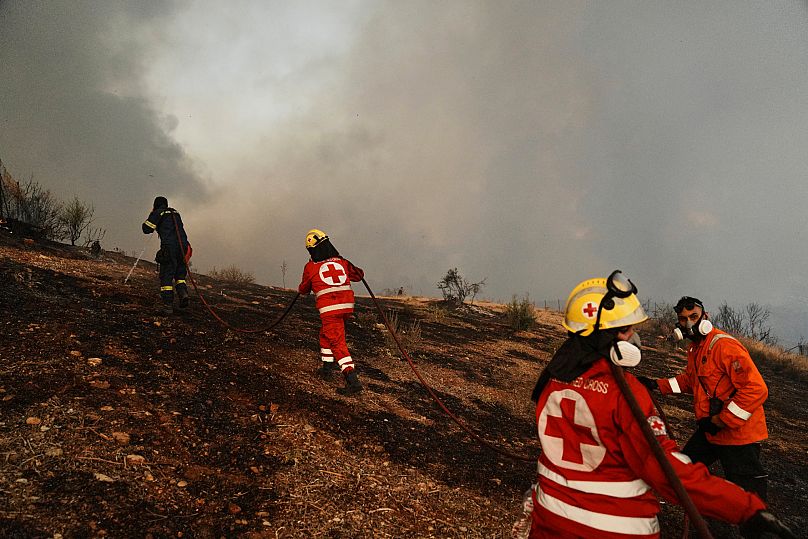 A firefighter and members of the Red Cross try to control a wildfire in Patras city, western Greece.
AP Photo/Thanassis Stavrakis
“Even with hundreds of pre-deployed firefighters, reinforcements from neighbouring countries, and water-dropping planes, the blazes have been devastating,” says Maja Vahlberg, technical advisor at the Red Cross and Red Crescent Climate Centre.
WWA says that while international deployments like this will still be needed, more focus needs to be placed on preventing fires. That includes efforts like improving community fire risk awareness and strategies to manage fuel for blazes, such as removing or altering vegetation.
“The hard work to implement long-term wildfire management strategies that proactively manage fuel availability and empower communities to prepare for wildfires must continue to help keep people safe,” Vahlberg adds.
