A Clinton-appointed federal judge on Wednesday denied the Trump administration’s request to unseal grand jury materials used to charge Jeffrey Epstein with sex trafficking, and instead said that the federal government is the ‘logical party’ to dump said ‘files.’
“The information contained in the Epstein grand jury transcripts pales in comparison to the Epstein investigation information and materials in the hands of the Department of Justice,” US District Judge Richard Berman wrote in a 14-page ruling, in which he said there is “clear precedent and sound purpose” for keeping the records under seal – and that the DOJ failed to show the Epstein papers demonstrate a “special circumstance” which would justify their release.
You do it…
According to Berman, the government has already conducted a comprehensive investigation into Epstein, and has assembled a “trove” of documents, interviews and exhibits. In fact, the government has such a mountain of evidence outside of that case – records which “dwarf” the “70 odd pages” of grand jury materials, that Berman cited it as a “significant and compelling reason” to reject the request.
“The Government is the logical party to make comprehensive disclosure to the public of the Epstein Files,” wrote Berman, adding “By comparison, the instant grand jury motion appears to be a ‘diversion’ from the breadth and scope of the Epstein files in the Government’s possession.”
Berman’s ruling is the latest in a saga pitting Trump – a former Epstein associate whose previous AG Bill Barr ‘presided’ over the death of the disgraced pedophile. Barr’s father, who wrote pedo-centric short stories – hired Epstein to teach children at the Dalton school in the early 1970s when Barr Senior was headmaster.
Were you aware that Bill Barr’s father wrote a book called “Space Relations” which described a planet where oligarchs engaged in child sex slavery? Seems like we should have been made aware of this. Don’t you guys think?!! pic.twitter.com/ttepCWTmuD
— American Artist April (@AmericanaApril) August 4, 2025
Continuing on – Trump has been acting super weird about Epstein since being asked about why he hasn’t released dead pedophile’s client list – something he promised to do on the campaign trail, and which firmly split the base after the president began saying things like ‘why are we still talking about Epstein?’
Making matters worse, the DOJ issued a joint memo last month insisting there’s no Epstein ‘client list,’ and that he definitely killed himself in 2019 while awaiting trial for peddling children to – nobody?
Then, realizing he’d made a yuge mistake, Trump directed AG Pam Bondi to seek the release of the grand jury files mentioned above – only for the judge to reply (paraphrasing); ‘Are you fucking kidding me? You guys have way more on Epstein than we do… you release it.’
Berman also smacked the DOJ around for failing to provide Epstein victims with sufficient notice before filing motions to unseal the grand jury material, calling it “another compelling reason not to unseal.”
Selling your business amidst covid is certainly not all doom and gloom. In fact many businesses can look forward to reaching new realms of respect both in their industry sector and from prospective buyers and lenders post-covid if they play their cards right.
Richard Alvin, Managing Editor of Business Matters talks to Gareth Smith, CEO of Hilton Smythe on this week’s podcast to find out what business owners can action now to future proof a sale. Enjoy this snippet to form an invaluable check list then subscribe and listen to the whole podcast here.
Are you seeing a number of people with distressed businesses? Running out of cash, looking to exit fast?
It’s an interesting time, unprecedented seems to be the buzz word with this pandemic. Yet actually most businesses are in the same boat. We haven’t seen a lot of distressed businesses at the moment. It could happen, with recession what you tend to find is that the businesses that don’t survive will start to struggle in the recovery phase with the majority of them folding at that point.
Do you think corona virus will have a hangover to the value of businesses, this year, next year, in five years time?
Actually I think the opposite may prove itself to be true. The way I’d like to look at it and I’m sure I’m not alone in this, is that if your business has survived something like this, then isn’t it reasonable to say well actually it’s worth more? If you can get through something like this and be on the other side, well then you’re ripe for picking aren’t you? I think it could show that you’ve got a much better business this side of corona virus than going in. Businesses have adapted the way they work to become more efficient, stronger and leaner and if they do that, they will add value invariably over the long term.
So it’s more that there’s a post-corona badge of honour to add to the value and not detract from it?
Yes I think so. It’s tough to say with value because what is a business worth? Well ultimately it’s worth what someone is prepared to pay for it and that’s down to if it’s an individual it might be down to psychology and the desire and want to buy the business, whereas if it’s an acquisition to an existing company that’s also survived corona virus who see it as a higher investment because it’s adding more profit. Until we get through to the other side it’s really tough to direct where the values are going to go.
For our SME audience that might be potentially thinking about selling their business next year, or the year after, what are the real takeaways that they can get from this for preparing their business for sale?
If you want to sell your business in the next year or two, first of all get your accounts in order because we know that lots of businesses like to ask for accounts to pay as little tax as possible, of course the accounts can be manipulated in various ways. Whereas for selling, the important thing is to show as much profit as possible. It’s the first step and you need a good two or three years of doing that, and make sure your processes are well in place. Take the opportunity to take stock of the business and make it better, more efficient and really drive hard the areas you can push – whether that’s outsource marketing, third party suppliers or even your own sales figures and team. Really push it. Use the time to take stock and drive the key performance.The other thing to have as a board or series of managers, is to have both leading and historic KPI’s so you know you’re on track and you know where you’ve been. Make sure you’re as profitable as you can be, watch your cost lines, make sure you’ve got a good manager structure in place and that they know what they’re doing, in other words, take yourself of the business and work out of the business and not in it, and make sure you’ve got key performance indicators showing where the business has been and some leading KPI’s to show where it’s going to measure whether you’re on track.
We’re hearing horror stories about high street lenders not lending for growth or business purchase, how have you found dealing with traditional high street lenders, both at the moment or the six months beforehand. Are the stories we’re hearing correct?
I’ve heard the stories, personally in my experience as a business owner and finance broker I just can’t see that there’s that issue. The banks generally are very good, if the business stacks up you can get really good rates from the banks. We don’t get many rejections but that’s down to the business. It’s all about risk to the banks – the longer the business has traded and the higher the turnover, the more likely is that the risk factor is lower dependent on the business sector of course. If people are struggling to get finance it might be that they don’t have a relationship manager and they’re going through the call centre route, if you’ve not prepared your case correctly you might struggle. Always speak to someone who knows how to apply for finance who can write the application in a specific way so someone looking at it from a credit point of view can see that it makes sense. Take advice.
Deferred payments are now very common place. Would you recommend them?
From a buyer’s point of view it’s very easy to say ‘look your business is doing well, we’ll link the sales price to that performance’. A straight out deferred payment where we say we’ll give you half a million for the business, 250 upfront and 250 deferred over two years again happens quite often, however there’s a lot of risk for the seller in that respect – what if they don’t pay you? Buyers often can’t give a guarantee. We don’t advise people to accept deferred payments for their businesses, if you decide to go ahead and accept this kind of deal I’d say that ultimately you need to be happy with the amount you see on that first payment then fine, because you might never see the rest.
Are there any specifics from a due diligence point of view that our readers should make a point of researching?
Due diligence is so involved and it’s easy to overlook something. I think this is down to having good representation from a lawyer that knows what they’re doing because they’ll make sure the warranties and covenants in the share or sale purchase agreement cover you as a buyer. Surround yourself with the right advisors. Forensic accounting is a key one to show accuracy in the accounts. You wouldn’t believe how many buyers miss out this area. HP lost a shed load of money by not properly investigating the accounts. Environmental due diligence is also something that needs to be considered very carefully. But often the biggest area a buyer fails to look at is the culture of the business and this is because your lawyer or your accountant won’t do it. You’re left to do it yourself. You tend to find then that you’re taking over this business, you’ve no idea what the culture is, and it hits you like a rock when you take it over as the staff will revolt against you, they don’t agree with too many changes too soon.
With Qatar’s arid and dry climate in mind, two Qatar-based eco-friendly tech companies are using innovative climate-resistant solutions to capture moisture from the sky to produce water – one quenches the thirst of humans and the other produces water for crops.
ADVERTISEMENT
Qatar 365 examines sustainability efforts in Qatar. Aadel Haleem spoke with the Interim Leader of Bangladesh and Nobel Laureate, HE Professor Muhammad Yunus, to discuss why the global efforts to protect the planet are failing. The team also stopped by ConocoPhillips’ Global Water Sustainability Center. Johanna Hoes visits two eco-friendly tech companies, Skydrops and agri-tech startup VFarms, who use smart water and food solutions on the ground.
Depression is like one type of sickness, but it can show up in many ways. People might feel it in different ways, and it has many symptoms. Even though it seems different for everyone, we still call it depression.
(adsbygoogle=window.adsbygoogle||[]).push({})
Anxiety is a word that can mean different things. Sometimes, we all feel worried, and that’s when we use the word “anxiety.” But when doctors talk about anxiety, they mean a bunch of conditions that can make you feel nervous or scared.
(adsbygoogle=window.adsbygoogle||[]).push({})
What is depression?
Depression is when a person’s mind doesn’t feel good. It brings a lingering sadness and takes away the interest in things that once brought joy. It’s not just a tough day; it sticks around, making everyday tasks difficult. Sometimes, it even affects the body, making it feel less great and cause of mental illness. Seeking help from people who understand this can create a significant positive change. It’s important to talk to someone who knows about these feelings and can provide the right support.
(adsbygoogle=window.adsbygoogle||[]).push({})
What is anxiety?
Anxiety is when you feel worried or nervous. It’s like that feeling you get before a test or meeting new people, but it’s more serious when it’s a medical thing. It’s not just regular worry; it’s a bunch of conditions where the worry is strong and lasts long, making everyday life tough. Sometimes, it comes with physical feelings like a fast heartbeat or sweating. If someone has a lot of anxiety, they might need some help and support to feel better.
(adsbygoogle=window.adsbygoogle||[]).push({})
Symptoms of Depression
Feeling guilty
Crying a lot
Feeling tired all the time
Thinking about hurting yourself
Eating more or less than before
Finding it hard to think or focus
Not enjoying things you used to like
Having trouble sleeping or sleeping too much
Feeling really sad, hopeless, or super worried
Symptoms of Anxiety
Feeling super stressed out
Feeling stuck or trapped
Getting sweaty or shaky
Feeling cranky or on edge
Being worried and overwhelmed
Feeling like things are out of control
Feeling scared, paranoid, and tense
Worrying a lot and feeling dread
Having trouble breathing and feeling tight in your chest
Types of Depression and Anxiety
Types ofDepression
Major Depressive Disorder (MDD) is when someone feels sad a lot and doesn’t enjoy things they used to like.
Persistent Depressive Disorder (PDD) is a long-lasting sadness that sticks around for a while but is not as strong as intense sadness.
Bipolar Disorder Having times of feeling super happy and then feeling down, with big mood swings.
Seasonal Affective Disorder (SAD) Feeling down, especially in the winter when there’s not much sunlight.
Psychotic Depression Feeling extremely sad, along with having strange thoughts or seeing things that aren’t there,
Postpartum Depression Moms feel very sad and tired after having a baby.
Types ofAnxiety
(adsbygoogle=window.adsbygoogle||[]).push({})
There are different kinds of anxiety disorders, and each one has its signs.
Generalized anxiety disorder is when you worry a lot about many things.
Social anxiety disorder is when you get too worried around other people.
Panic disorder makes you suddenly feel really scared, with symptoms like chest pain and a fast heart.
Phobias are strong fears of certain places or things, like small spaces or animals.
Obsessive-compulsive disorder is when you can’t stop thinking certain thoughts and doing certain things over and over.
Posttraumatic stress disorder (PTSD) usually happens after you’ve been through something really tough. It can make you relive it in your mind or make you feel very anxious when something reminds you of it.
British expat Martin Crozier calls Shenzhen home. Through park runs, maths meetups and family life, he shows how the fast-growing tech city offers both high speed and deep connection.
ADVERTISEMENT
In Shenzhen, a fast-moving tech city in southern China, British teacher Martin Crozier has found more than just a job — he’s built a life.
From leading weekly park runs in Talent Park to hosting monthly “maths jams” in local cafés, he’s created connections between expats and locals. Living in the Shekou district with his family, Martin embraces Shenzhen’s walkability, safety and speed of change.
In a city younger than he is, he’s discovered a surprising sense of home — one grounded in community, curiosity and a love of learning.
Rings can change how you feel. They can make you look special. A diamond ring in Singapore might look different from a simple band. Rings are more than just jewelry. They tell stories. They show who you are. Different rings suit different looks.
Why Rings Matter
Rings are small but powerful. They can be simple or bold. They can be modern or classic. Rings help express yourself. You can style them for any occasion. A ring can make you feel confident. It can make you feel pretty. It can make you feel unique.
Minimalist Rings
Minimalist rings are simple. They are perfect for everyday wear. They are easy to match with any outfit. These rings are not flashy. They are subtle. Minimalist rings are often thin. They might have one small gem. They are not heavy. They are light and delicate.
For Sam Andreano, rental income from a detached accessory dwelling unit (ADU) in his backyard initially helped offset mortgage payments, and later provided a place for his son to land.
“[I] started out as just a regular homeowner,” said Andreano, a resident of Dana Point, Orange County, who began converting his detached garage into an ADU in 2019.
Researching and permitting took a few months, and total build-time was around eight months. He financed it with cash and a refinance. The entire investment, including all labor, materials, city and associated fees, came out to $165,000, and he rented the one-bedroom unit for $2,500 a month.
Now he’s working on a two-story ADU project that he intends to sell as a four-plex.
Amid soaring home prices and a housing crisis—which California leads, by some estimates, with a deficit of more than a million homes—accessory dwelling units (ADUs) now represent a significant and steadily increasing supply of overall housing construction in the Golden State.
A descendant of the post-War “granny flats” or “dowager cottages” intended to house aging relatives, at least half of contemporary ADUs are predestined for the rental market. Most are modest studios or one-bedrooms that can be built at a fraction of the cost of a traditional home, but still command market rate rents.
California issued 30,231 permits for ADUs in 2024, representing 26 percent of all new housing construction, according to statistics provided by the Department of Housing and Community Development.
While the rate of increase has fluctuated, data over the past decade show a steady year-over-year climb. After plateauing in 2019 and 2020 at under 13,000 units, the number jumped to more than 20,000 in 2021, a more than 60 percent increase.
This is largely due to a series of liberalizing state laws that have, over the past eight years, made it much easier for property owners to get projects approved in residential areas originally zoned for single-family homes.
To proponents, the boom is a bulwark against a worsening affordable housing crisis, even a corrective measure to decades of exclusionary zoning.
To critics, it overburdens infrastructure, threatens property values, degrades aesthetics, and represents an unprecedented loss of community control over residents’ quality of life.
ADUs Versus Traditional Housing
Far cheaper and easier to build than traditional housing, ADU construction has grown consistently because it is not tied to state subsidies the way larger developments are, explains Celeste Goyer, vice president of research and operations for the nonprofit Casita Coalition, which advocates for affordable housing in California.
“Even in times when the state budget is tight and the subsidies may be reduced, ADU production keeps ticking on. They kept growing during the pandemic, even when construction costs were high and interest rates were high, because ADUs use the existing land—they allow you to work with what you’ve got,” she said.
Advocates of ADU liberalization say the dwellings are part of a broader strategy to confront the state’s affordable housing crisis, which is exacerbated by high construction costs, regulatory barriers, and zoning restrictions.
“ADUs are not intended to replace traditional subsidized affordable housing for renting,” Goyer said. “There’s still a lot of multifamily housing properties being built, and that’s where deed-restricted affordable housing for rentals is being produced.”
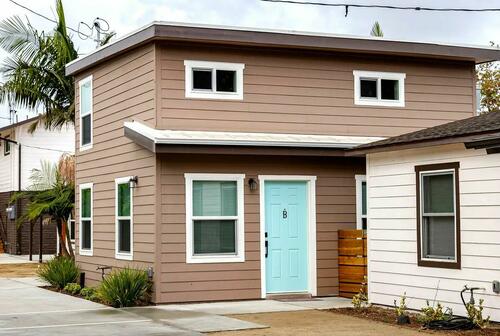
An accessory dwelling unit (ADU) in Costa Mesa, Calif., on Nov. 30, 2023. ADU construction has steadily increased in California in recent years to help meet the demand for affordable housing. In 2024, ADUs accounted for 26 percent of all new housing construction in California, according to official statistics. John Fredricks/The Epoch Times
She points to studies showing that ADUs are more affordable to low-and moderate-income tenants, typically renting for “much less—often half as much—as a standard single home.”
“Sixteen percent are rented to someone you know at low or no cost—that’s incredibly important housing,” Goyer said, calling ADUs a grassroots approach to housing family members and elders priced out of assisted living.
According to a 2021 study from the University of California, Berkeley, 51 percent of California’s new ADUs are income-generating rental units, while “very few”—15 percent—house senior citizens. Around 11 percent of new ADUs provide housing for school-aged children.
‘A Neat Little House’
At a fraction of the cost of a traditional home, unburdened by land costs, and relatively easy to approve, ADUs are attractive for both homeowners and emerging, small-scale developers.
Dennis Robinson, a resident of Anaheim, Orange County, built his first ADU in 2020, on a personal rental property.
“Then a neighbor saw what was going on,” he said. “They saw that it was just a neat little house in the backyard.”
They asked him to build one for them, which led to requests from friends and family. Within eight months, he was building full-time. So far, he’s done 60.
“Getting two ADUs, or even three, is fairly simple now across most Single Family Zoned houses,” he said.
This is thanks to SB9, enacted in 2021, which allows up to four dwellings on almost any lot zoned for a single-family residence. In 2024, SB1211 increased the number of detached ADUs allowed on lots with multi-family structures to eight.
Typically, it takes Robinson 30 to 60 days to submit a project for approval, and construction is completed within a year.
“Homeowners generally do not need to live there,” Robinson said.
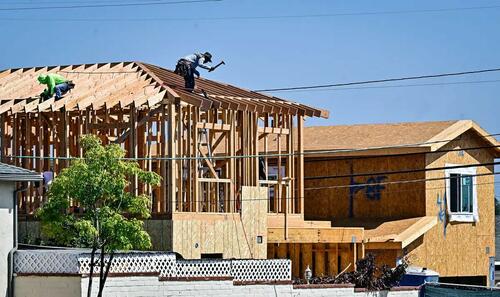
Construction workers work on the roof of a house in Alhambra, Calif., on Sept. 23, 2024. In recent years, state laws have made it easier for property owners to get accessory dwelling units approved in residential areas originally zoned for single-family homes. Frederic J. Brown/AFP via Getty Images
But in the state’s patchwork of local ordinances, homeowners can run into other obstacles.
When Wesley Yu, a resident of East Palo Alto, sought to build a new home and a detached ADU to house extended family, the city approved splitting the lot under SB9. However, because he was building two new structures, it refused to approve the permit unless he made one an “affordable” rental, or paid a one-time fee of more than $50,000.
Yu recently sued the city in federal court, drawing on a previous Supreme Court ruling. How that case is decided, and if the issue is taken up by the highest court, could have broader impacts for the state’s many jurisdictions—more than 170, according to some counts—with inclusionary zoning ordinances.
Zoning and Density
After years of debate over zoning and density, California’s recent ADU legalizations have effectively mandated reform by overriding existing local laws, requiring cities and counties to approve projects ministerially, without a discretionary review process.
According to a 2024 California Zoning Atlas Report from U.C. Berkeley, 95.8 percent of all residential land is zoned as single-family-only, “severely constraining the spatial possibilities for denser and more affordable housing.” The average is lower when unincorporated areas are removed, around 82 percent.
The study concludes impacts are racially exclusive: Areas with more restrictive zoning have fewer non-white residents.
Areas with restrictive zoning also typically have higher land and property values, higher production costs, and lower development rates. A 2025 study from the George W. Bush Institute notes the impact on affordability: “Highly restrictive policies have outsized effects on supply and prices in the lower-tier segment of the market. This is partly because the direct effects of cost-increasing rules are larger in percentage terms when homes are relatively small and inexpensive. It’s also because overly restrictive rules undermine or reverse the filtering-down process that accounts for most housing affordable to lower-income families.”
The same study ranks the top 100 largest metro areas in the United States from the “most pro-growth” down to the “most restrictive.” Nine California cities—including San Francisco, Sacramento, and San Diego—feature in the bottom 15.
Along with other states including Oregon, California has in recent years doubled down on corrective policies meant to increase affordability, in large part by increasing density.
But eliminating single-family zoning citywide in places including Minneapolis, Portland, Oregon, and California cities, the study notes, has not produced substantial positive results.
For example, Minneapolis eliminated single-family zoning, but added only 23 “plexes” or small multi-family units in the first two years, and other trends suggested “reform allowing multifamily development in commercial areas has been far more effective than permitting complexes in formerly single-family neighborhoods.”
Portland fully eliminated single-family zoning and legalized ADUs everywhere in the city. That, plus other reforms, added only around 0.6 percent to housing stock between 2021 and 2024, according to the study.
Canned talk show host Stephen Colbert’s leftist audience proved how demented and sick they are by loudly booing when Colbert addressed stupid online rumours of President Trump’s demise and lamented that the President “is very much alive.”
Colbert stated “It’s great to be back with all of you. We were on vacation for three weeks, but I want you to know I take this job seriously, and while we were gone, I still closely followed all the news that was on any cocktail napkin.”
“When I came back in the office, I was shocked to learn that this weekend, the biggest story was, ‘Frenzied social media rumors speculating whether Donald Trump had died,’” The Late Show host continued, prompting the lunatics in the audience to cheer.
Colbert has to rein in his audience after they start booing news that Trump is still alive: “No! We like our presidents alive.” pic.twitter.com/ICyhzLOIc3
“For the record, Donald Trump is very much alive,” Colbert announced, sending the twisted audience into loud boos.
“No, we like our presidents a lot,” Colbert responded, adding, “Donald Trump is very much alive, and this whole crazy rumour started simply because Trump has zero events on his schedule Wednesday, Thursday, or Friday.”
The host then did a ‘comedy’ bit that wasn’t at all funny as usual.
“And one of the only signs that he might still be around was ‘music in the Rose Garden, which the White House confirmed was the president’s music, which I gotta say, is not the strongest proof of life,” Colbert further blathered.
Colbert then mimicked a White House staffer, stating “Yes, nurse, I do see that flatline, but the patient is clearly alive, because his iPhone is playing ‘Papa Loves Mambo.’”
HA HA HA. Sooooo hilarious.
Exhibit #2,567,432 on why he’s being canceled. It’s a shame it’s a prolonged cancel…
I know two wrongs do not make a right, yet when a political person on the left dies, dont expect kind words from the right. These people are insufferable.
As we highlighted yesterday, Vice Presidential loser Tim Walz appeared excited at the prospect of Trump being ill or dying, telling a crowd “You get up in the morning – the last few days, you woke up thinking there might be news! Just saying…There WILL be news, some time!”
Walz’s remarks prompted CNN’s Scott Jennings to go nuclear on the Democratic Governor, labelling him a “complete piece of shit.”
* * *
Your support is crucial in helping us defeat mass censorship. Please consider donating via Locals or check out our unique merch. Follow us on X @ModernityNews.




 ADVERTISEMENT