Tag: St

  • Q2 GDP Revised Sharply Higher As Data Center Investments Sharply Boost Growth

    Q2 GDP Revised Sharply Higher As Data Center Investments Sharply Boost Growth

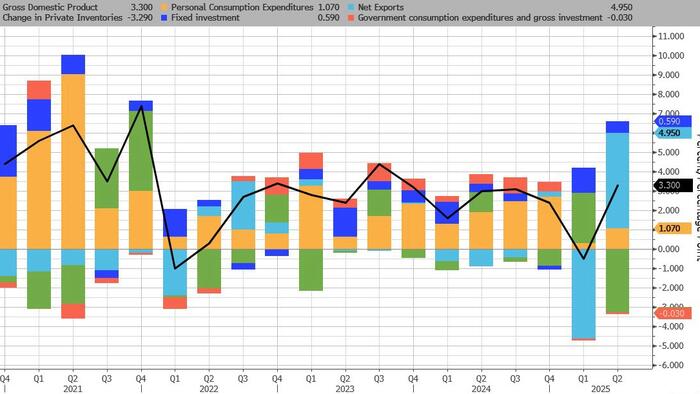
    While the number mostly reflects a reversal of the tariff frontrunning seen in Q1 (which dragged GDP sharply lower due to a surge in imports), moments ago we got the BEA’s first revision of the Q2 GDP print which already came in red hot at 3.0% one month ago… and was just revised even redder and even hotter to 3.3%, beating estimates of a 3.1% print…

    … and the highest quarterly print since Q3 2023.

    According to the BEA, the 0.3% upward revision from the original 3.0% print reflecting upward revisions to investment and consumer spending that were partly offset by a downward revision to government spending and an upward revision to imports. 

    Taking a closer look at the composition, we find the following:

    • Personal Consumption increased to 1.07% of the bottom line GDP print, up from 0.98% in the original print
    • Fixed Investment jumped substantially from just 0.08% to 0.59% of the bottom-line print. We warned one month ago that either this number suggested that hyperscalers were lying or the number would be revised substantially higher. It was the latter.
    • The change in private inventories was modest, from -3.17% of the final GDP number, to -3.29% as companies depleted stocks purchased during the tariff build up period.
    • Net trade (exports and imports) added 4.95% to GDP, virtually unchanged from the 4.99% original print, and a mirror image of the -4.62% hit to GDP from Q1.
    • Finally, government flipped from adding a modest 0.08% to GDP, to subtracting 0.03%

    More important than the GDP print even was the sharp upward revision in real final sales to private domestic purchasers, the sum of consumer spending and gross private fixed investment, which surged 1.9% in the second quarter – largely thanks to the huge upward revision in fixed investment – and up 0.7% from the previous estimate.

    Finally, the price index for gross domestic purchases increased 1.8% in the second quarter, revised down 0.1% from the previous estimate. The personal consumption expenditures (PCE) price index increased 2.0%, revised down 0.1% from the previous estimate. Excluding food and energy prices, the PCE price index increased 2.5%, the same as previously estimated.

    Overall, this was a very solid GDP print, with the upward revision not due to another boost in spending but rather the all important investment on data centers, which also helped almost double Real Final Sales from 

    Loading recommendations…
  • Apple Pulls Back in China: Shuts Long-Standing Store Amid iPhone Decline

    Apple Pulls Back in China: Shuts Long-Standing Store Amid iPhone Decline

    Apple’s Big Leap Into Chinese Market Roughness

    Apple has been feeling the pressure from all sides in China—think rising Chinese rivals like Huawei, Xiaomi, and Vivo, a deepening deflation wave, waning consumer enthusiasm, and the bubbling tensions between China and the United States. The nearest example of this squeeze is the latest move last month: Apple is finally closing one of its own brick‑and‑mortar stores in the homeland of billions.

    Why the Closure Matters

    Back then, back in 2008, Apple opened its first outlet in Beijing’s Sanlitun district, looking bright and brilliant. Fast‑forward to July 29th, the Apple website announced that the Dalian Centennial City Shopping Center store would shut its doors at 8 p.m. on August 9th. This closure marks a historic first for Apple in China—closing a directly‑operated shop for the first time since it opened.

    The Triggers Behind the Move

    • Chinese Competition – The tough business landscape with the likes of Huawei, Xiaomi, and Vivo has Apple’s market share under constant strain.
    • Economic Downturn – China’s slowdown and deflation mean fewer people are willing to splurge on an Apple device.
    • Trade Tensions – The rocky relationship between China and the U.S. adds extra headaches for Apple’s strategy.
    What the Media Is Saying

    State‑run outlet Securities Times (abbreviated ST) called the move “highly unusual.” Their article highlighted that this was the first instance of Apple pulling the plug on an in‑country shop that it operated directly, underscoring how much the situation has shifted since those “first‑ever” days in 2008.

    Looking Ahead

    With Apple stepping back from a physical location, the company will have to rethink how it connects with consumers in a market where palms are moving toward online sales and local competitors are popping up at every corner. It’s a big test for the tech giant’s adaptability—will they keep crushing it or will the competition finally overtake the premium brand?

    Apple’s Shanghai Retreat: The Real Reason Behind the Store Closure

    Apple’s spokesperson cut the red carpet for the closure of one of its Dalian Centennial City lobbies by citing the sudden exodus of local retailers from the area. “We’re just scaling back where not all partners can stay,” the company said.

    Why This Matters in a Giant Hotspot

    Apple keeps 41 outlets in China, a modest 10% slice of its 530-plus stores across the globe. Yet the latest numbers from IDC paint a stark picture: China’s smartphone market shrank in Q2, with four of the top five brands reporting fewer shipments as buyers grew more cautious. Apple found itself the fifth-ranked brand, trailing behind domestic giants like Huawei, Xiaomi, and Vivo.

    A Shift In Production—and It’s Not a Pity Party

    Canalys data for the quarter ending June shows Apple’s friendshoring strategy taking shape: production is pulling away from China and toward India. In a surprising first, India became the largest exporter of smartphones to the U.S. with 44% of all shipments. Vietnam followed closely as the second‑largest exporter.

    ST’s take: “The Chinese smartphone market is expecting more pressure down the road.”

    Is This a Red Flag for Tim Cook?

    One thing’s clear: the shutdown is not a sign of triumph. It reflects the relentless erosion of iPhone market share in China by local players. The change is best interpreted as Apple tightening its belts in a market that’s been turning frigid.

    In Short…
    • Apple’s Dalian store closed due to partner withdrawals.
    • China’s smartphone sales are down; Apple ranks fifth.
    • Apple is shifting production to India; Indian exports hit 44% to the U.S.
    • The store exit signals a cautious retreat from a contested territory.

    It’s a reminder that even the most polished brands must adapt—or risk being left behind by local competition and shifting supply chains.

  • London‑Berlin Direct Trains Near Reality Under New UK‑Germany Accord

    A New Rail Link Will Slap the Flight Path and Hit the Green High‑Speed

    Why You Might Trade Your Airline Seat for a Train Seat

    • Speedy: The corridor promises a London‑to‑Berlin hop in just under four hours—no “tail‑wind” needed.
    • Low‑Carbon: Trains churn out a fraction of the CO₂ compared to aircraft, making the planet sigh a sigh of relief.
    • Chill Factor: Spacious seats, wi‑fi that actually works, and a “you can bring as many groceries as you want” vibe.

    What’s the Real‑Deal?

    Air travel glows with jet‑lag glamour and in‑flight entertainment, but if you’re ready to swap a few extra hours on the runway for a sleek, scenic ride that keeps the Earth a tiny bit happier, this train could be your new go‑to.

    All Aboard: London‑to‑Berlin Trains Might O‑kay Soon!

    Picture this: you hop on a train in London at St Pancras, feel the clickety‑clack, and next thing you know you’re chilling in Berlin. Sounds like a dream? Not anymore, thanks to a brand‑new pact between the UK and Germany.

    What’s the Deal?

    • Chancellor Friedrich Merz and Prime Minister Sir Keir Starmer nailed down a “first‑of‑its‑kind” treaty.
    • The treaty’s main mission? Smash the legal and logistical potholes that have kept a straight‑line rail link from ticking over.
    • Early goal: dash from London to Frankfurt and Cologne on Eurostar‑style super‑fast trips.
    • Nice future plan: extend the route all the way to Berlin (super‑broadway baby travel).
    • Next 10 years—step‑by‑step road‑map via a joint taskforce of transport whizzes from both sides, tackling border checks, safety standards, and all the pesky details that keep trains on the right track.

    Behind the Scenes

    It’s not just a ticket‑to‑ride hype. The taskforce will dive into:

    • Elevating border and security protocols so passengers can hop on without a passport‑maze.
    • Co‑ordinating with rail operators to meet technical and commercial demands—think safety, speed, and a sprinkle of class.
    • Ensuring every steel rail rung beats the beat of both nations’ standards.

    Bottom line: The UK and Germany are dancing to a pivotal beat that could transform cross‑channel commuting from a jet‑setter fantasy into a everyday reality. Stay tuned, train‑walkers, the rails are getting ready to roll!

    Could a direct rail link cut train journey times?

    Lights, Camera, Trains: Eurostar’s Grand Plan to Beat Take‑Aways

    Ever tried to get from the Queen’s city all the way to the German capital and felt like you’d walked across Europe? It’s quick—well, sort of. The current rail routes are a bit of a marathon:

    • London to Frankfurt: 8–9 hours, with at least one change.
    • London to Berlin: up to 11 hours, plus two to three transfers.

    So, where’s the hustle? Eurostar’s latest headline‑grabber: a direct line from London straight into Germany and Switzerland. They’re calling it the dawn of a “new golden age of international sustainable travel.” Green, fast, and way cheaper than those airport queues.

    When the Train Comes Out of Hibernation

    These shiny new tracks are slated to roll out in the early 2030s. By then, you’ll be able to hop on a train that could shave a four‑hour leg off the current round of two stopovers.

    • London → Frankfurt: down to about 5 hours straight away.
    • London → Berlin: the same speed‑up magic on the horizon.

    In a world where airlines still dominate the skies, Eurostar’s goal is clear: make trains the first choice for city‑to‑city journeys. If you’re looking for a sustainable way to travel fast—and maybe even catch a scenic view—keep an eye on the rails; they’re about to get a major upgrade.

    A ‘faster, more convenient and significantly greener’ alternative

    html

    All Aboard: Britain’s New Expressway to Berlin

    Picture this: you’re lounging in London, sipping your afternoon tea, and in a single, smooth ride you’re on your way to experience the concrete‑stone memories of the Brandenburg Gate, the grim history of the Berlin Wall, and even Checkpoint Charlie. No jet lag, no airport lines—just the gentle hiss of a train, a bit of scenery, and a dash of continental adventure.

    The Big Deal

    Transport Secretary Heidi Alexander is rolling out the red carpet for this new era, declaring that “our new rail route could offer an alternative to flying within the next decade.” She’s got optimism in her hair and a future brimming with faster, greener journeys.

    • Speed: Skip the queue at the airport; the train will reach Berlin in about seven hours, a serious time‑saver compared to a cramped flight.
    • Convenience: Direct from London to Berlin—no layovers or visa headaches.
    • Green thumbs up: Trains chew up far less fuel than jets, slashing greenhouse emissions and keeping the sky blue.
    • Comfort: Spacious seats, power outlets, the ability to stretch your legs—train travel is the ultimate luxury of the 21st century.

    Alexander’s Vision

    She warns that this agreement could do more than just phase out plane trips. “It has the potential to fundamentally change how millions of people travel between the two countries,” she says—meaning millions of email notifications will be synced to a new Train App 2.0. It’s the kind of change that will generate buzz in office gossip, wanderlust planners, and Instagram reels alike.

    What’s Next?

    By 2026, train enthusiasts and routine commuters alike can look forward to:

    1. Booking seats via a user‑friendly portal—no more mystery luggage restrictions.
    2. Entering a fresh age of cross‑channel charm, complete with pubs and coffee shops along the route.
    3. Refreshing the image of Britain as a hub in a better‑connected continent.

    So, strap in, dear traveler. The destination is unmistakable; the route is thrilling. Get ready to trade the rigid airconditioned plane for a relaxed, panoramic ride that’s sure to unroll the continent’s stories (and maybe even a few jokes along the way).

    Opening up e-gates to frequent travellers

    Smooth Sailing: UK‑Germany E‑Gate Plans & More

    What’s the scoop?

    • e‑gate access for frequent flyers – Germany will let UK passengers slip through passport e‑gates at airports before the end of summer.
    • Bye‑bye, manual stamping – since Brexit, UK travellers had to stand in line for those tedious passport stamps. The new treaty aims to ditch that hassle.
    • Fast‑track for everyone soon – the hope is to extend this quick‑entry perk to all travellers as soon as possible.
    • School exchange on the rise – the agreement also opens the door to expanding study‑tour programmes between the two nations.

    Why it matters

    Imagine zipping through the gate without a single break in your coffee‑drinking rhythm. That’s the future the treaty promises: no more queueing, no more stamping, and a chance for students to swap cultures without the paperwork headache.