Tag: typically

  • Wisdom Teeth: Everything You Need to Know – Health Cages

    Wisdom Teeth: Everything You Need to Know – Health Cages

    Introduction:

    Wisdom teeth, also known as third molars, are the last set of teeth to emerge, typically appearing in late adolescence or early adulthood. While some people may experience no issues with their wisdom teeth, many face complications due to their late arrival and limited space in the mouth. These problems can lead to discomfort, infection, and other dental issues if not addressed promptly. 

    (adsbygoogle=window.adsbygoogle||[]).push({})

    In this blog, we’ll discuss these topics:

    (adsbygoogle=window.adsbygoogle||[]).push({})

    Wisdom Teeth: What Are They?

    Most people have four wisdom teeth, one in each corner of the mouth. They typically emerge in late adolescence or early adulthood, around ages 17 to 25.

    (adsbygoogle=window.adsbygoogle||[]).push({})

    While they can be beneficial for chewing if they align properly, many people experience issues because there often isn’t enough space in the mouth to accommodate them. This can lead to impaction, misalignment, crowding, or other dental problems. In such cases, dentists often recommend their removal to prevent complications.

    (adsbygoogle=window.adsbygoogle||[]).push({})

    How Come They’ve Named Wisdom Teeth?

    Wisdom teeth got their name because they typically appear when people are older and supposedly wiser, usually in their late teens or early twenties. This age is associated with increased maturity, hence the term “wisdom.”

    Common Issues with Wisdom Teeth

    Wisdom teeth, also known as third molars, typically emerge in late adolescence or early adulthood. They often cause various issues due to their late emergence and limited space in the mouth. Here are some common problems associated with wisdom teeth

    (adsbygoogle=window.adsbygoogle||[]).push({})

    1. Impaction

    • Description: Wisdom teeth may become impacted if there isn’t enough room for them to emerge properly. They can be trapped within the jawbone or gums.
    • Types:
      • Fully impacted: Completely stuck within the jawbone.
      • Partially impacted: Partially emerges but can’t fully break through the gums.

    2. Crowding

    • Description: Emerging wisdom teeth can push against other teeth, causing crowding or shifting of the existing teeth.
    • Impact: This can affect alignment and may require orthodontic treatment.

    3. Cysts and Tumors

    • Description: A sac filled with fluid, called a cyst, can form around the impacted wisdom tooth. Rarely, these cysts can lead to tumors.
    • Impact: This can damage the jawbone, teeth, and nerves.

    4. Tooth Decay

    • Description: Partially emerged wisdom teeth create spaces that are hard to clean, making them prone to cavities.
    • Impact: Leads to tooth decay and gum disease.

    5. Gum Disease

    • Description: Partially erupted wisdom teeth can create pockets in the gums where bacteria can grow.
    • Impact: This can lead to gum inflammation and infection (pericoronitis).

    6. Alignment Issues

    • Description: The pressure from emerging wisdom teeth can alter the alignment of teeth.
    • Impact: This can undo orthodontic work or cause new alignment problems.

    7. Pain and Discomfort

    • Description: Pain is a common issue, often due to pressure on adjacent teeth, infections, or cysts.
    • Impact: Can cause significant discomfort and interfere with daily activities.

    8. Sinus Problems

    • Description: Upper wisdom teeth are close to the sinuses, and their roots can affect sinus cavities.
    • Impact: This can cause sinus pain, pressure, and congestion.
    Wisdom Teeth: Everything You Need to Know - Health Cages

    Symptoms of Problematic Wisdom Teeth

    Recognizing the symptoms of problematic wisdom teeth is important for timely intervention and treatment. Here are some common symptoms to watch for

    1. Pain and Discomfort

    • Location: Pain at the back of the mouth, behind the molars.
    • Description: This can be a constant dull ache or sharp pain that comes and goes.

    2. Swelling and Redness

    • Gums: Swollen, red, or tender gums around the wisdom teeth.
    • Face: Swelling in the jaw or cheeks.

    3. Bad Breath

    • Cause: Bacteria accumulating around partially erupted teeth can cause persistent bad breath (halitosis).

    4. Difficulty Opening the Mouth

    • Description: Limited ability to open the mouth due to swelling or pain in the jaw muscles.

    5. Unpleasant Taste

    • Cause: Infection or food particles trapped around the wisdom teeth can cause a foul taste in the mouth.

    6. Headaches

    • Cause: Pressure and misalignment from impacted wisdom teeth can lead to tension headaches.

    7. Stiff Jaw

    • Description: Jaw stiffness or difficulty moving the jaw.

    8. Infection Signs

    • Symptoms: Fever, swollen lymph nodes, and pus around the affected area.

    9. Crowding and Shifting of Teeth

    • Description: Noticeable changes in the alignment of teeth, often causing discomfort.

    10. Sinus Issues

    • Symptoms: Sinus pain, pressure, congestion, and frequent sinus infections, especially with upper wisdom teeth.

    Treatment and Extraction of Wisdom Teeth Issues

    Treatment and extraction of problematic wisdom teeth depend on the severity of the issues and the symptoms experienced. Here’s an overview of common treatments and the extraction process:

    Non-Surgical Treatments

    Pain Relief

    • Over-the-counter Medications: Ibuprofen or acetaminophen can help alleviate pain and reduce inflammation.
    • Prescriptions: For severe pain, a dentist may prescribe stronger pain relievers.

    Antibiotics

    • Usage: Prescribed if there’s an infection around the wisdom teeth.
    • Duration: Typically taken for a course of 7-10 days to clear the infection.

    Mouth Rinses

    • Salt Water Rinse: Helps reduce inflammation and cleanse the area.
    • Antibacterial Mouthwash: Can help reduce bacteria and prevent infection.

    Surgical Treatments

    Pre-Surgery Preparation

    • Consultation: Initial visit with an oral surgeon or dentist to discuss symptoms, review x-rays, and plan the extraction.
    • Medical History: Providing a comprehensive medical history, including any medications being taken.
    • Instructions: Pre-surgery instructions, such as fasting before surgery, if general anesthesia is used.

    Anesthesia

    • Local Anesthesia: Numbs the specific area where the tooth will be removed.
    • Sedation Anesthesia: Administered through an intravenous (IV) line to calm the patient.
    • General Anesthesia: Patient is made unconscious during the procedure.

    Extraction Procedure

    • Incision: A small incision is made in the gum to expose the tooth and bone.
    • Bone Removal: Sometimes a small amount of bone around the tooth needs to be removed.
    • Tooth Sectioning: The tooth may be divided into sections to make removal easier.
    • Extraction: The tooth is gently extracted from its socket.
    • Stitches: The incision may be closed with stitches to aid healing.

    Post-Surgery Care

    • Pain Management: Prescribed painkillers or over-the-counter pain relievers.
    • Swelling Reduction: Applying ice packs to the outside of the cheek intermittently.
    • Rest and Recovery: Resting for at least 24 hours and gradually resuming normal activities.
    • Diet: Eating soft foods and avoiding hard, crunchy, or spicy foods.
    • Oral Hygiene: Keeping the mouth clean with gentle brushing and rinsing with salt water.

    Follow-up

    • Post-operative Check: Follow-up appointment to monitor healing and remove any stitches if necessary.
    • Complications: Monitoring for signs of complications such as dry socket, infection, or excessive bleeding.

    Alternative Treatments

    • Coronectomy: Partial removal of the tooth’s crown, leaving the roots in place, sometimes recommended if the roots are too close to nerves.

    Potential Complications

    • Dry Socket: A painful condition that occurs if the blood clot at the site of extraction is dislodged.
    • Infection: Signs include fever, severe pain, pus, or swelling.
    • Nerve Damage: Rarely, damage to the inferior alveolar nerve can cause numbness or tingling in the lip, tongue, or chin.

    Recovery Tips

    • Hydration: Drink plenty of water, avoiding alcohol, caffeine, and hot beverages.
    • Activity: Limit physical activity to avoid dislodging the blood clot.
    • Smoking: Avoid smoking as it can delay healing and increase the risk of complications.
    Wisdom Teeth: Everything You Need to Know - Health Cages

    Preventive Care

    Preventive care for wisdom teeth involves regular dental check-ups and good oral hygiene practices to minimize the risk of complications. Here are some preventive strategies

    Regular Dental Check-Ups

    1. Routine Visits
    • Frequency: Schedule regular dental visits every six months or as recommended by your dentist.
    • Purpose: Early detection of potential issues with wisdom teeth.
    1. X-rays
    • Dental Imaging: Regular x-rays can monitor the development and position of wisdom teeth.
    • Timing: Especially important during late adolescence when wisdom teeth typically start to emerge.

    Good Oral Hygiene Practices

    1. Brushing
    • Frequency: Brush teeth at least twice a day.
    • Technique: Use a soft-bristled toothbrush and fluoride toothpaste. Pay special attention to the back of the mouth where wisdom teeth are located.
    1. Flossing
    • Daily: Floss between all teeth, including the back molars.
    • Technique: Gently slide the floss between teeth and curve it around each tooth to remove plaque and food particles.
    1. Mouthwash
    • Antibacterial Rinse: Use an antibacterial mouthwash to reduce bacteria and plaque buildup.
    • Salt Water Rinse: Periodic rinsing with warm salt water can help maintain gum health and reduce inflammation.

    Diet and Lifestyle

    1. Healthy Diet
    • Balanced Nutrition: Maintain a balanced diet rich in vitamins and minerals, which support oral health.
    • Limit Sugary Foods: Reduce the intake of sugary and acidic foods and drinks that can lead to tooth decay.
    1. Hydration
    • Water: Drink plenty of water to help wash away food particles and bacteria.
    • Avoid Sugary Drinks: Limit consumption of sodas and sugary beverages.

    Avoid Harmful Habits

    1. Smoking
    • Impact: Smoking can increase the risk of gum disease and complicate oral health.
    • Cessation: Seek help to quit smoking for better overall and oral health.
    1. Chewing Hard Objects
    • Avoidance: Avoid chewing on hard objects like ice or pens, which can damage teeth.

    Early Intervention

    1. Monitoring
    • Growth: Regularly monitor the growth and alignment of wisdom teeth, especially if they begin to cause discomfort.
    • Consultation: Consult a dentist promptly if you notice any symptoms such as pain, swelling, or changes in teeth alignment.
    1. Preventive Extraction
    • Assessment: Your dentist may recommend removing wisdom teeth before they cause significant problems, particularly if there’s limited space in the mouth or if they are impacted.

    Education and Awareness

    1. Understanding Risks
    • Education: Be aware of the potential issues that wisdom teeth can cause.
    • Awareness: Recognize symptoms early and understand the importance of preventive care.
    1. Professional Advice
    • Consultation: Regularly seek advice from dental professionals regarding the best preventive practices for your specific needs.

    Conclusion

    In conclusion, wisdom teeth, or third molars, can cause a variety of dental issues due to their late emergence and limited space in the mouth. Common problems include impaction, crowding, cysts, tooth decay, gum disease, alignment issues, pain, and sinus problems. Recognizing the symptoms of problematic wisdom teeth, such as pain, swelling, bad breath, and difficulty opening the mouth, is crucial for timely intervention.

    Faq’s 

    Q1. What are wisdom teeth?


    A1. Wisdom teeth are the last molars at the back of your mouth. They usually appear when you’re in your late teens or early 20s. This is normal as your mouth develops.

    Q2. Why are they called wisdom teeth?


    A2. They’re called wisdom teeth because they come in when you’re older and supposedly wiser. Healthy wisdom teeth can help with chewing.

    Q3. What age do wisdom teeth come in?


    A3. Wisdom teeth are the last adult teeth to grow, usually between ages 17 and 25. Not everyone gets them, and they may need to be removed if they cause problems like pain or infection.

    Q4. Is wisdom tooth painful?


    A4. Wisdom teeth usually don’t cause pain unless there’s an issue. Pain can happen as they grow in, breaking through the gums, which can cause swelling and soreness.

    Q5. Why do humans get wisdom teeth?


    A5.
    Anthropologists believe early humans had these extra molars to help chew tough, uncooked foods like roots and raw meat. Their larger jaws had more room for these teeth, aiding in eating.

    Healthy living: A journey worth giving. Explore more on our blog:

  • Which of the Following Is Not a Cloning Vector for Bacteria

    Which of the Following Is Not a Cloning Vector for Bacteria

    What’s the Deal with Vectors?

    Picture a vector as the funky messenger that shuttles DNA from one place to another. In the world of molecular biology, it’s the Ultimate Delivery Service – basically a DNA courier that brings your awesome gene of interest straight to the bacterium’s cargo bay. Let’s dive into the nitty‑gritty while keeping the mood light and the science front‑and‑center.

    Cloning Vectors – Introduction

    Imagine you’ve found a superhero gene, the one that could cure a disease, boost crop yields, or even make your taste buds dance. You need a reliable way to carry this gene into a host organism. That’s where cloning vectors step in: they’re like the tiny, but mighty, “mail trucks” that ferry foreign DNA into bacteria, yeast, or mammalian cells.

    Expression Vectors

    Expression vectors are the “copy‑cat” version of cloning vectors. Once a gene lands inside the host, these vectors jumpstart its production – think of them as the command center that forces the host to crank out massive amounts of your protein. They’re used when you want to turn your gene into a functional protein, not just sit there as a silent piece of DNA.

    Cloning Vector Characteristics

    • Modular Design: A place to drop your gene (the Multiple Cloning Site), a “boss” promoter for gene activation, and a tiny ‘passport’ marker that helps you isolate successful clones.
    • Versatility: They can carry large DNA fragments (up to 30 kb!), and they usually come with a handy selection marker.
    • Reproducibility: High fidelity ensures your gene pieces stay intact and not get shuffled around.

    Origin of Replication (Ori) in the Host Cell

    Every vector bears an origin of replication (Ori) – the “do‑you‑get‑divided” flag that tells the host cell to duplicate the plasmid. Without a suitable Ori, your vector would be a one‑off, and the whole delivery fails. This is why choosing the right Ori for the host is like picking the right bus route for your trip.

    Sites for Multiple Clones (MCS)

    Think of the MCS as a crossroads where many different enzymes can slip in and cut out pieces for you to paste in. It’s the flexible region that allows you to snap your target gene onto the vector with high precision.

    Cloning Vector Types

    There’s a wide spectrum of vectors, each specialized for certain missions:

    • Standard Cloning Vectors: Basic tools for easy DNA manipulation.
    • Expression Vectors: Dedicated to turning genes into proteins.
    • Recombinant Vectors: High‑capacity vectors for gigantic DNA.
    • Gateway™ Vectors (blessing or bane? Depends on your perspective): Provide a seamless transfer system using recombination technology.

    Which of the Following Is Not a Cloning Vector for Bacteria?

    We’ve seen the classic suspects (pUC, pBR322, pET). But without the full list from your classroom or quiz, we can’t pick the exact wrong answer. Generally, anything that’s designed for use in mammalian cells, like the adenovirus backbones or plasmids lacking a bacterial Ori, would not qualify.

    The Utilization of Vectors

    When you slot a gene into a vector, the process is straightforward:

    1. Pick the right vector that matches your host.
    2. Insert your gene of interest using the MCS.
    3. Transform the host (usually a bacterium) with the recombinant plasmid.
    4. Use selection markers (antibiotics, color reporters) to isolate colonies that carried our vector.
    5. Verify the gene copy, express it (if it’s an expression plasmid), and harvest your protein.

    Conclusion

    Vectors are the unsung heroes of modern biotechnology, turning raw genetic material into powerful tools for research, therapy, and innovation. By mastering the art of vector selection and manipulation, you’re equipping your lab with a robust harness for the next leap in scientific discovery.

    Disclaimer

    While this overview offers a friendly primer on cloning vectors, always consult detailed protocols and expert guidance before diving into complex experiments. The world of DNA manipulation is full of quirks, but with the right knowledge and a sense of humor, you’ll navigate it with confidence.

    Cloning Vectors – Introduction 

    Here, a vector in molecular biology is a DNA molecule. Moreover, it introduced foreign genetic information into a different cell.  

    Further, vectors come in four main categories:

    Plasmids

    Viral Vectors 

    Cosmids

    Artificial Chromosomes

    Moreover, it’s a multi-cloning site and the origin of replication. Also, a selectable marker features all designed vectors. 

    A transgene inserts plus a longer sequence. 

    Later, that acts as a vector backbone that makes up the vector. Typically, a DNA sequence. 

    Usually, the function of a vector is to isolate and multiply. Also, express the insert in the target cell. 

    When genetic information is further transferred to another cell. 

    Expression Vectors 

    Expression Vectors (Expression Constructs) are vectors designed. Especially to express the transgene in the target cell. 

    Moreover, they typically have a promoter sequence that activates transgenic expression. Contrary to expression vectors, simpler vectors are here known as transcription vectors. 

    Here, they can only replicate in a target cell but cannot express themselves. The insertion of expression vectors is here amplified using means of transcription vectors. 

    Further, the insertion of a viral vector is frequently referred to as transduction. It’s typically called the transformation of bacterial cells. Also, transfection of eukaryotic cells. 

    A double-standard often circular DNA sequence called plasmids. They may autonomously replicate inside the target hostess. 

    Cloning Vector Characteristics 

    Moreover, all vectors are carrier DNA molecules. Regardless of the kind of vector chosen. Further, carrier molecules generally need to share a few characteristics. 

    It needs to reproduce on its own inside the host cell. 

    It must have a special restriction site for restriction enzymes. 

    The donor fragments must not hamper the vector’s ability to replicate itself. 

    It must have a market scene. Often an antibiotic resistance gene is missing from the host cell.

    Later, they may be here used to identify the Recombinant cell. 

    Moreover, it should be simple to extract from the host organism. 

    Origin of Replication (Ori) in the Host Cell

    How the Tiny Replicators Work Inside Your Cell

    Picture your cell as a busy city and the viral vector as a delivery truck dropping off the exact DNA package it needs to copy itself.

    Getting the Driver’s Route (The Host’s Replication Engine)

    Once the truck pulls in, it hands its instructions to the host’s replication machinery—the super‑fast copy‑cat of life. This copy‑cat only starts its job when it spots the “left‑hand” cue known as the Ori (origin) sequence.

    A Tale of Two Base Pairs

    In DNA, there are two lock types: A–T and G–C. The A–T lock has two hydrogen bonds (like a soft pair of gloves), while the G–C lock carries three (a sturdy double‑helix handshake). Since A–T pairs have fewer bonds, they’re the preferred choice for the virus—lighter, faster, and easy to slip through.

    Why the AT Preference Matters

    • Fewer bonds mean fewer obstacles for the cell’s copying crew.
    • AT‑rich sections make the DNA look like a silky single strand, speeding up replication.
    • Less competition from GC‑heavy regions keeps the lane clear.

    Short & sweet: the virus works smarter by riding the lightweight, AT‑packed roads of the genome, letting it crowd-duplicate in record time.

    Sites for Multiple Clones (MCS)

    Let’s Dive Into the MCS: The Tiny Powerhouse of Plasmid Cloning

    Ever wonder why those shiny little strips on a plasmid look so mysterious? They’re actually the Multiple Cloning Sites—the backstage where all the magic happens.

    The Role of an MCS

    • Compact but Powerful: It’s a short DNA segment packed with several cutting spots for restriction enzymes.
    • Perfect Sequence Needed: The vector must carry the right string of bases for those enzymes to do their job.
    • Insert the Piece: Scientists slip in an “insert” fragment, and the MCS guides the fairytale insertion.

    Why Is This Stuff So Important?

    Think of the MCS as the front desk you have to pass through to get to the VIP lounge. Without the correct restriction sites you’ll end up stuck in the lobby of a plasmid, unable to add your gene of interest.

    In short: a well‑crafted MCS is the secret handshake between your DNA fragment and the plasmid, making sure everything sticks together just the way you intended.

    Cloning Vector Types

    Plasmids

    • Circular Double‑Stranded DNA: Plasmids are mini‑genomes that happily coexist beside the main bacterial chromosome.
    • Size Range: They vary from a tiny 5 kb to a whopping 400 kb—think of them as DNA postcards of different dimensions.
    • Transformation: The process of slipping a plasmid into a bacterial cell. It’s like sending a text message to a friend, but in molecular form.
    • Insert Capacity: Each plasmid can carry a DNA fragment up to 10 kb; that’s enough to hold a tiny book of genetic information.

    Bacteriophage

    • What Are They?: Viruses dedicated to a single adventure—infecting bacteria.
    • Intracellular Lifestyle: They’re obligate intracellular parasites that feast on every host enzyme to make a life inside bacterial cells.
    • Genome Delivery: Bacteriophages are the original delivery vans for injecting genomes into bacteria.

    Bacterial Artificial Chromosomes (BACs)

    • Definition: Despite the “artificial” label, BACs are actually small plasmid-like constructs.
    • Cloning Power: Perfect for cloning DNA pieces between 75 kb and 300 kb—like a stretchable backpack for genetic fragments.
    • Big Picture Use: Core tools in genome projects; they’re the go‑to for assembling large genomes.

    Yeast Artificial Chromosomes (YACs)

    • Large Capabilities: Capable of holding the huge DNA segments ranging from 100 kb up to a staggering 1000 kb.
    • Yeast Expression: These are yeast-based vectors that clone massive fragments with ease.
    • Mapping Utility: Ideal for physical mapping of complex genomic regions.

    Human Artificial Chromosomes (HACs)

    • What They Are: Mammalian or human artificial chromosomes—often grouped together as HACs and MACs.
    • Development Stage: Still in the making, but promising a bright future.
    • Functional Role: Designed to fill in missing chromosomes in human cell lines.
    • Gene Carriers: Serve as vehicles to introduce novel genes—think of them as the “Trojan horses” of genetics.

    The Utilization of Vectors 

    The most crucial class utilized for introducing foreign DNA into host cells. 

    For various applications in the cloning vector family. 

    The most significant use of vectors is the creation of designed organisms. 

    Along with a specific purpose. Such as altering E. coli bacteria to produce insulin. 

    Vectors can be here used to extract a specific gene sequence. 

    So, DNA Sequencing can be further used to identify its nucleotide sequence. 

    The cloning vector is here used to investigate the composition. Along with the function and synthesis of protein in various species. 

    Moreover, phage therapy is a type of medicine. 

    They are further used to treat various bacterial diseases in people. 

    Also, other animals by using bacteriophage vectors. 

    They are here used to detect illnesses like HIV, HCV, and CMV.

    The recombinant antigens have been also created using cloning procedures. 

    Clinical microbiology has here exploited the component DNA technology in various ways.  

    Including recombinant antigens, vaccinations, and diagnostic probes. Which of the Following Is Not a Cloning Vector for BacteriaCould you let me know the list of options you’re considering? Once I see them, I’ll point out which one isn’t used as a bacterial cloning vector.

    Conclusion 

    Which of the Following Is Not a Cloning Vector for Bacteria. Here, Cloning vectors are DNA molecules into which foreign DNA is here inserted. Moreover, scientists adapt naturally occurring structures. So, they can replicate independently of chromosomal DNA. These kinds of plasmids can be further modified to include genes. So, it can be useful for cloning and manipulating other genes. A modified plasmid that is further used for cloning is here known as a vector. 

    Disclaimer 

    Further, we hope that all the information may satisfy your curiosity relatively. However, we can guarantee that all the information is 100% accurate.

  • Robomart unveils new delivery robot with  flat fee to challenge DoorDash, Uber Eats

    Robomart unveils new delivery robot with $3 flat fee to challenge DoorDash, Uber Eats

    Robomart, a startup that builds self-driving delivery robots, is unveiling its latest robot with an ambitious goal of using it to make on-demand delivery profitable.

    The Los Angeles-based company announced its patented Robomart RM5 on Monday. The level-four autonomous vehicle can carry up to 500 pounds and is made up of 10 individual lockers that hold customer orders. This structure is designed to allow for batch ordering so a robot can work on multiple deliveries at the same time.

    Robomart plans to use these new robots to operate an on-demand delivery business model similar to those of established food delivery platforms, Ali Ahmed, Robomart co-founder and CEO, told TechCrunch. This model involves retailers partnering with Robomart to open their own storefronts on Robomart’s app — which is similar to apps like UberEats or DoorDash.

    What is different is the cost structure for the customers. Each time a customer orders from Robomart they pay a flat $3 delivery fee, which the company hopes will be a much more attractive option than the multiple fees typically charged by other delivery apps, Ahmed said.

    “We see this as building our own autonomous marketplace,” Ahmed said. “That is something that is pretty unique in this space, an autonomous marketplace for on-demand delivery using self-driving robots.”

    Robomart plans to start onboarding retailers in its first market, Austin, Texas, over the next few months ahead of launching the delivery service later this year.

    This announcement marks an expansion from Robomart’s roots. The company was founded in 2017 and started piloting an autonomous “store on wheels” in 2020, which brought a mobile autonomous store stocked with goods like pharmacy items and ice cream direct to customers who requested it.

    Techcrunch event

    Tech and VC heavyweights join the Disrupt 2025 agenda

    Netflix, ElevenLabs, Wayve, Sequoia Capital, Elad Gil — just a few of the heavy hitters joining the Disrupt 2025 agenda. They’re here to deliver the insights that fuel startup growth and sharpen your edge. Don’t miss the 20th anniversary of TechCrunch Disrupt, and a chance to learn from the top voices in tech — grab your ticket now and save up to $600+ before prices rise.

    Tech and VC heavyweights join the Disrupt 2025 agenda

    Netflix, ElevenLabs, Wayve, Sequoia Capital — just a few of the heavy hitters joining the Disrupt 2025 agenda. They’re here to deliver the insights that fuel startup growth and sharpen your edge. Don’t miss the 20th anniversary of TechCrunch Disrupt, and a chance to learn from the top voices in tech — grab your ticket now and save up to $675 before prices rise.

    San Francisco
    |
    October 27-29, 2025

    REGISTER NOW

    While the company started with its “store on wheels” model, this move into on-demand delivery was a natural progression, Ahmed said. He added that the company knew it wanted to tackle on-demand delivery from the beginning.

    Prior to Robomart, Ahmed founded Dispatch Messenger, an on-demand delivery platform in the U.K., in 2015. Ahmed said that his previous company just couldn’t make the economics to remain profitable while still relying on human delivery drivers. That focused his attention on automation to cut costs. Now, Ahmed believes they’ve cracked the code.

    “Our robots bring the cost of a delivery down by up to 70%,” Ahmed said. “That is a critical difference. If you are paying a driver $18 an hour, your cost, just for that driver, is $9 to $10 per delivery.”

    Robomart has gotten to this point with very little funding, something that Ahmed said he’s really proud of. The company has raised less than $5 million in funding from firms including Hustle Fund, SOSV, and Wasabi Ventures, among others.

    “We have raised almost $4 million in funding, and that has enabled us to build five generations of robots and now deploy the first autonomous marketplace for the road,” Ahmed said. “I’m proud of our team, and it’s a testament to how much we have been able to achieve.”

    While the on-demand delivery sector is a crowded space with several large legacy players, including UberEats and GrubHub, Ahmed thinks Robomart is bringing a totally new product to market at a price he thinks consumers will be attracted to.

    “To give them this incredible proposition of $3 and no other charges, just [price] markups in themselves can be prohibitively expensive,” Ahmed said. “They don’t even realize they are paying that markup and the other fees and the tips. This makes [our model] very attractive to the retailers and customers.”

  • Sabotage: Inside Trumps BLS Director Tirade

    Sabotage: Inside Trumps BLS Director Tirade

    Who’s Been Sneaking Around Those Job Numbers?

    So, folks, last week the labor market update blew out the charts in a way that made even the most seasoned economists go, “Hold up, what’s this?” Trump, lashes it out—calling the revisions “incompetency” at best, a patch‑up of “intentional sabotage” at worst. And honestly, while the first smackdown makes sense, the second is a wild goose chase.

    Data Integrity: A Long‑Running Roadblock

    • Job numbers haven’t been the cleanest thing. We’ve been steeped in inconsistencies.
    • The Bureau of Labor Statistics (BLS) struggled to keep the data sane for ages.
    • Now someone’s dropped a wrench into the mix, fiddling with the figures.

    Was It Politics or Just Bad Plain Tweaking?

    Let’s break it down: the obvious adjustments? Clearly a bit suspect.

    • Think of it like someone messing with your playlist, swapping out a single track for a total EDM boomerang.
    • It’s possible political motives tipped the scales, but it’s just as plausible it’s a slip‑ups from data wranglers.

    How to Keep Your Head in the Game

    Instead of letting the chaos get under your skin, here’s the low‑down:

    1. Don’t sweat the tiny misfires—focus on the big picture.
    2. Keep an eye on consistent data releases. If something feels off, flag it.
    3. Lastly, stay informed, but don’t let the numbers turn into a “who’s doing what” showdown.

    In short, the job numbers’ drama is a bit of a circus, but the best way to survive it is to stay calm, stay curious, and keep your wits about you. No amount of sabotage can shuffle you out of the game if you’re rolling with the right info.

    PROBLEM #1: Garbage in, Garbage Out

    Government Data Surveys: The Vanishing Acts of Response Rates

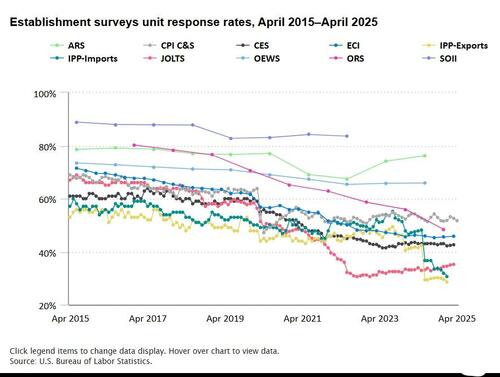
    Picture this: a government survey waiting giggling in the inbox of everyone who has ever opened a “you will be asked to comment on the couch’s upholstery” letter. But once you glance at the question, they’re already disappearing into the ether. That’s the reality we’re facing today.

    What’s Slowly Sliding Away?

    • Declining Participation: Growing numbers of people, from busy professionals to weekend hibernators, no longer feel the itch to fill out these questionnaires.
    • Questionable Incentives: The sweeteners that once proved irresistible—promised pizza discounts, monthly giveaways—aren’t enough to shake the civic apathy.
    • Survey Fatigue: With an overload of reminders bouncing off us, the very act of responding has become a thing of the past.

    A Quick Takeaway

    In the world of data collection, the tide is turning. Whether it’s a subtle shift or a dramatic wave remains to be seen, but one thing is clear: if we don’t speak to the masses, our numbers will never be complete.

    Why the Fed’s Numbers Might Be a Bit Off‑Balance

    Picture this: you send a “Hey, how big is your payroll?” questionnaire to 100,000 companies. Only 40,000 open the envelope and write back. That leaves a pretty glaring gap in the data.

    The Big‑Company Bias

    • HR departments love surveys. Corporate giants with a full HR team are far more likely to hit “send.”
    • Small shops? Probably not. A lone pizza joint owner who’s juggling orders on the sidewalk isn’t going to bother with a form about payroll.

    What This Means for Numbers

    When big firms dominate the responses, the total payroll count shrinks on the smaller side. That’s like listening to only the loudest voices in a conversation—you miss all the quieter, yet still important, perspectives.

    Tech‑Sensitive Small Businesses

    Small companies are often the ones who feel the pinch of a slowing economy first. If they’re underrepresented, the snapshot you get is a little out of date.

    The Bean‑Cup Effect on Fed Decision‑Making

    Because the data is skewed, the Federal Reserve’s big policy calls feel like they’re riding a delayed train. They’re reacting to a picture that’s a smidge older than the real world, and that can lead to a lag in the right economic nudges.

    KILLING THE WRONG MESSENGER

    Who Is Erika McEntarfer, the Ex‑Director of the BLS?

    Picture this: a high‑flying economist lands a top‑ballot gig, gets slapped with a colossal problem, and finds herself in the cross‑fire of politics. That’s Erika McEntarfer’s story. Let’s unpack the drama, credentials, and why the headlines called her a scapegoat.

    A Quick Run‑Down of Her Journey

    • PhD in Economics – She earned her doctorate and gunned her way into the Census Bureau.
    • Early stints as an advisor on labor markets sharpened her policy chops.
    • Member of the Council of Economic Advisors before stepping into the BLS Director’s chair.
    • Officially took office in January 2024, with a portfolio that’s all about data and jobs.

    Do Her Credentials Line Up With the Job?

    On paper, Erika looks like the type of labor economist everyone dreams of in the academy or in Washington. But the reality of running the Bureau of Labor Statistics (BLS) is a different ballgame.

    • She’s lacking hands‑on experience running big bureaucratic wheels.
    • The BLS has its own data‑collection maze, a niche that even seasoned economists don’t typically navigate daily.
    • Erika knows the big picture but the nitty‑gritty operations? Not so much.

    Why the Scapegoat Label?

    Think of the BLS Director as a ceremonial crown—the real work is executed by a team of analysts, survey technicians, and data wranglers. When a national data lop‑off occurs, the people in the ring start looking for someone to pin a blame on. Erika was the trophy target.

    The Data Dilemma She Faced

    Right after she assumed office, the BLS was grappling, as all agencies had been doing for years, with subfields in the jobs data. But here’s the kicker: she was told to fix it.

    • Zapped 810,000 jobs from the March 2024 count during the “annual revision.” The “bright” 2.8 million job growth story flopped to a more modest 2 million.
    • Later, the May‑June NFP report pulled another 280,000 jobs, causing a sudden dip that made headline‐makers gasp.
    • In the middle of all this, Fed Chairman Powell pushed back on rate cuts, citing a “strong jobs market” narrative.

    Political Backdrop

    Trump’s administration was no fan of friendly bureaucracy—unlike the West Coast’s “hand‑hold” style in California where leaders can stay on if they manage to keep the betrayal low. Under Trump, swift firings were the norm for any slip‑up.

    • Erika’s dismissal was part of a fleeting wave of turnovers led by the president.
    • Some argue the firing shattered BLS’s credibility, but the agency itself had been bleeding credibility long before the firing.
    • Contrast with Hegseth’s case—because his oversight of Pentagon communications wasn’t a direct failure in his core duties, he got a “second chance.”

    Bottom Line

    The 2024 BLS saga shows that the chief of a major data agency can be treated like a fuse: if something goes off spark‑y, the director, not the entire machine, gets the blame. In Erika’s case, professional rigor met a nitty‑gritty task she hadn’t fully mastered, and a politically motivated admin decided that someone needed to be held accountable. That’s why she’s being called a scapegoat.

    In the world of labor economics, it’s a reminder that degrees and titles don’t guarantee survival—context and operational expertise are equally vital.

    EVIDENCE OF DATA SKEWING: THE WHAT BUT NOT THE WHO AND WHY

    Payroll Data Glitches: The 98K Job Mystery

    For the past months, I’ve spotted two glaring signs that the payroll numbers are getting a little hand‑adjusted. Let’s take a quick walk through these clues.

    What Happens in a Single Month?

    • In April, the payroll department suddenly invented 98,000 jobs out of nowhere.
    • That surge blew the April NFP numbers higher… almost like pulling a rabbit out of a hat.

    Why This Is a Red Flag

    • Historic norms for this sector: typical monthly growth sits around 15,000, with peaks topping out near 22,000—and never anywhere close to that 98,000 spike.
    • The jump appeared and vanished within just one month, which is as rare as finding a four‑leaf clover in a calculus textbook.
    • When a sector truly expands or contracts, it usually does so in a sustained wave, not a lightning‑flash.
    Bottom Line

    Seeing a 98K jump pop up and disappear overnight feels more like a prank than a legitimate payroll update. If this was a one‑off blip, it should align with the sector’s long‑term growth trend, but it didn’t—making it a smoking gun for possible data tinkering.

    Full-on Data Shuffle: The Public Education Blues

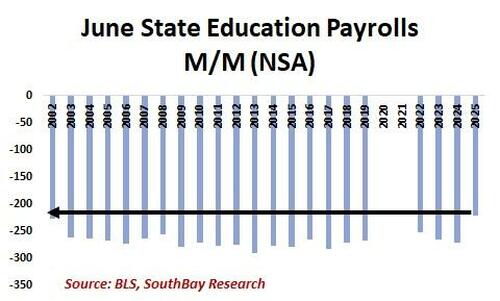
    What’s going on? The charts from the June preview of the NFP (National Fiscal Pulse) are screaming at us. Roughly 70,000 jobs rippled out of our State and Local schools. That number is the sort of thing that makes you want to grab a coffee and do a double-check.

    Hold on—schools are holding more people than ever

    For the first time in decades, schools are keeping folks on the payroll instead of making hasty cuts. You’d expect a shortage to trigger staff downsizing, but nope—the opposite happened. Teachers, aides, support staff… every single one of them feels a little more secure.

    Why is this so wild?

    • Schools usually have a lot of temporary hires who usually get let go when the academic year wraps up.
    • Yet, the numbers tell a different story: they’re sticking around. That’s not just unexpected—it’s basically a scene out of a sitcom where the main characters all suddenly decide to stay in town.
    • Imagine a school with 100 seasonal temp staff—because of a sudden spike in enrollment they still get paid the full term. That feels like a sign illuminating that “we’re in it together.”

    Bottom line

    So while your spreadsheets might say “pang!” (or slam a fist on the desk), the reality on the ground is: teachers, aides, front‑desk clerks, and that sneaky tech team have a good chance of not being laid off next spring. It’s almost like a plot twist, but this time the writers are the NFP and the actors are good‑old public employees.

    THE DEVIL IN THE DETAILS

    Oops! A Batch Goes Boo—And It Stuck

    Picture this: a junior analyst, fresh from the office, reaches for a keyboard and accidentally sends billions into the system instead of millions. Classic “fat‑fingering” meets financial blunder—but why did nobody catch it in time?

    The Big Fumble

    • Reality check: the glitch happened within minutes of the data publishing schedule.
    • It wasn’t a one‑off; a similar mishap popped up in a separate BLS release.
    • Both incidents involved unintentional swapping of decimal points or a simple typing error.

    Where’s the Early‑Warning System?

    The question that keeps people up at night: why didn’t a single BLS analyst spot the anomaly right away? Think of the BLS as a busy bookstore—every shop assistant should see if a book title is misspelled.

    • It turns out BLS internal checks were weak, more like a light stroll than a deep audit.
    • Data collection happened perfectly; the flaw sprang from an oversight trap in post‑processing.

    Who’s Holding the Gloves?

    With such loopholes exposed, attention turns to the Director of the BLS. Was she too distracted or simply a figurehead, letting the mess build under her umbrella?

    • The headlines say: “Did the Director care?”
    • Reality: she has the tools and access that could have wrangled this issue.
    • Now, the debate centers on whether the Director was actively engaged or merely waving her hands.

    In the end, this blip shows it’s more than a tool glitch—it’s an organizational oversight problem. Time for a full audit, a clearer chain of command, and maybe a double‑check system. Until then, let’s hope the next batch sticks to the million marks and not the billion ones!

    TO THE PARANOID, A WEB OF DECEPTION

    Trump’s “Job Fiddling” Conspiracy: A Tale of Numbers and Politics

    Picture this: the Trump camp is watching the economy like a detective on a crime scene. When the Biden team makes a move, Trump sighs. When he needs an edge, he spots the numbers slipping.

    1⃣ The “Biden‑Boost” Timeline

    • In the months leading up to the election, the Fed slashes rates and the BLS drops strong jobs data. Both hand‑shakes for Biden.
    • After the polls, the BLS flips the script: “Oops, jobs were actually bad.” The headline revives the weak‑jobs, weak‑economy narrative.
    • March’s jobs revisions set the stage for an “embarrassing” post‑election fallout.

    2⃣ July: The Great Job Game

    • Before the crucial July Fed meeting, BLS reports solid payrolls. Numbers look like a party for the Fed’s rate‑cut wishes.
    • When the Fed says “No cuts for now,” the spins spin fast. The “strong‑jobs” story cracks like a bad ice cube.
    • Revisions appear overnight, wiping the jobs glow and leaving a flat‑lined economy that screams for cuts.

    3⃣ Trump’s Take: “I’m Not the Target!”

    “Guess what, Mr. President? Those revisions are actually good news. They help push the Fed to cut rates.” Yet, Trump can’t shake the feeling that the economy is being painted with a smudge.

    4⃣ Are Bureaucrats Sabotaging?

    • Question: “Did someone create jobs out of thin air?” Trevor thinks that some numbers may have been over‑inflated for a good reason.
    • Case in point: The public‑sector education jobs in June vanished during the July revision. Suddenly, they were as real as a unicorn.
    • And why should the government do this? Why big unwinding of fabricated jobs?

    In the end, Trump feels a tangle of numbers, politics, and “mysterious” edits. Whether that’s a clever tactic or just a messy stats‑dump is a debate that’s still open. Either way, the penguin’s been juggling numbers like a circus act.

  • Building a business through acquisition

    Building a business through acquisition

    Growth: the act or process, or manner of growing. In business, that act or process of increasing in size, revenue, market share, or profitability is vital – particularly in the current economic climate, which is testing the resolve of even the strongest businesses.

    There are various types of business growth, including organic, when a company creates the right conditions for expansion; strategic, which focuses on long-term growth through specific initiatives; as well as through acquisitions.
    The latter is often referred to as ‘buy and build’ – a concept that sounds straightforward in nature. You acquire a company and, with it, increase your value and grow the business. Easy, right?
    Yes, it can be a highly effective way of reaching your strategic objectives in a relatively short amount of time, but it’s not always an easy investment thesis to get right. Each business you buy has a different culture and geographical spread, therefore, the transition of two becoming one requires time and careful consideration. You have to work hard to integrate what you’ve bought.
    However, when executed correctly, buy and build can help to accelerate growth – whether that’s adding complementary products, services or skills to your proposition, expanding your geographical footprint, opening the door to new markets, or deepening your sector presence. Typically, it can deliver the sort of growth that could take three to five years to achieve organically.
    So, what do businesses need to consider when going down the route of buy and build as part of an overall expansion strategy?

    Organic comes first

    For buy and build to be successful, it should also complement an organic growth strategy. Without the right foundations in place, a buy and build plan is less likely to succeed. Businesses at their root need to be well-managed, well-capitalised and already delivering strong organic growth. As such, focus on the fundamentals and the rest will come.

    Planning and strategy

    Making the right buying decisions, at the right price, takes planning. Having an appetite for growth is one thing, but unless you create a road map and bring the future into the present, then your desire to accelerate growth is likely to fail. Be very clear what your objectives are from the beginning and what’s important to you as an individual and for the company. Emphasis should be placed on establishing a value proposition, understanding how defensible you are in the wider market, and the key opportunities and risk facing the business.

    Funding ambition

    Raising finance to fund your vision is a critical step in the process of buy and build. Funding options vary from business loans to debt finance, private equity and even crowdfunding. Whatever route you choose, finding the most suitable investor who fits with the culture and strategic aims of the business is hugely important. At the core of raising finance is building a relationship with your investor. Make sure they understand what your business stands for and equally that they want to safeguard it. At the same time, consider their approach and if that fits with yours – whether that’s hands off, when needed, one that’s supportive in nature, or one that’s more entrenched in your business. Trust is key.

    Hitting the right target

    When sourcing potential acquisition targets, it’s essential to carry out thorough due diligence to ensure there are no unexpected problems or unforeseen liabilities down the track. This includes making sure you request full disclosure on all financial and operational aspects of the business you are looking to acquire. Ultimately, when integrating an acquired company, you want to achieve sales and costs synergies that will support future growth, so it’s essential you do your homework so you don’t get saddled with a company that drains you of both time and money.

    Market potential

    A buy and build strategy will only be a success in a market where there’s space for consolidation. If your target market has experienced rapid consolidation in recent years, with large well-established participants buying up smaller companies and rivals, it can make it more difficult for new entrants to grow by acquisition and build a business of scale.

    Timing is everything

    Knowing when the time is right is crucial. Is your business at that ‘step-change’ moment? Has it achieved sufficient scale and is trading in such a way that it provides enough width and depth to allow a management team to accelerate growth? It’s easy to underestimate the management bandwidth required to scale a business at pace. Does your strategy require a dedicated integration team? Are there enough middle managers to handle each newly acquired site or business? And does the senior management team have the capacity to execute a seamless acquisition plan while continuing to run the business day to day? If you get your timings wrong, there’s a danger that you won’t have the right team or processes in place to achieve your aims.
    There’s no doubt that buy and build is an effective method for ambitious, entrepreneurial businesses looking to scale up – and scale up quickly. Yes, it only works when the opposing parts fit together and complement one another. But, in a short space of time, you can achieve scale through careful and strategic additions. What’s more, the last few years of economic uncertainty have done little to dampen the intent of businesses. Why? Because innovative businesses that take a more risk-welcoming approach, choosing to embrace growth in the face of adversity, are the ones that have and will continue to flourish.

  • Modern-Day Monopoly: GOP Senator Warns of Mega‑Corp Takeovers Threatening U.S. Beef Supply

    Modern-Day Monopoly: GOP Senator Warns of Mega‑Corp Takeovers Threatening U.S. Beef Supply

    Why the “Beef Babes” of America Are Munching on Monopoly

    Republican Senator Josh Hawley just turned the Senate’s Subcommittee on Competition Policy into a meat‑talk hotspot, calling the current beef‑processing scene a “modern‑day monopoly.” The spotlight falls on four behemoths—JBS, Tyson Foods, Cargill, and National Beef—who together chew up more than 80 % of the nation’s beef supply chain. Two of them? They’re foreign‑owned, so that’s a bit of a “strawberry‑mash” with a dash of national‑security flavor.

    What’s the Beef‑Bite Problem?

    • Who’s chewing? Four companies monopolize beef, pork, and poultry processing.
    • Who’s being let down? Farmers feel the squeeze, while grocery shoppers end up paying a premium at checkout.
    • Why the fuss? If only a handful of packers control the market, retailers pay higher prices, which trickles down to consumers. The resulting “arms race” drives further consolidation.

    Hawley’s Takeout

    This Texas‑style rant isn’t just about beef. Hawley said, “I’ll end with this right now—beef processing is one example but the same pattern exists everywhere. The only winners are the monopolists. If you’re a cattle rancher, you’re getting paid a pittance. If you’re a grocery‑shopper, you’re paying an arm and a leg for a hamburger.” He calls for more competition nationwide—because a monoculture of meat ain’t something anyone wants.

    On X, Hawley posted a tweet that reads like a call to arms:

    “The winners here? The monopolists – like Tyson Foods. The losers? Farmers & grocery shoppers. We need more industry competition in America.”

    FTC’s Playbook (and the DOJ’s Sidekick)

    Mark Meador from the Federal Trade Commission agreed that FTC can indeed intervene at the retail level. The Department of Justice usually takes care of packers, but the FTC watches the downstream pricing dynamics. “When there’re fewer packers, the retail chain feels the pressure and wants to merge, perpetuating the cycle,” Meador explained.

    What’s the Solution? Local Beef for Local Flavor

    Several voices—like those on ZeroHedge—suggest a grassroots revival: regional microprocessors. Instead of a few giant plants, there would be a mesh of smaller, community‑driven facilities. They can:

    • Provide alternative outlets for ranchers.
    • Help farmers fetch higher prices.
    • Revive rural economies.
    • Keep the supply chain from stalling, like what happened during the early Covid‑pandemic.

    Think of it like a “cattle‑hub” network—a network of smaller processors, decentralized but robust, that can keep the meat flowing even if one big plant shuts down. The vision is simple: bring the control back to the ranchers who own the land, not to foreign‑owned conglomerates that serve as a national‑security threat in the making.

    Stirring Up the Good “MAHA” Movement

    By championing local ranchers, the movement, dubbed MAHA, hopes to keep the fiber‑rich, beefy future of America firmly rooted in its own countryside. This is the new frontier for food sovereignty—where the end of the chain gets back to the end of the chain.