Tag: year
-

Dealing With Christmas Objections – Part Two
It’s always interesting as we head towards the festive period, how many business owners and salespeople always fall for the ‘call me back after Christmas/call me back in the New Year’ objections!This week I looked at some top tips on improving your sales techniques to avoid the Christmas holiday objections.Sales Tip Number 1 – Be PreparedYou know you’re going to start getting these sorts of objections from November onwards, so you need to prepare for them!I hear so many business owners and salespeople fall for these same objections year after year! Why not consider how you’re going to deal with them and practice your responses? Most people fail to do even those simple things!This means working out your objection handles, then practicing them with friends, colleagues or even in meetings with the rest of the sales team! The better prepared you are for when the objections come up, the better you’ll deal with them! That goes for the other objections you face as well, but let’s focus on the ‘Christmas’ ones for now!And please, don’t leave this until the last few moments before your telephone call or client meeting (or even worse – until you’re waiting in reception), do this in ‘small chunks’ – a little bit at a time but done on a regular basis – that helps you remember and use the objection handles best.Sales Tip Number 2 – Think About What They Really MeanOften when the buyer or decision maker says the words ‘call me back after Christmas’, that phrase might have a different meaning than the one you’ve accepted at face value!Let’s face it – if everyone who said those to you either met with you or bought from you in January, then there wouldn’t be a problem, would there? So I’m talking here about the people that use that phrase, but then don’t seem to necessarily follow through come January.Let’s think about this a little deeper – might some people use that phrase when actually what they really mean is ‘go away?’ Or perhaps ‘it’s not important enough for me to look at right now?’ As someone who originally trained as a professional buyer, I can guarantee you that’s the case!Here’s a quick distinction – the more ‘new business’ your telephone call or appointment is, the less rapport you have – therefore the likelihood of them ‘fobbing you off’ is much higher! If you’re with an existing client you have personally a very good relationship with, it’s more likely that they’re telling the truth.….Next time I give you some final tips on how to ask the right questions and having the right attitude and really getting around those Christmas holiday objections.
-

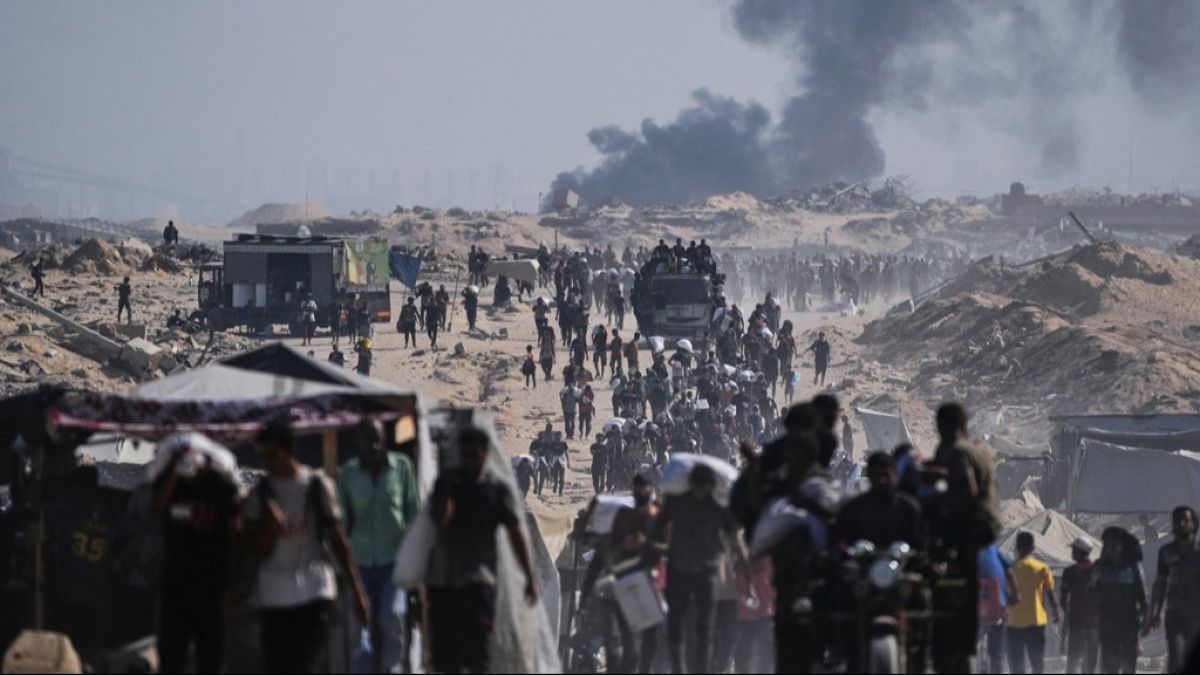
At least 64 Palestinians killed in Gaza in the past 24 hours as Israel shifts focus to Gaza City
The attacks come as Israel finalises plans for an imminent assault aimed at occupying Gaza City, after Israel’s security cabinet approved Netanyahu’s plans to capture the northern city.
ADVERTISEMENT
At least 64 Palestinians were killed in Israeli attacks across the Gaza Strip in the past 24-hours. Medical sources at hospitals in the enclave say at least 16 people were killed on Sunday, including seven aid seekers.
They were traveling through a military zone in the south of the Strip, trying to reach a food distribution point near Khan Younis, ran by the Israeli-backed US contractor Gaza Humanitarian Foundation (GHF).Eyewitnesses and hospital officials say Israeli soldiers opened fire at crowds of Palestinians marching their way to the distribution hub. It’s the latest in a string of fatal incidents surrounding the GHF operation, which commenced in late May.
Palestinian relatives mourn over the body of 13-year-old Karim Qdeih, who was killed along with others in overnight Israeli strikes in Khan Younis, Saturday, Aug. 23, 2025
Mariam Dagga/Copyright 2025 The AP. All rights reserved.“The gunfire was indiscriminate,” Mohamed Abed, a father of two from the Bureij refugee camp, said, adding that while many fled some people fell to the ground after being shot.
Abed and Ahmed Sayyad, another aid seeker among the crowd, said troops opened fire when a group near the front of the crowd pushed forward toward a distribution site before its scheduled opening.
The shooting occurred just hundreds of metres away from the GHF hub. The Delaware-based foundation has not commented on the incident but have previously denied any fatal incidents on their premises.The Israeli Defence Forces do not have direct security involvement in the GHF operation, but are tasked with providing a security perimeter a few kilometres away from their sites. The IDF has not publicly acknowledged the latest incident but have repeatedly stated in the past that their troops only fire warning shots if Palestinian aid seekers get too close to their posts.
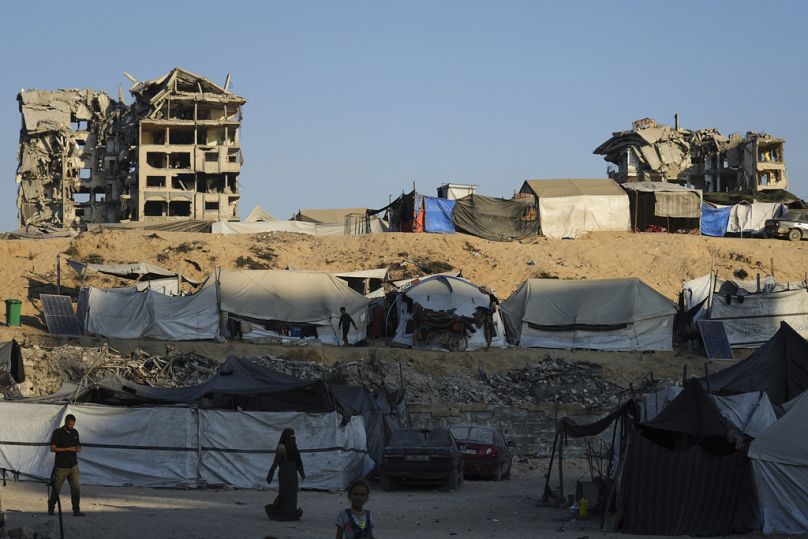
Palestinians stand by a makeshift tent camp located next to buildings destroyed during Israeli air and ground operations, in Gaza City, Saturday, Aug. 23, 2025
Jehad Alshrafi/Copyright 2025 The AP. All rights reserved.The Hamas-run Gaza Health Ministry says that more than 2,000 Palestinians have been killed and close to 15,000 others were injured while seeking aid at the GHF sites or enroute to their hubs.
Many have criticised the initiative, a US-Israeli collaboration aimed at replacing traditional UN aid systems, after Israel accused the UN of having Hamas combatants embedded within its staff, and slammed the group for looting supplies for their own consumption and to sell.Israel has not produced any evidence of those allegations, which the UN have rejected, claiming its aid deliveries are heavily secured and routinely arrive at distribution warehouses safely.
It comes as an already dire humanitarian catastrophe further deteriorates as Israel continues to prevent the access of food and basic necessities into the enclave.
Palestinians walk on an area at a makeshift tent camp located next to buildings destroyed during Israeli air and ground operations, in Gaza City, Saturday, Aug. 23, 2025
Jehad Alshrafi/Copyright 2025 The AP. All rights reserved.The UN say 90% of Gaza’s roughly two million population are at dire risk of starvation due to the critically low levels of food in the besieged territory.
On Sunday, at least eight people died from malnutrition-related causes, including one child. The Gaza Health Ministry says the total amount of famine related deaths have risen to 289, including 115 children.
Meanwhile, Israeli attacks across the strip are intensifying ahead of an imminent offensive aimed at occupying Gaza City in the north of the enclave, after Israel’s security cabinet approved Prime Minister Benjamin Netanyahu’s plan to take control of the city.
Air strikes have been targeting multiple locations, from the southernmost Rafah to the north. Eyewitnesses say Israeli missiles are targeting civilian areas, including designated safe havens. On Saturday, several people were killed in Israeli shelling of a displacement camp in Khan Younis.
A demonstrator takes part in a protest against Netanyahu’s government and calling for the release of hostages held in Gaza by Hamas, Tel Aviv, Israel, Saturday, Aug. 23, 2025
Ohad Zwigenberg/Copyright 2025 The AP. All rights reservedThe war started after Hamas staged an attack on southern Israel on 7 October, 2023, killing just under 1,200 people, whom Israel says were mainly civilians. The Gaza-based group also captured 250 people as hostages on their retreat to the Strip.
Most of the hostages have since been released in several ceasefire and exchange deals between Israel and Hamas. 50 still remain under Hamas captivity, with roughly 20 believed to be alive.
The death toll from Israel’s 22 month offensive on Gaza is now closing in on 63,0000 according to the Health Ministry.
Its figures do not distinguish between civilian and combatant casualties, but the UN says more than two-thirds of deaths it has been able to independently verify were women and children. -

The Quality Of Data Is Not Strained
By Peter Tchir of Academy Securities
It is twice blest;
It blesseth him that gives and him that takes.Please forgive the Shakespearean indulgence, but I’m in Waterloo, in Wellington Country, not too far from the Shakespeare festival in Stratford on the Avon (the Canadian version).
But finally, literally everyone is talking about a long-running theme in T-Reports – we need high quality data to make good decisions.
I’ve lost count of the number of times I’ve written or spoken the words “Garbage In, Garbage Out” but it is a real issue with real world consequences.
We didn’t get to talk much about jobs in Tuesday’s Bloomberg TV interview, but we did get to talk about the balancing act of Tariffs vs. National Production for National Security and the importance the strike on Iran has had on U.S. relations with our allies.
While we won’t focus on it today, the court rulings on the legality of existing tariffs could impact markets.
Our Geopolitical Intelligence Group crafted a report on the announcement that the U.S. is moving two nuclear subs, which spooked markets, but is another example of some steps, that while potentially dangerous, are necessary in reestablishing deterrence and building Peace through Strength (see SITREP).
Imagine an “Alternate Reality” July 3rd
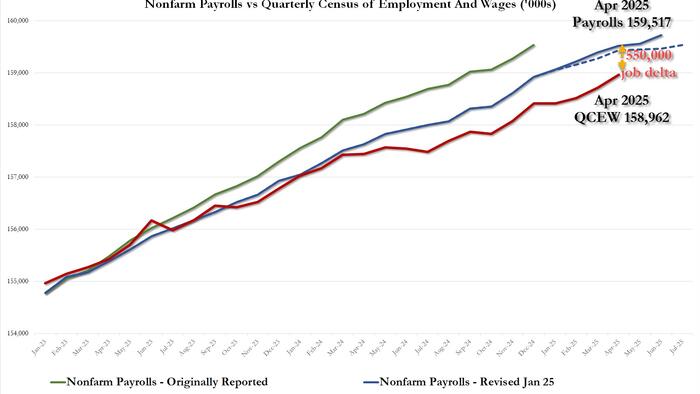
Imagine that on July 3rd, we had a June NFP headline of 14,000 jobs instead of 147,000.
Let’s further imagine that May’s reported number was 19k, instead of whatever had been reported at the time.
It is easy if you try, since ADP was -23k and 29k respectively (why the markets and the Fed consistently ignore ADP is beyond me, but that is an argument for another day).If we had that jobs data, would this FOMC been different?
Maybe we wouldn’t have gotten a cut, but why the heck not? We had 2 dissents as it was. With this No Silver Lining Jobs Data, there would have been a lot of pressure to cut. The unemployment rate, which hasn’t been bad, has largely been stable because we have seen a 0.4% reduction in the labor force participation rate since April.
Certainly, my flight back from London would have been more enjoyable as the data would have been even worse than my already pessimistic views and Treasuries could have continued their strong performance. It isn’t just our view that was hit by data that now looks very incorrect. On the July print, if memory serves, only 1 economist surveyed had an estimate that was higher. Now, it looks like in hindsight, that every estimate was above the actual number (though closer on average to the original print).
The real-world impact of having inaccurate data is problematic (and let’s be honest, for all we know this month’s data will be revised higher next month – which doesn’t change the argument that Garbage In, Garbage Out needs to be addressed).
It’s Not Just Jobs Data
We have often made well-reasoned arguments (some would say, rants) around incorrect inflation data. The owners’ equivalent rent is fraught with issues, including significant lag time. We’ve argued that the country voted based on the inflation they saw in the real world, not the calculated inflation (which seemed low on many things – like health insurance costs). Many look to things like Truflation to get potentially more accurate, real-time information (though not sure what good it does, if policy makers don’t).
The jobs data has caught everyone’s attention, it is time to address data across the board.
Let’s not forget we live in an electronic and AI world, which should help us get better answers.
Two Problems
The Collection Problem.
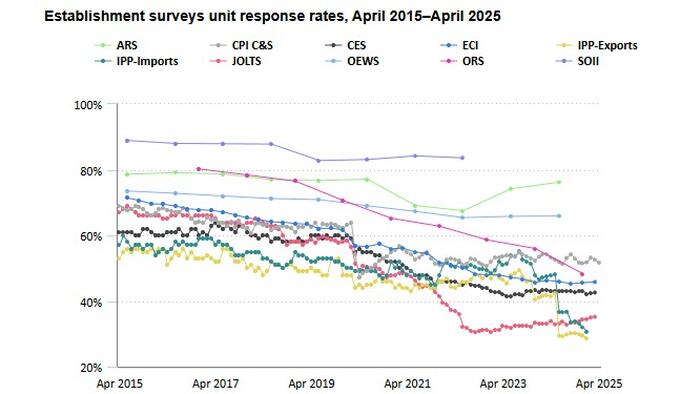
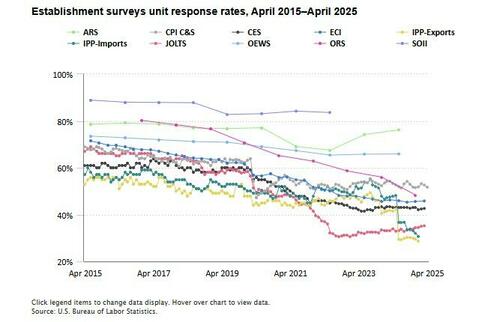
- Survey Response Rates. The initial survey response rate has been between 25% and 35% for the past year. Prior to 2020, the initial response rate averaged close to 70%. We now get less than half of the initial responses than before, and that seems problematic.
- By final revisions, the response rate is typically above 90%, even approaching 98%. Maybe we should stop pretending NFP is timely? If we get far more respondents after the initial publication, it isn’t surprising that the data is all over the place.
- There are collection problems on almost any data series. It is part of living in the real world, but how do we address these problems and try to minimize them?
The Seasonal Adjustment Problem.
- Even if the underlying data was perfectly accurate (it isn’t) we move on to the “seasonal adjustments.” We “love” adjusted data as it provides “smoother” data. Apparently we couldn’t handle that the Non-Seasonally adjusted jobs were -1.07 million, +360k, +703k, and +825k for the past four months (in all honesty, I don’t know whether those have been adjusted or not via revisions, but that is the actual jobs data).
- Is there any reason to believe that the BLS (or anyone) has the “best” seasonal adjustment methodology? I think not, as I’d like to see as many different estimates as possible.
So, we have all these incredibly smart, well-resourced economists trying to do 1 of 2 things:
- Determine, to the best of their abilities, the number of jobs created.
- Guess what the jobs numbers calculated by the BLS will be, and then guess what the adjustments will be. To the extent that this is prevalent, it reduces the impetus to change existing official methodologies.
While “similar” the two things are very different.
The first is a truly valid exercise in establishing where the economy stands and providing data to make good decisions. Despite that, it is somewhat useless if no one believes you and just gravitates to the officially published data.
The second is what makes careers. Bloomberg reports analysts that are most “accurate.” Not accurate in terms of what the final data comes in at, but at predicting the pseudo random number that comes out the first Friday of the month (or other dates, for other data series).
My bet gravitates towards the crowd-sourced efforts of economists trying to predict the actual state of the economy (though I’m not sure if that is the goal of many, or trying to guess the NFP is the goal, which is similar but different).
Some Food for Thought on Solutions
Enough ranting and rehashing old arguments. Let’s take a peek at some potential solutions, or at least some ideas that we think warrant discussion.
Getting the most accurate, timely data as possible.
Every year, our employers send the IRS our tax forms, that include our income and our Social Security, so the IRS can link all of our employment income together. W2s and 1099s have to cover a significant part of the legal work force. Maybe I’m wrong, but I would expect that W2s and 1099s would cover a large percentage of the legal, documented workforce. It misses under the table payments, all cash jobs, and probably some sole proprietorship jobs, but virtually everyone I know receives at least 1 paycheck a month (some are weekly, or biweekly).
So how about providing some “encouragement” for companies to provide that information every month?
- Privacy concerns? Sure, but the federal government (IRS), and probably your state will all get this information over the course of time. Does it really matter whether they know your monthly data in addition to the annual data? Sure, my initial reaction is that this seems sketchy, but is it really? Certainly, some information could be “redacted” so individuals don’t stand out (though it would still likely need to be collated by SSN to determine those working multiple jobs). 1099s may pose some similar issues (by SSN or EIN), but it seems like something that should be “workable.”
- What do we mean by “encourage”? Maybe a reduction in certain payroll taxes. Maybe even a small rebate to the company and/or the employee. Would this cost some money? Yes, but would the cost be more or less than living with data that is so unreliable that it leads to bad decisions at the policy, corporate, and even individual level? Data collection in any form tends to have expenses, but doing something to encourage (or mandate) timely data would be interesting.
Just imagine a world where on the 20th of each month (just to pick a date) anyone cutting checks that will show up on W2 or 1099 reports, sends (in an identical format) the information to the data collection area (probably involving the IRS, as they are the ones already entitled to this information on an annual basis).
That data is plunked into an algo that then comes up with changes in employment.
Would we be missing some parts of the economy? Sure. Without a doubt. But would we have highly accurate information on the vast majority of the economy? Probably. This part of the jobs report could be published as such. Then we can all try to spend time figuring out what is happening in the part of the economy that is not captured.
Again, I’m not advocating for giving up our privacy, but the reality is that the information goes to the government, just not in this organized or frequent type of approach. I presume companies or payroll companies could code this additional step in a matter of weeks. Yes, maybe I’m missing a lot of legal issues, but can this really be worse than a survey?
I would also like to see some “cohort” analysis. What I like about Case-Schiller is that it tracks a set of houses, not every house. There is effectively a “control” group. For wage inflation, it would be great to see data by cohort. Track the wage of a particular person over time. When we think about wage inflation, we think about what people get paid over time. This sort of methodology would mimic that. It could also potentially be done by income bracket (now this might be going too far, but just tossing it out there). What we currently get on average hourly earnings is a change in the entire pool of workers. But if someone retires and is replaced by a new employee at a much lower wage, the current methodology would likely see lower wage inflation than there really is. Tracking by cohorts over time may give a better read on wage pressures than existing methodologies. This is a second order effect, but hey, why not try to make a really robust report?
Open source the seasonality. Let’s publish both the unadjusted number (as volatile as that is) along with the adjusted number and the algorithm used to do that adjustment. Then the brightest or most curious minds can try to improve it. In this day and age, I wouldn’t bet against a group of kids in college playing around with the methodology and figuring out improvements – especially if we have reduced the range of issues around the data collection.
Whether or not these ideas make any sense, there should be some simple steps taken.
- Identify and implement ways to reduce the margin for error on broad swaths of the labor force. The more data that can be collected very accurately means we have less to worry about on the data that isn’t calculated as accurately.
- Then focus on ways to reduce the errors in the data that isn’t as accurately collected.
- In parallel, work on ways to ensure that the adjustments are realistic and up to date with the current economy (a major shift in jobs (like AI and Data), or the GIG economy, or regional preferences as where people live and work has changed). Adapt and refine.
Finally, and this might sound weird, stop pretending that the data is accurate to the nth degree.
Imagine having only a yard stick with no measurements marked in between. Then being asked to use that yardstick to measure a long distance over a hilly, rocky field. You take that yardstick and to the best of your ability, flip it over and over, counting the number of flips until you have traversed the field.
Then you come with an answer of 3,423 yards and 12 inches. There is no way the methodology laid out can produce something to that degree of accuracy. Maybe you could say that given the terrain, slippage, etc., we estimate between 3,400 and 3,500 yards, which isn’t as satisfying as 3,423 yards and 12 inches, but does convey a more accurate assessment of the situation. Significant figures exist in science for a reason, to avoid creating the perception of more accuracy than there really is. Maybe more of our economic data should incorporate that concept?
Maybe we need a warning note along with the data?
We are getting warnings about almost everything these days. Objects in the mirror might be closer than they appear. Not eating fully cooked food. You get the idea.
Maybe the warning label should be:
Before using this data, the margin for error is 136,000 for the Establishment Survey. Yes, the margin for error is larger, in some cases, than the actual number we report. Please rely on this data at your own risk as it may or may not be accurate, may be changed multiple times in the coming months, and again in annual revisions. If you think that is a wide margin of error, then we warn you not to even think about the margin for error in the Household Survey. BLS Technical Notes.
Bottom Line
I do not believe that the BLS intentionally gets anything wrong in either direction, but I do believe that in an era with so much of the data floating around electronically and the ability to apply hardcore computing power to that, we should be reinventing our data collection and publication tools to the greatest extent possible (I would include inflation and other important metrics in this project).
I do not like the idea of “shooting the messenger” as that doesn’t create the goal of true intellectual honesty in developing new and better tools.
Garbage In, Garbage Out should no longer be acceptable, and we should be able to corral the will and the resources to mitigate that risk.
End rant, and have a great weekend!

Loading recommendations… - Survey Response Rates. The initial survey response rate has been between 25% and 35% for the past year. Prior to 2020, the initial response rate averaged close to 70%. We now get less than half of the initial responses than before, and that seems problematic.
-

Kanye West Seemingly Cosigns Post About Being Bianca Censori’s ‘Master’
Kanye West seemingly cosigned a message about being Bianca Censori’s “master” when he reposted a message on X.
“Every man needs himself a Bianca,” the original message read. “She is a good woman that does whatever Ye tells her to do without caring what anyone else has to say, the only thing she cares about is being a subservient extension to her master.”window.firework_player_src = ‘//asset.fwcdn3.com/js/storyblock.js’;
window.split_percentage = 0;Ye, 47, shared the message on Wednesday, April 30, amid rumors that he and Bianca, 30, had gotten back together.
Earlier this year, the “Can’t Tell Me Nothing” rapper shared several strange messages on X, including one where he stated that he had “dominion” over Bianca just days after she walked the red carpet at the Grammys in a completely sheer dress.
Kanye West Spotted With Mystery Woman Amid Bianca Censori Divorce Rumors
“I HAVE DOMINION OVER MY WIFE THIS AINT NO WOKE AS FEMINIST S–T SHES WITH A BILLIONAIRE WHY WOULD SHE LISTEN TO ANY OF YOU DUMB ASS BROKE BITCHES,” Ye wrote on February 7. “PEOPLE SAY THE RED CARPET LOOK WAS HER DECISION YES I DONT MAKE HER DO NOTHING SHE DOESNT WANT TO BUT SHE DEFINITELY WOULDNT HAVE BEEN ABLE TO DO IT WITHOUT MY APPROVAL YOU STUPID ASS WOKE PAWNS.”
He continued, “I HAVE NO RESPECT OR EMPATHY FOR ANY ONE LIVING CAUSE NO ONE LIVING CAN F–K WITH ME BUT I DO LOVE SOME PEOPLE AND I GIVE THEM FAVOR.”
In a follow-up message, Ye claimed to have fired one of his employees after they admitted that Bianca’s nudity at the awards ceremony made him uncomfortable.
“THIS [PERSON] THAT WORKED FOR ME SAID HE WAS UNCOMFORTABLE WITH MY WIFES GRAMMY LOOK FIRED AND BLOCKED ITS MORE PEOPLE LOOKING FOR WORK THEN THEY ARE PEOPLE GIVING WORK,” he added.
Two days later, a message was posted from Bianca’s official account on X that expressed concern about her husband, but it was quickly deleted.
“Lord, I lift up my husband to You with love & concern. Soften his heart, guide his words, and fill him with wisdom and kindness. Protect him from trouble & lead him toward understanding & respect for all people,” the post read. “Despite our differences, I love him unconditionally. Strengthen our bond & help me be a source of patience & encouragement. I trust in Your grace to work in his heart. God Bless Israel and All The Good Jewish People. Amen.”
Kanye West, Bianca Censori’s Relationship Timeline Amid Reported Split
“I DONT WANT TO JUST ‘SEE’ MY KIDS. I NEED TO RAISE THEM. I NEED TO HAVE SAY SO OF WEAR [sic] THEY GO TO SCHOOL AND WHO THEIR FRIENDS ARE AND WHOSE HOUSES THEY SLEEP OVER WEATHER [sic] MY DAUGHTERS WEAR LIPSTICK AND PERFUME,” Ye wrote via X on March 16. “ALL THESE RIGHTS HAVE BEEN TAKEN FROM ME BY THE KARDASHIAN MOB, HULU AND DISNEY AND THE BIGGER AGENDA TO USE THE SELECTIVELY BRED BLACK CHILDREN TO BE PLATFORMS TO INFLUENCE BLACK PEOPLE.”
-

Tariff Surge Yields Unexpected $27B US Budget Surplus in June
Unexpected Fiscal Upswing: Trump’s Tariffs Turned Into a Goldmine
When the Treasury Department rolled out data for June, it turned the headlines on their head. Thanks to a surge in tariff revenues, the U.S. government found itself in a surprising position: a $27 billion budget surplus. This bright spot in the long‑running federal deficit chart shows that President Donald Trump’s tariff policies might be evolving into a hefty source of income for the administration.
Why Tariffs Matter
- The government pulled in more money from trade duties than it had expected.
- Those earnings helped cover a chunk of the ongoing fiscal shortfall.
- It’s the first time we’ve seen a surplus in a while.
The Ripple Effect
While the surplus is a nice feel‑good moment, it’s just one piece of a larger fiscal puzzle. Persistent deficits still loom large, but this data suggests that the tariffs are a growing revenue stream—potentially reshaping the economic landscape in the President’s favor.
Looking Ahead
Will the tariff‑generated revenue keep rolling in, or is this a one‑off? Only time will tell, but for now, the numbers give a glimpse of how trade policy can influence the budget in unexpected ways.

Tariffs: The Unexpected Cash Cow (Spoiler Alert—It’s Not a Dairy Farm)
From a $316 billion Deficit to a $27 billion Surplus
In May, the Treasury’s budget look‑alike was a scorching $316 billion deficit. Fast forward to July, and the nation closed the month with a tidy just over $27 billion surplus. That’s a staggering swing, thanks in large part to the soaring customs duty collection that decided to pay its debts in style.
Why the Numbers Look So Good
- Customs revenues hit record highs. In June alone, the government pocketed $27 billion in tariffs, topping its 108 billion haul for the first nine months of the fiscal year.
- January‑June figures beat last year’s 9‑month total by 93%. That’s more than double what we got in 2023.
- July adds another $2.4 billion. Streaking that influx keeps the government’s till humming.
The Treasury’s year‑to‑date deficit shrank to $1.34 trillion—a modest 1 percent improvement over last year, but still a hefty sum that keeps the deficit narrative alive.
Command Line: Secretary Bessent’s Sales Pitch
At a July 8 White House Cabinet meeting, Treasury Secretary Scott Bessent got airplane‑style talk about future revenue. He said the United States is on track to collect a $300 billion haul by the end of 2025—don’t forget that the Trump tariffs we’re counting on didn’t kick in until the second quarter.
He also cited a CBO report hinting that $2.8 trillion could be the total tariff revenue over the next decade. The administration thinks that figure is probably on the low side.
Why Trump’s Tariffs Are “Big Money” (If You’re into That)
Since his second‑term return, Trump slapped on 10 percent universal tariffs plus selective reciprocal tariffs on a smorgasbord of nations.
Short note: “The big money will start coming in on Aug. 1.” And, if a country wants to keep its importers happy, “push your trade barriers down.”
Tariff Numbers for 2024 (The “Whisper” List)
25 % on Japan, Kazakhstan, Malaysia, South Korea, (and) Tunisia
30 % on Bosnia & Herzegovina & South Africa
32 % on Indonesia
35 % on Bangladesh & Serbia
36 % on Cambodia & Thailand
40 % on Myanmar & Laos
And a second batch:
- 30 % on Algeria, Iraq, Libya, Sri Lanka
- 25 % on Brunei, Moldova
- 20 % on Philippines
Canada? 35 % starting Aug. 1. It’s a buffet of percentages—but economic and national security for the win.
Takeaway: Are We in a Bargain‑Shopping Show?
With tariffs on the rise, the government’s coffers feel a little richer, but the world view is that there’s a gigantic “trade deficit” threat. Whether you’re a market enthusiast or a toe‑cracking skeptic, the bottom line is: The U.S. is gearing up for a big bump in revenue—though it’s a vibrant, if not pretty flashy, growth story.
-

How a Cardiologist Can Help You Prevent Heart Failure – Health Cages
Heart failure impacts a large number of people every year, yet when it is treated promptly and with proper guidance, many cases can be prevented. Clinics for cardiology are at the forefront of this endeavor with the early detection of heart disease, lifestyle counseling and the most advanced medical treatment to ensure that at-risk patients are protected for the health of their hearts. This is how your cardiologist could assist you in preventing heart problems:
(adsbygoogle=window.adsbygoogle||[]).push({})Early Detection Makes a Difference
For those who are at high risk, the early detection of heart disease is one of the primary avenues of protection. Cardiologists closely review the patient’s medical history, family history, and daily routine to detect warning signs before heart disease develops. Regular screenings, which include testing for cholesterol, blood pressure and imaging, aid in detecting any early signs of changes to heart function. Recognizing these warning signs helps patients take appropriate actions, while interventions are most efficient.
(adsbygoogle=window.adsbygoogle||[]).push({})Lifestyle Changes Play a Role
The way you live your life plays a major role in maintaining heart health. Cardiologists help patients make lifestyle changes that improve their health. They can help with:
(adsbygoogle=window.adsbygoogle||[]).push({})- A heart-healthy diet that is rich in plenty of vegetables, fruits, lean proteins and whole grains
- Reduce salt intake and processed food consumption
- Aiming to increase your daily activities, for example, swimming or walking
- A healthy weight and maintaining it
- Limiting alcohol and tobacco consumption
Every positive improvement, even the smallest ones, helps the heart’s capability to perform at its peak. Cardiologists are available to help the patient, talk about challenges, and make recommendations for adjustments that are appropriate to the needs of each patient and their preferences.
(adsbygoogle=window.adsbygoogle||[]).push({})Regular Check-Ups and Monitoring
The regular appointments afford cardiologists the chance to observe their progress, alter treatments, and provide the necessary encouragement. These appointments allow any change in symptoms or the appearance of new risks to be dealt with quickly. Through testing for blood, imaging and physical examinations, Cardiologists monitor the performance of the heart in the course of time. This helps to prevent warning signs from developing into something more serious.
Personalized Treatment Plans
There are no two patients who are identical. Cardiologists design individual treatment plans that are based on the individual’s risk profile along with their medical history and life style. Certain people may require medication to aid in controlling cholesterol levels or blood pressure. For others, organized weight loss programs or the recommendation of nutritionists or exercise experts can be a great help.
(adsbygoogle=window.adsbygoogle||[]).push({})This individualized approach provides patients with the resources and assistance they require for maintaining their long-term heart health. With a focus on individualized treatment, cardiologists are able to address the particular needs and goals of each patient with greater efficiency. This patient-centric, comprehensive approach improves outcomes and helps encourage permanent lifestyle changes to improve health of the heart.
Advances in Cardiology for Prevention
Modern technological advancements along with cardiology research have provided fresh methods to avoid heart failure. The latest imaging methods, genetic testing and new medications permit targeted interventions prior to when signs appear. Monitoring devices remotely as well as digital health apps assist patients and their healthcare team stay connected, monitor health information, and make quick adjustments when needed.
Find a Cardiology Clinic Near You
In order to prevent heart failure, it is a team initiative. Cardiologists and patients work as an entire team, sharing knowledge about barriers to overcome and celebrating important milestones. Through taking an active role in their health management and heeding the expert advice, patients at risk have the best chance of living an extended, healthier life. If you’re at risk of heart disease or have questions about your heart health plan regular visits to the cardiologist.
-

Brace For Another Huge Negative Payrolls Revision, Greenlighting A 50bps September Rate Cut
It was almost exactly one year ago that the constant stream of BS coming out of the BLS (Bureau of Labor Statistics) finally snapped.
-

Trump & DeSantis Set to Attend 125th Army‑Navy Game Today – Space Coast Daily
game starts at 3 p.m. ET on CBS

It’s Finally Here: The Army‑Navy Showdown Gets the VIP Treatment
The 125th edition of the Army‑Navy game is gearing up for a showdown that’s as electrifying on the sidelines as it is in the stands. Army and Navy, fresh from their first wins of the season, are setting their sights on a moment that’s been tracked by fans and politicians alike.
Why This Game Is a Big Deal
- Combined 19 Wins – The Raiders have got the edge early, but the Midshipmen weren’t left behind.
- Non‑Conference Showstopper – It’s their season opener, so the stakes are high and the pressure is real.
- Historic Rivalry – 125 years of tradition means every touchdown is a tribute to that legacy.
Who’s Heading Into Landover, Maryland?
- President‑elect Donald Trump – fifth time at the game, ready to watch some true‑blue action.
- Vice President‑elect J.D. Vance – He’s bringing the heat, plus a touch of charm.
- Florida Governor Ron DeSantis – Florida’s flag may still be in his back pocket.
- Defense Nominee Pete Hegseth – A formal nod from the upcoming Secretary of Defense.
- Marine Veteran Daniel Penny – Known for standing firm in tough spots, he’s on Vance’s side for the game.
Coach Highlights
Naval Academy head coach Brian Newberry is proud of the Midshipmen’s first winning season since 2019. He praises the Black Knights for being “the most complete, well‑rounded Army football team” he ever saw, and the stakes just add another layer to the excitement.
Feel the Energy
Picture the roar of the crowd, the smell of field‑level post‑its, and the buzz of a politically charged atmosphere. This Saturday’s clash isn’t just a game – it’s a convergence of sport, history, and headlines.
-

Summer 2025 ranks among Spain's hottest ever after historic August heatwave
Extended periods of high temperatures this summer have significantly increased wildfire risks and put vulnerable communities on alert across Spain.
ADVERTISEMENT
Summer 2025 is on track to be one of the two hottest ever recorded in Spain, nearly matching 2022.
A historic August heatwave set a new record for intensity, with a temperature anomaly of 4.6°C, according to the national meteorological agency AEMET.Based on observed data and forecasts through 31 August, summer 2025 is almost certain to be one of the two hottest summers on record. It is nearly tied with summer 2022, currently the warmest on record, and both clearly surpass the historic summer of 2003.
During 2025, warm spells have vastly outnumbered cold ones. While March was notably cold and May was close to average, all other months have been warm, very warm, or extremely warm.
As a result, 2025 ranks as the second warmest year on record from January to August, just behind 2024, in what is effectively a four-way tie among the past four years, all well ahead of previous years in the historical record.Related
Wildfires devastate nearly 10,000 km2 in 2025 with Spain and Portugal hardest-hitAmid brutal heatwaves, Spain sees one of its worst months for heat-related deaths
This summer’s temperature pattern has been marked by a prolonged period of above-average heat in June and early July, a cooler spell at the end of July, and then the most intense heatwave ever recorded in Spain, which hit in August.
The most intense heatwave in history
The recent August heatwave was the most intense ever recorded in Spain, exceeding the 2022 event with a temperature anomaly of 4.6°C, according to provisional data from AEMET. It surpasses the previous record set in July 2022, which had an anomaly of 4.5°C.
The heatwave lasted sixteen days, making the first twenty days of August the warmest such period (1–20 August) in Spain since at least 1961. More specifically, the stretch from 8 to 17 August was the hottest ten-day period ever recorded in the country, dating back to at least 1950.
The scale of this event becomes clear when looking at historical data: five of the 20 warmest periods on record are from the recent heatwave, and 15 have occurred since 2022. Based on observed data and forecasts through 31 August, this month is likely to rank among the four warmest Augusts in the historical series. This continues a pattern in which four of the five hottest Augusts have taken place within the past four years.“The persistence of extreme heat intensifies its adversity,” AEMET emphasised in a post on social media. “The health of vulnerable people suffers, and the level of fire danger increases”.
Following the end of the heat wave on 18 August, Spain has seen a period of cooler-than-normal temperatures for the season. However, temperatures are expected to rise again in the coming days, with a possible further drop before the end of the month.Climate change as a root cause
The average temperature in Spain has risen by 1.69°C between 1961 and 2024, leading to more frequent episodes of above-normal temperatures. When these occur in summer, they often result in longer and more intense heatwaves.
Scientific evidence shows that heatwaves in Spain are becoming longer, more widespread, and stronger. Although the county has always experienced hot summers, recent years have seen more frequent episodes of very high daytime and nighttime temperatures.
Climate change is driving this rise in temperatures and the increasing occurrence of extreme heat events, as confirmed by the IPCC’s analysis of global temperature trends.Related
Is hot weather putting you in a bad mood? Science suggests it might beBillions at ‘real’ risk of extreme heat in the workplace, World Health Organisation says
Climate projections suggest that by the middle of the 21st century, typical summers in the Mediterranean region, including Spain, could be around 2°C warmer than between 1981 and 2020. Alarmingly, the summers of 2022 and 2025 are already comparable to those expected in mid-century conditions.
The fact that four of the five most intense heatwaves have taken place since 2019 is no coincidence. While not every summer will be hotter than the last, the overall trend towards more extreme summers is clear and undeniable.
In light of this reality, the focus must be on both adapting to and mitigating climate change, recognising that today’s summers are warmer than those of past decades, even though very hot summers have also occurred in earlier years. -
European Investment Bank Boosts Defence Funding Threefold
European Investment Bank Unveils a €100 Billion Reboot for 2025
Picture this: a European bank wading into the pandemic‑swept waters of 2025 with a pocket full of fresh cash, ready to splash it around in defence, energy, and tech. The European Investment Bank (EIB) just set a brand‑new financial ceiling for the year – a whopping €100 billion.
Why This Matters (and Why Everyone Should Care)
- Defence: With geopolitical tensions simmering, the EIB wants to back projects that bolster our security machine. Think better drones, smarter cyber‑defences, and upgraded naval fleets.
- Energy Networks: The battle for a cleaner, smarter grid is on. From renewable solar farms to high‑speed electricity highways, the bank’s money will push this transition forward.
- Technology: AI, quantum computing, and next‑generation software are the new frontiers. The EIB is ready to fund the labs and start‑ups pushing these ideas into reality.
How the €100 Billion Will Be Placed
The allocation isn’t just a big pot to dip in; it’s carefully stacked to hit high‑impact projects. Here’s a quick peek at the blueprint:
- Defence Projects: 35 % of the budget goes toward initiatives that can strengthen Europe’s military footing.
- Energy Networks: 40 % fuels the renewable wave – think wind farms in the North Sea and power‑storage megasheds.
- Technology: The remaining 25 % backs cutting‑edge R&D across the continent, from AI hubs to quantum labs.
What This Means for Local Communities
When the EIB puts €100 billion into the pot, the ripples spread far beyond boardrooms. It can mean:
- Local jobs created in construction, research, and maintenance.
- Partnerships that let SMEs leap over the funding wall.
- Innovation hubs that attract talent and spark fresh entrepreneurial ideas.
Cheers to a Brighter, Safer Future
Now, let’s celebrate the European Investment Bank for giving us a fresh stretch of financial ambition – because having a €100 billion plan is less about numbers and more about a collective surge toward security, sustainability, and smart innovation.
Unpacking the EIB’s Bold Move into Defence Finance
Hold onto your hats, Europe—The European Investment Bank (EIB) is turning up the heat on its money‑making powers, smashing a new record of €100 billion in financing for this year. The bank’s strategy? Spin the dial on defence and security straight to the 3‑point‑eight mark.
Why the EIB is Bumping Up the Budget
- Geopolitical drama is raging across the continent, so the EIB is double‑checking its commitment to keeping the EU safe.
- They’re tripling the money it pours into defence projects—a big leap from last year’s numbers.
- Now, 3.5 % of all its financial muscle is earmarked for the military side of things.
- With “32 flagship projects” lined up, the bank looks ready to tackle everything from big tech to big tents.
Who Gets the Paycheck?
The new funding scheme is a “one‑size‑fits‑all” deal. Whether you’re a goliath corporate giant or a scrappy startup, the public sector or a private outfit, all EU companies are on the welcome list.
Public Sector Projects
Expect big names in infrastructure—think sprawling military barracks that can transform back‑end strategy into front‑punch tactics. For example:
- Recently, the EIB signed off a significant military barracks in Lithuania—home to a Bundeswehr brigade that’s practically hugging the Belarus border. Talk about strategic proximity!
Private Sector R&D
Meanwhile, the bank isn’t leaving out the entrepreneurs and tech firms that keep our economies running on the cutting edge:
- Big private companies are getting the green light to invest in research and development across innovation and industrial capacity.
The Partnership Palette
Under the leadership of President Nadia Calviño, the EIB is also teaming up with the European Commission to scout out other critical pieces of military mobility. Think of it as the EU’s own “big brother” in the world of strategic infrastructure.
Takeaway: A New Paradigm for the EIB
The latest moves confirm the EIB’s expanded security mandate—a big shift in its mission narrative. With a hefty budget, an eye on defence, and the open door for all EU players, the bank is not just clinking its coins; it’s setting the stage for a stronger, more resilient Europe.
The climate priority
EU’s Double Play: Security Meets Green Energy
The European Investment Bank (EIB) is playing a two‑track game. It’s tightening its focus on defence, but it’s also staying fiercely committed to fighting climate change. After all, a climate‑resilient Europe is a secure Europe.
TechEU—A £70 Billion Tackle
- What’s the plan? A brand‑new programme called TechEU, launching from 2025 to 2027.
- Where’s the cash? €70 billion in a mix of equity, quasi‑equity, loans and guarantees, all backed by the EIB Group.
- Private partners? The EIB wants the private sector to jump in, pulling up to €250 billion of additional investment.
- First wave focus? Clean industries—think net‑zero tech, green infrastructure and, oh, wind power!
Why Clean Tech Matters
“We need the gadgets that build energy networks. It’s all about backing clean‑tech innovators with guarantees and working with the wind‑energy sector,” says Calviño, the EIB president. He stresses that-friendly power purchase agreements are crucial to stabilise energy prices for Europe’s big industries.
Strategic Autonomy
Calviño wraps it up by pointing out that pushing forward the green transition and tech innovation is key to Europe’s strategic autonomy. In other words, when we’re green and tech‑savvy, we gain the independence we need.
-

Last Chance Countdown: Going, Going, Gone!
Why the Democrats Are Waddling into a Death Spiral
James Howard Kunstler once said: “Because they can no longer tell the line between fantasy and reality, they’re too bonkers to steer this country, and America knows it.” Sasha Stone echoed that sentiment, and it gives a solid reason why the Democratic Party feels like a house of cards on a windy day.
What’s Going Wrong?
- Lost Direction: The party’s identity crisis has turned politics into a guessing game.
- Culture Zapped: Their policies have chipped away at the basic fabric of American life.
- Political Program? Unclear! The promises they deliver are more maze than map.
From Ideology to Racket
Some folks think the Democrats stumbled blind—plain oversight. But a closer look shows they swapped big‑ideas for a treadmill of shady deals. Picture it as a matrix of hustles that fills the void left by any real, sensible plan.
So what does that mean for us?
Bottom Line
- They’re building a bubble instead of a platform.
- Progress? Rubbing against a wall.
- Time to step back and rethink what “leading the country” actually looks like.
In short, the Democratic Party’s downfall feels less like a crime and more like a sitcom gone wrong—everyone’s laughing, but nobody knows how to buckle down and get it right.

A Rough Guide to America’s 21st‑Century Road Trip
Hey folks, strap in. The last couple of decades in the U.S. felt a bit like a roller coaster where the brakes were on fire and someone kept switching the tracks. From gut‑wrenching job loss to corporate intrigue, the drama has been punch‑y enough to make any soap opera jealous.
The Fading Factory Fame
- Industrial juggernauts, the ones that used to march proudly down Main Street, started draining out of the country like a leaky faucet.
- With factories gone, blue‑collar workers—think truck drivers, factory assemblers, and the folks who pulled the oil from the ground—saw their wages slip, leaving a chasm for the next big demographic: the Democratic base.
- The “financialized economy” burst onto the scene, replacing hard‑squeezed labor with glossy Wall Street, complete with loopholes, lax regulation, and a very slippery Federal Reserve.
How Money Went Where It Wasn’t Needed
Government‑focused industries poured resources into new “solar‑powered” corridors—call it the “war machine” of a different era, a partnership between Pentagon contracts and big‑name tech (yes, even the bench‑warmers in the Intel circle). And then, there’s the baroque web of non‑profits that blinked into existence, pretending to help but actually keeping the promise of “jobs for all” alive while the real world was receding.
The “Jobs” Playbook: A Sickly Trick
- Think of this as a revolving door: college graduates who can’t find steady employment are tricked into being “activists” at NGOs that were actually built or funded by billionaires like Soros and Gates.
- These NGOs were fancy front‑doors for personal agendas—imagine a Chef with a portion of the menu that just tastes better because the chef bought the kitchen.
Debut of the Democratic Sou‑are
By 2016 the Democrats were basically a collection of sponsors for a pot‑luck where every club had a favorite dish. Their coffers were stocked by the medals of civil‑rights victories and the big “structural racism” drama.
Race and Reality: The Invisible Hand in “Underclass” Creation
People hoped that the 60s Civil Rights fight would lead to a boy‑friend‑girl‑friend society. Instead, the dream shook up the very fabric of society, resulting in an uneasy patch of “underclass” that didn’t match the equal‑share promise. In short, the “students become the future,” and yet economists realized the real future belonged to someone else.
From “Multiculturalism” Rock‑Chrome to “Vulnerable” Catches
The new hope was a policy called multiculturalism—where everyone could share their own gastronomic delights. But the return to common ground? Well, the plan was built on a hand‑shaken promise that everyone would have a seat at the table (even if the table was rigged). Instead of returning us to the secret family recipes of the past, it just left people with a culture that felt half‑finished.
The Raucous Rise of MAGA and Effortless Culture
Enter MAGA—watching out for the “common culture” that offers a common set of values and behaviors. While the Democratic Party was generously gifting grants to “activists” that hid behind the cloak of “rapid activism,” MAGA quietly reassembled a shared feeling: “we’re co‑opting values because everyone else is a fussy picky eater.
The Democrat’s “Paint‑by‑Numbers” Coup?
- Over time, the Democrats built an army of influencers—organizers, ward‑heels, and volunteer organizers—who crime-walked through non‑profits to keep a “victim” narrative going.
- They played the DEI card (diversity, equity, inclusion) as a smokescreen for the crime of “oppression” extortion—like a grand old purse that is always spilling coins to the right people.
- The big public drama of “Victimhood” was half the money that tied the Democrats to their power base.
Why 2024 is a Game‑Changer
Stakeholders now see that the money source is wearing out, the fundier is losing. In a world where “unity” or “common culture” would bring all sides together, the Democrats’ role is dwindling fast.
Projected Opposition Party: The “My‑Town” Hero
Picture a party that fights for local folks—small business owners and rural farmers—committed to consent and community. This party won’t play the money game. Instead, it will practice an approach of re‑localization and central “value.” In this new game, a clean and affectionate summation of a “common culture” could be at the center. Support for privacy, big‑ticket Bill‑of‑Rights, smaller governance—these will be policies that come out of a clear sense of identity.
Bottom‑Line: The Future Ride
Only the people who decide on a plan that is both well‑balanced and allows vibrancy can change the game—this is America’s real “common culture” case. The next two‑party system can be built on this fresh consensus, reconnecting the American dream with authenticity, openness, and equal participation.
-

Trump calls for billionaire George Soros to face federal charges
The US President blamed the billionaire philanthropist, who is an important donor to the Democratic Party, for supporting ‘violent protests’ across the US and called for Soros and his son to be charged with racketeering.
ADVERTISEMENT
Donald Trump is threatening 95-year-old billionaire George Soros and his son with charges of racketeering.
In a post on his social media platform Truth Social, the US President said on Wednesday that “George Soros, and his wonderful Radical Left son, should be charged with RICO because of their support of Violent Protests, and much more, all throughout the United States of America.”The US President referred to the Racketeer Influenced and Corrupt Organizations (RICO) law which is used to prosecute criminal organisations. However, Trump did not offer any evidence in his post, nor did he give more details on whether Soros was under any investigation.
Trump called the billionaire and his organisation “radical left-wing psychopaths” in his post.Related
Taylor Swift is miles richer than her new fiancé. Here’s by how much
Who is George Soros?
Billionaire George Soros is known for his philanthropy and the numerous donations he has made through his organisation, the Open Society Foundations (OSF). He is also an important donor to the Democratic Party in the United States.
This isn’t the first time the billionaire has faced backlash from Trump and his supporters, who regularly accuse George Soros of orchestrating a migration crisis in the country.
The Open Society Foundations has responded to the president’s accusations. A spokesperson from OSF told Euronews Business, “These accusations are outrageous and false. The Open Society Foundations do not support or fund violent protests.” The organisation added that its mission is “to advance human rights, justice, and democratic principles in the US and around the world”. -

China & India Ignite Global Air Conditioning Boom
The Cool Race: Why A/C Sales Are Sky‑High
Who’s Pumping Up the Numbers?
Turns out the planet’s heat‑throne is getting hotter—both because more folks are popping up on Earth and because the climate’s warming faster than your favorite sitcom.
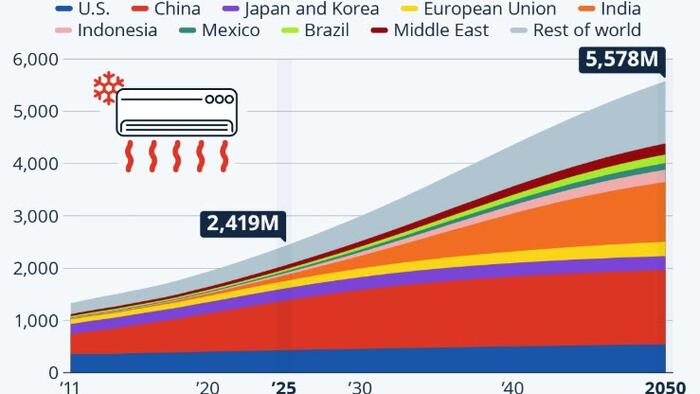
According to the latest scoop from the International Energy Agency, over 2.4 billion air conditioners are churning out complaints of heat left and right this year alone. And that’s just the start.
Fast‑Forward to 2050
- By mid‑century, the count could jump to a jaw‑dropping 5.6 billion units.
- Everything’s being met with a colossal demand for cool.
The Powerhouses: China & India
In this global cooling drama, two giants take the stage, pulling the bulk of the action.
- China – with its sprawling cities and endless manufacturing, air‑conditioning is practically mandatory.
- India – from Mumbai heat waves to Delhi’s monsoon mix‑ups, the need for a chill is undeniable.
In short, if you’re curious about how we’re keeping our living spaces comfortable, remember: it’s all about bulk, both in numbers and in the sheer size of the markets that dominate.

Cooling, Charging, and Heating Trends (2020‑2050)
Ever wondered where the world’s ACs and fans are headed? Let’s take a quick ride through the numbers, with a dash of humor to keep things breezy.
Indonesia’s Air‑Conditioning Fireworks
- AC units there are expected to jump eleven‑fold from 2020 to 2050.
- Picture a city that’s literally turning from hot to club‑cool—fans will have to keep up!
Mexico’s Mild Heat‑Hug
- Four‑to‑six‑fold increase in ACs will help Mexico keep chill during those sweltering summer nights.
- Fans and ACs together will also double, as the nation hits that sweet spot of “just right”.
The Big Asian Play
- Even with their meteoric growth, Indonesia and Mexico still lag far behind the two powerhouse Asian markets.
- Asia’s AC and fan volumes are leveling up the global scale game—think “big flex” meets “cool savings.”
Electricity: The Real Heat‑Sink
- All ACs and fans are responsible for about 10% of worldwide electricity consumption—a tiny fraction of the total but a major footnote in the tech story.
- Meanwhile, electric vehicles will contribute a sizzling 13% of the ever‑growing energy demand.
- Heaters, not as flashy as EVs, will take up 7% of the hardware spotlight.
In short, while the world is cooler by 2025 (thanks, ACs), the car-riders and hot‑heads are looking to the future too. If you’re looking for fresh infographics about these trends, Statista has a gallery waiting to keep you informed and entertained. Enjoy the ride—and maybe crack a window or two!

Hot Weather, Hotter Planet: The Ticking AC Clock
Imagine living in a world where every summer heatwave means a tiny but relentless tick on your energy meter. Unless air‑conditioning tech steps up its game, the sky‑high demand for cooling will be a major environmental headache by mid‑century.
How Cooling Is Crankin’ the Energy Scale
- Mounting Energy Use – The bigger the fins, the heavier the bill. Global AC units today gobble up over 200 terawatt‑hours annually.
- Carbon Footprint Rise – Less efficient units are basically pumping more CO₂ into the atmosphere, especially in regions where the power grid still runs on fossil fuels.
- Heat‑trap Effect – Heat circulators suck hot air from inside to the outside, but that flailing airflow can pull extra heat from the environment, a feedback loop that’s hard to break.
Why We’re in This Heat‑Squeeze
Think of it like a game of global Monopoly, but instead of landing on “Go,” every house you cool is a dollar drawn from the planet’s economy. Cities are growing, homes are multiplying, and as we chase comfort, our planetary budget is getting thinner.
Solutions That Are Cooler Than Your Average A/C
- Elegantly Efficient – Build smarter, not harder. Coolers that use less electricity while still doing the job score high on the eco‑ranking.
- Renewable Power Power‑Up – Plug your AC into solar or wind. A cooler bill, a cooler Earth.
- Smart Schedules – Wearable tech and AI can learn your family’s rhythms and run the unit only when you’re actually there.
- Heat‑Resistant Homes – Better insulation, reflective roofs, and green roofs keep interiors cooler without extra cooling.
In short, if we keep shipping out air‑conditioners the same way we ship soda cans, we’re going to blow a bigger hole through our planet than a fridge, literally. But with a clever mix of tech, energy, and a pinch of environmental awareness, we can have our boards and keep the planet chill. Cheers to a cooler future!
-

Databricks CEO says fresh $1B will help him attack a new AI database market
Databricks is in the process of closing a fresh round at a $100 billion valuation, sources confirmed to TechCrunch. The round was originally reported by the Wall Street Journal.
A source familiar with the deal tells TechCrunch exclusively that the new round is about $1 billion and was wildly oversubscribed. Databricks, best known for its data analytics products, refrained from selling even more equity because it didn’t need cash for operations after its once record-breaking $10 billion raise at a $62 billion valuation in January, according to the source. (OpenAI has since squashed the record with a $40 billion raise in March.)
The round was co-led by both Thrive and one of Databricks’ early investors, Insight Partners, TechCrunch has learned. These two firms led the last round as well. The company has now raised about $20 billion since it was founded in 2013.
This was a primary round, meaning it didn’t include employees selling their shares. However, sources close to the company say Databricks has already had two secondary rounds for employees in 2025. Those offers allowed employees to sell up to 40%, 50%, or 60% of their shares, depending on the size of their holdings.
In both cases, the source said, the full funds available for the secondary round were not maxed out, meaning employees held on to more shares than they could have sold. While Databricks clearly isn’t in a hurry to IPO, employees have had two recent chances to cash out shares.
This new round, however, was raised to pursue two specific projects — a database for AI agents and its AI agent platform — Databricks co-founder and CEO Ali Ghodsi told TechCrunch in an interview.
The company will invest heavily in its database for AI agents, making it generally available to all customers. It launched the product, known as Lakebase, in June at its annual tech conference. Lakebase, which is based on the open source database Postgres, is enterprise grade and supports corporate developers’ vibe-coding projects. This makes it a competitor to Supabase.
Techcrunch event
Tech and VC heavyweights join the Disrupt 2025 agenda
Netflix, ElevenLabs, Wayve, Sequoia Capital, Elad Gil — just a few of the heavy hitters joining the Disrupt 2025 agenda. They’re here to deliver the insights that fuel startup growth and sharpen your edge. Don’t miss the 20th anniversary of TechCrunch Disrupt, and a chance to learn from the top voices in tech — grab your ticket now and save up to $600+ before prices rise.
Tech and VC heavyweights join the Disrupt 2025 agenda
Netflix, ElevenLabs, Wayve, Sequoia Capital — just a few of the heavy hitters joining the Disrupt 2025 agenda. They’re here to deliver the insights that fuel startup growth and sharpen your edge. Don’t miss the 20th anniversary of TechCrunch Disrupt, and a chance to learn from the top voices in tech — grab your ticket now and save up to $675 before prices rise.
San Francisco
|
October 27-29, 2025REGISTER NOW
“The database market is $105 billion of TAM [total addressable market], of revenue, sitting there, kind of unaffected in the last 40 years,” Ghodsi told TechCrunch, giving a subtle nod to how database giant Oracle has had a lock on the market for decades.
“Here’s the interesting statistic nobody’s paying attention to: a year ago, we saw in the data that 30% of the databases were not created by humans. For the first time, they were created by AI agents. And this year, the statistic is 80%,” he said, adding that he predicts this stat to increase to 99% of new databases within a year.
“There’s a new user. The user is not human. It’s an AI agent, and if we just double down on making that user persona successful, that’s the wedge to disrupt that TAM,” he said.
As for how Lakebase will differentiate from Supabase and others already building Postgres-based databases for agents, Ghodsi said the key is “separated compute and storage.”
By untying the pricey compute from the lower-cost storage, Databricks can affordably let users create many databases. “Because these agents are super fast. They just spin up lots of databases, much faster than humans can, but you don’t want to go bankrupt because you’re doing that,” he explained.
The second project Databricks will be investing heavily in is AI agent platform Agent Bricks, also launched in June. “Everybody’s super focused on superintelligence,” Ghodsi said. “But that’s not what we need in organizations.”
Rather than artificial general math geniuses or cancer-curing scientists, what companies need are agents that can reliably handle, unaided, mundane tasks like onboarding employees or answering personalized questions about HR benefits.
“I think that’s a much bigger opportunity, actually, for the worldwide GDP and for organizations,” he said. He believes that such focus will give Agent Bricks a competitive advantage.
He also raised the extra cash so Databricks can get into the AI poaching wars. “As you know, it’s pretty expensive to hire AI talent right now,” he said, smiling.
We’re always looking to evolve, and by providing some insight into your perspective and feedback into TechCrunch and our coverage and events, you can help us! Fill out this survey to let us know how we’re doing and get the chance to win a prize in return!
-

Millions Grapple with Blazing Heat as June Heatwave Persists Across the US
East Coast on Overdrive: Heatwave Feels Like a Sizzling Summer Camp
The entire slice of the East—from the windy streets of Chicago all the way to the bright lights of New York—has turned into a giant pizza box on a hot day. But don’t worry, it’s not just the coffee that’s burning up!
Why It’s Heating Up
On the same day the temperature charts jumped over the average, the atmosphere seemed to decide it’d only feel good when the thermometer read “new‑school science experiment” rather than a normal sunny day.
Heatwave Highlights (Cities on Board)
- Chicago – The wind’s gone quiet while the heat screamed louder than the wind‑chill warnings.
- Pittsburgh – Steel‑city switched to steel‑heat mode; even the traffic lights seem blistered.
- Philadelphia – Historical sites sweating parallels to the Liberty Bell’s bronze glow.
- New York – Times Square’s neon rivals the sun’s rays; taxis buckle while sidewalks burn.
Feel the Scorch
If you can read this, chances are you’ve forgotten the difference between a coffee break and a skinny dip in some cool slush. The heat is so intense that even the pigeons have started wearing sunglasses.
What to Do (Survival Hacks)
- Hydrate like you’re auditioning for a marathon.
- Dress in light, breathable fabrics—because silk is for blazers, not sweat fences.
- Stay out of the sun if you can: midday is when the sun throws the ultimate light show.
- For those brave enough to stay indoors, turn the AC on “murder.”
When the mercury goes out of its way to be outrageous, remember: keep cool, stay hydrated, and enjoy the rhythm of the heat‑wave—just without getting scorched.
Heat Wave Hits Midwest & East: Hot, Hot, Hot!
Why the Temperatures Are So Scorching
It’s the kind of summer sun that makes you question if you’re actually in a heat dome—a giant high‑pressure blanket trapping heat and humidity all over the board. This meteorological mischief is turning the Midwest and eastern U.S. into one giant kitchen.
Where It’s Happening
- From Minnesota stretching all the way down to Maine
- Parts of Arkansas, Tennessee, Louisiana and Mississippi
- And even the big north‑east, under heat warnings
Official Warning from the Weather Service
The National Weather Service says the scorching day is likely to last until Wednesday, 25 June. Your local weather office is sounding the alarm: “Take frequent breaks, stay hydrated, and give any outdoor animals the same level of care.” Our Wakefield, Virginia office is even sending a memo on X (formerly Twitter) urging folks to keep cool.
Stay Safe, Stay Cool!
- Plan ahead—no mad dash to the office or mall.
- Hydrate constantly; water is your best friend.
- Create shade anywhere you spend time outside.
- Watch out for those furry friends—animals get just as hot.
The One-Word Takeaway
Don’t trust your breath in the sun. Remember, the heat isn’t just a nice old friend; it’s a real, sweaty beast. Keep cool, folks, and stay safe!
Thunderstorms slam New York State
Heartbreak in Kirkland: Twins Tragically Lost Amid Storm Fury
Storm‑tossed Sadness
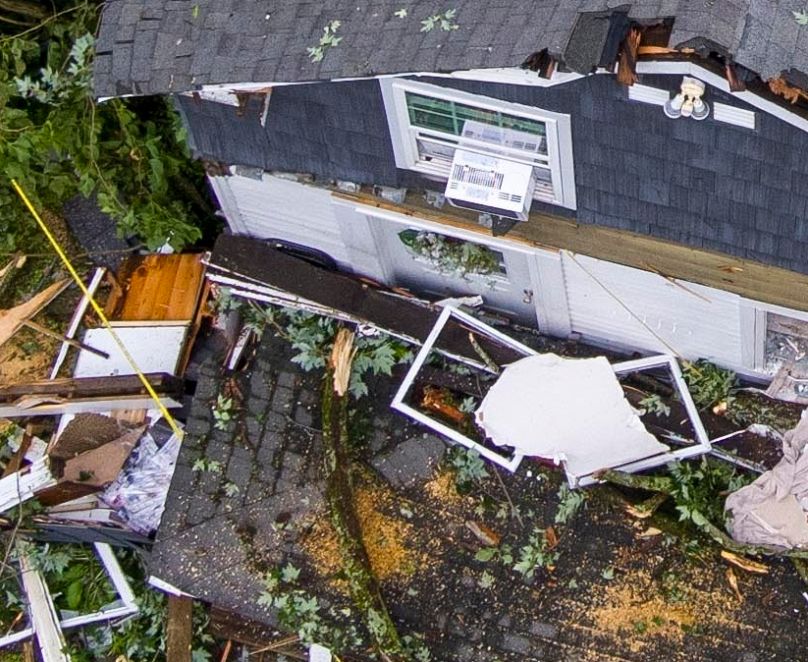
- Three Lives Lost: Two six‑year‑old girls, a second child, and a parent perished when a thunderstorm slammed a massive maple right into their homes.
- Rugged Rain: Just a few hours of relentless downpour turned the calm town of Kirkland into a flooded nightmare.
- Front‑line Hero: Jared Bowman, the neighbor, dashed over as the maple ripped through the roof around 4 a.m., attempting a rescue.
- Mom’s Call: While the roof trembled, the mother shouted, “Get my kids out!” as Bowman hustled to move her out of the window.
- Police Update: The Oneida County Sheriff’s Office confirms the scene of the tragedy early Sunday morning.
Behind the Chaos
- The thunderstorm brought not only rain but a destructive gust that sent trees crashing onto homes.
- Local residents remain shaken, hope hinges on the courage of those who reacted in the worst of times.
- Emergency services are currently reviewing safety protocols to avoid future tragedies.

When a Tree Takes a Sudden Spin… New York’s Storm Tragedies
It’s one thing to brace yourself for a bad day, but a powerful storm can turn a quiet neighborhood into a bruised battlefield—especially if a tree decides to do a “space walk” into the middle of a house.
In the Slip‑Zone
- A massive oak apparently mistook a family home for a parking lot and crashed in, taking two young girls right along with it.
- Meanwhile, a 50‑year‑old woman met a similar fate when a tree slammed into a house across the street.
- The wind sent electrical lines spinning across the alleys—turning the streets into an impromptu obstacle course.
- Because of all the chaos, thousands of residents were left in the dark.
Why It Matters
Governor Kathy Hochul acted swiftly—declaring a state of emergency across 32 counties to help the storm’s aftermath and brace for the heat that’s expected to pack on.
Takeaway
Nature’s way of reminding us that even your neighborhood can become a drama set—if you’re standing in the wrong spot at the wrong time. Stay safe, keep your trees trimmed, and remember: when a tree wants a walk, it may just take a walk…
‘I just want to sit in my air conditioning’
Midwest & East Coast Heatwave Wreaks Second‑Day Fury
Sunday was the hottest of the year so far, with heat indexes climbing to a scorching 39.4 °C in Chicago and a sweaty 38.3 °C in Madison, Wisconsin. That’s enough to turn the town’s annual naked bike ride from a “just a little fun” into a sticky, sweat‑soaked nightmare.
Day Care Director Plays Air‑Conditioning Game
- Lynn Watkins, 53, is the director of Sacred Hearts Day Care in Sun Prairie, a suburb of Madison.
- She tried to beat the heat by grilling outside, but the swelter ran away with her plans and forced her inside.
- She’s cancelling all outdoor activity for Monday, when temperatures are forecast to dip to a more bearable 33.8 °C.
- “I can’t stand being outside when it’s like this. I just want to sit in my air conditioning,” she said.
Heat News from Pittsburgh & Columbus
The heat index in Pittsburgh has hovered around a fiery 40 °C, and Columbus is no exception, chilling at roughly the same temperature.
Philadelphia declares a heat emergency
East Coast Heatwave Hits Hard—Philly, Rehoboth, & Cromwell All in the Hot Mix
Forecasts predicted a scorching 42.2 °C (108 °F) heat index for Philly on Monday, and the city’s public health squad wasn’t kidding. They moved the heat emergency into force until Wednesday evening, turning normally quiet spots—libraries, community centers, even the free Wi‑Fi pirate’s porch—into people‑friendly air‑conditioned havens. They even set up a dedicated “heat line” where medical pros chat about heat‑related woes.
Rehoboth Beach: The Thermometer’s Party
Despite temperatures bubbling in the mid‑80s, Rehoboth Beach was a full‑blown beach‑party on Sunday.
- “It’s only going to get worse,” muttered beachgoer Vak Kobiashvili.
- He said even his dog wanted to skip the beach and stash somewhere cool.
- “East Coast summer feels like walking through a swamp,” Kobi laughed.
Giant Heat at the PGA Travelers Championship
Over in Cromwell, the heat index hit 40.6 °C (105 °F) on Sunday—perfect weather for a “steamy” golf round.
- Fans clutching fans, umbrellas, and extra water were found behind trees and beneath breezy bench shade.
- One hydration station near the ninth green held a queue that could survive a marathon.
-
New York’s Karin Skalina was soaking under a bleacher sun‑spot by the eighth green, then even found a vent‑legged cooling bench. “Didn’t work,” it sighed.
- Newington’s Courtney Kamansky brought a full water bottle arsenal, told reporters she’d hunt shade “by carrying an umbrella.”
Quick Tips for the Heat‑Hardened
Just a few things we’re telling the locals to juggle when the sky turns a sweaty amber:
- Stay in the shade (trees, cool benches.
- Carry water—ideally more than your bottle could hold.
- Dress light—think cotton, loose fits, and a straw hat if you’re playing golf.
- Use the “heat line” if you feel a heat‑stroke flickering.
Because the forecast said it’s going to get scorching, and every sun‑baked seaside, library, and tee‑off knows that none of us can survive a hot day without a little chill.

Heatwave Hiccups: Mariners’ Sean‑Pitcher Nathan Daze Marooned On the Field
When Warmth Turns Wicked
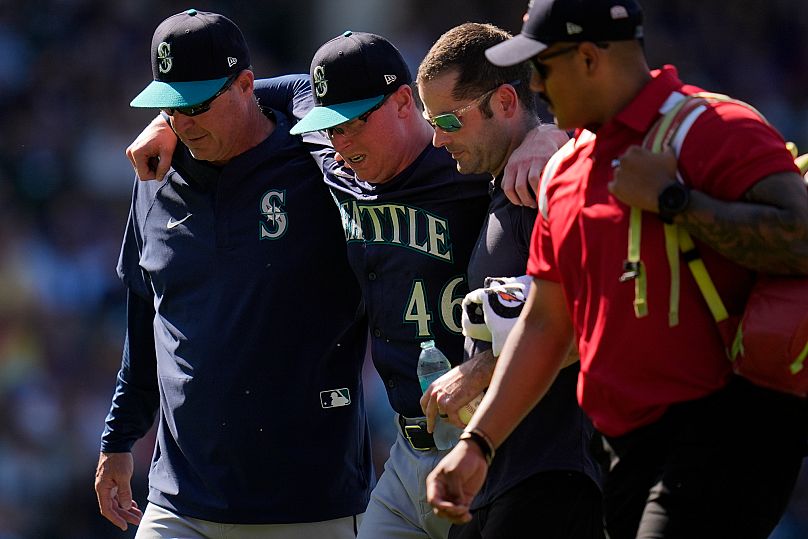
During the recent showdown at the Apple Park, where the Seahawk squad faced the Chicago Cubs, the merciless heat took a toll on Seattle’s bullpen hero, Trent Thornton. The pitcher had to be gently escorted off the diamond after a bout of heat exhaustion. It wasn’t a lone incident – a slick August sun also dealt a nasty blow to Cincinnati’s shortstop Elly De La Cruz, who collapsed during an intense clash against St. Louis’s Cardinals.
What Went Down?
- High Temperature – Temperatures at the ballpark hovered around 88°F (31°C), turning every inning into a sauna session.
- Physical Strain – Both players were pushing their limits, fielding pitches, catching fastballs, and running the bases.
- Immediate Response – Medical staff sprung into action, administered cooling measures, and kept a close eye on the players’ vitals.
Quick Takeaways
- Even with top-tier conditioning, heat can catch anyone off guard.
- Teams are now revisiting hydration protocols.
- Fans are left cheering (and sweating) on the sidelines – their top priority: keeping the game safe.
Final Thoughts
All eyes are on the recovery and the time it takes for the pitchers to get back in the line‑up. Until then, the heat is still the invisible antagonist ensuring the sport remains unpredictable and, dare we say, exhilaratingly sweat‑driven!
Heat to persist into the coming week with highest temperatures shifting eastward
Heatwave Hits the East Coast: Prepare for a Sun‑Full Sunday
The summer sun is refusing to play “hit‑and‑go.” This week, it’s here to stay, peaking and then sliding eastward like a lazy river. NYC is spelunking into 35 °C highs on Monday and Tuesday, while Boston is carving out 37.7 °C on Tuesday. Across the Potomac, Washington, D.C. will not miss the heat—expect the same 37.7 °C on Tuesday and Wednesday.
Key City Snapshots
- New York City: 35 °C on Monday & Tuesday
- Boston: 37.7 °C on Tuesday
- Washington, D.C.: 37.7 °C on Tuesday & Wednesday
What the Meteorologists Say
National Weather Service’s Mark Gehring, from Sullivan, Wisconsin, reminds us that summer heat is nothing exotic for the U.S., normally arriving in mid‑July or early August. Nonetheless, this wave is an “unusual” blockbuster because it’s engulfing everywhere east of the Rockies. High dewpoints and blistering temperatures are now the new normal across a massive swath of the continent.
Global Heat‑Wave Context
While the East Coast is cooking, the rest of the world is turning up the heat too. Consider the UK’s 32 °C spell—research indicates it’s now a 100‑fold jump in climate‑change chance. Europe’s May also ranks as the second‑hottest on record, sparking flood‑faced drought concerns across the continent.
Thoughts for the Heat‑Ready
Think of the weather like a giant pop‑torch—everywhere you look. Stay cool, drink plenty of water, and remember: a good sunblock and a chilled beverage are your best sidekicks this week.
-

Akin To Damaging 'Brand USA': Bessent Exposes Cracks In Fed's So-Called 'Independence'
Amid all the hair-pulling and teeth-gnashing over President Trump’s ‘firing’ of Fed Governor Lisa Cook (for alleged mortgage fraud), the market seems increasingly complacent that The Fed’s holier-than-thou independence is under threat.
For its part, the market shows no fear whatsoever about USA sovereign risk…
Perhaps the market doesn’t believe the hype that Fed ‘independence’ is actually under threat by the president’s actions… or perhaps, the market knows full well that The Fed has never been truly independent, and the temper tantrums being thrown by establishment types is merely the vinegar strokes ending the delusion that maintains The Fed’s unquestionable omniscience?
First things first though, we need to know what’s at stake and no one has described the shifts in perceptions of Fed independence better recently than Citadel Securities’ Nohshad Shah:
RESERVE CURRENCY STATUS, GLOBAL LEADERSHIP IN TECH INNOVATION, THE WORLD’S BEST ACADEMIC INSTITUTIONS, BEING A MAGNET FOR GLOBAL TALENT…AND CRUCIALLY, THE RULE OF LAW WITH INDEPENDENT INSTITUTIONS…HAVE COMBINED TO ENSURE THAT THE US HAS BEEN THE MOST COMPETITIVE PLACE ON EARTH TO DO BUSINESS AND GROWTH HAS EXCEEDED MOST OF THE DEVELOPED WORLD BY A WIDE MARGIN…OTHERWISE KNOWN AS “US EXCEPTIONALISM”.
A core part of this construct is the independence of the Federal Reserve, and this remains sacrosanct in the minds of global investors. There is concern amongst market participants that President Trump’s recent move to fire Fed Governor Lisa Cook could be an attempt to garner greater influence over central bank policy. Whilst the merits of the case will surely be analysed thoroughly by the courts, markets are uneasy about the broader emphasis of this Administration on Unitary Executive Theory…the constitutional doctrine that the US President holds sole absolute authority over the entire executive branch including all federal agencies, departments, and officers…and the power to remove any executive branch official at will.
Proponents of this doctrine argue it is vested in the President from Article II of the Constitution and that other branches of government (including Congress and Courts) should not limit or interfere with Presidential Authority, thereby ensuring maximum accountability…ultimately to voters. Of course, as with much of US public discourse, this is a contentious issue with critics warning that it concentrates too much power in one seat undermining checks and balances, risking authoritarianism. In the near-term, should the President succeed in removing Cook, he would be appointing two new governors (including Miran), which when you include Governors Waller and Bowman, takes him to a majority of four out of seven on the Board aligned with his views.
Not only does this have an impact on upcoming FOMC decisions, but it allows Trump to re-shape the entire FOMC given the Board must reappoint all regional Fed presidents in February next year. However, there are several obstacles. First, it is unclear if Cook’s firing will stand – the President can fire a Fed member for “cause”, but there remains uncertainty around whether the mortgage fraud allegations made against Cook meet this definition: negligence of duty, inefficiency, or malfeasance. Friday’s initial hearing of the case ended without a ruling – we will learn more in coming days. There is also a broader executive authority consideration for the Supreme Court, which in May allowed the President to fire two members of the NLRB, asserting that agencies exercising “considerable executive power” fall closer to Article II authority in a boon to unitary executive theory…
BUT…earmarking the Federal Reserve as a “uniquely structured, quasi-private entity that follows in the distinct historical tradition of the First and Second Banks of the United States” suggesting a carve out of sorts for the Fed due to it being a constitutionally exceptional institution with roots in the country’s earliest banking history. Interestingly, Justice Kavanaugh has written approvingly of the Fed’s independence in the past (h/t Brooke Cucinella):
“To be sure, in some situations it may be worthwhile to insulate particular agencies from direct presidential oversight or control—the Federal Reserve Board may be one example, due to its power to directly affect the short-term functioning of the U.S. economy by setting interest rates and adjusting the money supply.” (Brett M. Kavanaugh, Separation of Powers During the Forty-Fourth Presidency and Beyond, 93 Minn. L. Rev. 1454, 1474 (2009)).
So even with SCOTUS’ broader embrace of unitary executive doctrine, we remain in murky waters as to where this issue lands. Second, whilst Governors Waller and Bowman are currently firmly in the dovish camp, this was certainly not always the case…indeed when inflation surged in 2021, Waller was an early proponent for tightening monetary policy pushing for both tapering asset purchases and aggressive rate hikes in 2022. Similarly, Bowman’s stance until late 2023 was hawkish.
The point here is that whilst there might be short-term incentives to be dovish given the backdrop of Chair selection, both are seasoned professionals with a track-record of public service…so if the economic growth and inflation picture shifts (as I expect), so should their monetary policy views. And finally, regarding the election of regional fed bank presidents…the Board of governors does indeed have an effective veto on appointments, but it will not be trivial to exert influence upon each of the 12 regional bank boards of directors, with a total of 6 per board (72 directors in total, most of them public representatives) required to affect the selection process.
In sum, I expect this to be an ongoing saga to be played out in the courts in coming months whilst remaining a source of uncertainty and volatility for asset prices.
ANY EROSION OF FED INDEPENDENCE WILL HAVE UNTOLD IMPLICATIONS FOR THE US AND GLOBAL ECONOMIES…
…and this is starting to play out in market pricing…1y1y USD forward swaps are 3.02%, priced for a return of policy rates back to what most consider neutral…something I would consider to be a dovish outcome, given the current backdrop for the US economy (unless the labour market collapses in coming months)…and yet 10y10y forward swaps have risen to 4.66%, the highest in over a decade (chart below).
This likely reflects a level of concern from bond markets around deficits (which continue to rise)….inflation (above target and at-risk of rising w/tariff effects)…and risk premium for Fed independence. It also serves as a reminder for policymakers that the economy is most impacted by the long-end rate not the short-end (10x multiplier for FCI). Whilst these levels are still within acceptable ranges, one need only look over the pond at the UK to see what happens when investors are perennially concerned about governments’ ability to manage the fiscal outlook…30y Gilt yields (5.60%) have been rising consistently for four years now and have risen over 100bps since July 2024 when the BOE started cutting policy rates from 5.25% to 4.00%!
Perhaps the biggest sign for US policymakers should be the ~13% depreciation of the US dollar against EUR this year, far outpacing what interest rate differentials would suggest.
All told, the risks of damaging Fed independence are akin to damaging Brand USA and the medium-term implications are likely to be wide-ranging and uncertain…not to mention the consequences of allowing inflation to spiral out of control. Inflation credibility has been hard won by central banks across the developed world, most notably in the 1970s. In their most recent fight, the majority have been unable to bring inflation back to target reflecting wide ranging changes in the global economy…most importantly the introduction of pro-cyclical fiscal policy (despite large deficits) and a partial unwind of globalisation.
This does not seem like an opportune time to lose control of this mandate.
But, what if The Fed is already un-independent?
No lesser authority than Treasury Secretary Scott Bessent has just this day unleashed his
swordpen in a Wall Street Journal Op-Ed, “The Fed’s ‘Gain of Function’ Monetary Policy”, pointing out that the central bank put its own independence at risk by straying from its narrow statutory mandate.In the lengthy op-ed, Bessent critiques the Fed’s post-2008 monetary policies, comparing them to a risky “gain-of-function” experiment with unpredictable outcomes.
He argues that The Fed’s over-use of complex, nonstandard tools, mission creep, and regulatory overreach have undermined its independence, credibility, and effectiveness.
The most notable aspects of The Fed’s failures include:
-
Failed Forecasts: The Fed’s over-reliance on flawed models led to significant errors, like overestimating GDP growth post-2008, missing the impact of supply-side policies, and fostering inequality through a wealth effect that favored asset owners.
-
Economic Inequality: Policies like quantitative easing disproportionately benefited large firms and homeowners, widening class and generational gaps, as noted in Karen Petrou’s book: “Engine of Inequality”.
-
Eroded Independence: The Fed’s expanded role in fiscal-like interventions, Treasury debt management, and bank regulation (e.g., post-Dodd-Frank) has blurred lines between monetary and fiscal policy, creating conflicts of interest and enabling fiscal irresponsibility.
-
Regulatory Failures: The 2023 Silicon Valley Bank collapse highlights the risks of combining monetary policy with bank supervision, which should be delegated to agencies like the FDIC.
Bessent concludes by stating that The Fed’s overreach has caused economic distortions, inequality, and a loss of credibility, threatening its independence.
It must scale back and recommit to its core mandate to ensure economic stability and public confidence.
Bessent’s suggestion is that The Fed should simplify its toolkit, use unconventional policies only in emergencies, and undergo an independent review to refocus on its mandate of maximum employment, stable prices, and moderate interest rates. This is critical to restore public trust and safeguard its independence.
Loading recommendations… -
-

Unplugging Distractions: Mastering Concentration in the Modern World
How often do you find yourself pulled away from your tasks by distractions throughout the day? The answer for most of us is “many times.”
Ever Wonder Where All the Time Went?
Picture this: you’re in the middle of a monster‑sized report, your fingers dancing on the keys. Suddenly an email pop‑up shatters your focus. We’ve all felt the itch to open it. You pause, devour the message, and then return to the report, only to find your head in a fog: “Where was I?”
Now multiply that every day, every week, every month. 12 months later you’ll be left with more questions than answers: how many minutes (or even hours) have slipped away?
And it’s not just a numbers nightmare – your output suffers. Every time you toss your brain from one task to another, you break the hard‑won flow state.
The Classic Distraction Checklist
- Email alerts screaming like raccoons at midnight.
- Phone calls and missed calls that seem to demand your answer right then.
- Your internet cravings – scrolling endlessly, chasing the next meme.
How to Turn the Tide (and Bring Your Focus Back)
- Mute the Noise: Turn off those nags that send email notifications. Remember: you don’t have to answer right away.
- Keep Your Phone on Silent: Don’t let that ringing wobble your groove. Let the voice message handle the drama.
- Say “No” with a Smile: A polite decline can be your superpower. Not every ping actually matters.
- Train Your Mind: Think of distractions like buzz alerts – you’re controlling the moments to hit dismiss.
- Set a 10‑Minute Internet Cap: All right, devote ten blissful minutes to online surfing, then wheel back to your masterpiece.
- Communicate Your “Do Not Disturb” Mode: Tell colleagues, friends, and family when you need a sandbox of focus. Set boundaries so your deep‑work stays uncompromised.
Why Bother? Because Quality Wins
When you’re in the flow, you’re not merely working – you’re creating something remarkable. Every interruption is a step away from excellence. By locking out distractions, you unlock a roaring productivity machine.
Happy focus-flowing!
-

Space Coast Sports Hall of Fame Highlights Mick Graham’s Dual Stars on the Diamond and in the Classroom
Space Coast Sports Hall of Fame
Rising Star of Florida Softball: Lindsay “Mick” Graham (now Hein)
Back in 2004, a little girl with big dreams and even bigger hands burst onto the softball scene in Florida. She wasn’t just good—she was the best. Or so the baseball‑loving folks at the Gatorade organization and the Orlando Sentinel told us.
Why Everyone Was Watching
- 2004 Florida Gatorade Softball Player of the Year – A title that, in their eyes, meant she could hit a home run in a rainstorm and still look polished.
- Junior of the year, named Central Florida Player of the Year by the Orlando Sentinel – a shout‑out from the local press that basically said, “We’ve got a top‑tier talent in our midst!”
- Senior season, she carried the ball (literally) to morning glory, acquiring eight-ball skill that turned fans into resolute believers.
Behind the Scenes: A Quick Peek into the Iconic Moment
Picture this: a sunny field, a fearless young batter, and a crowd that’s rooting for her like a symphony orchestra. The video evidence captures her by taking a swing that would make even legendary MLB sluggers look like they’re learning from scratch.
So, What’s Next?
When you’re born with a lively mix of talent, grit, and a knack for storytelling, the ball will continue to roll. Marty’s future (yes, that’s the nickname folks call her) promises more incredible feats, and maybe even a cameo in a future sports documentary when the rehab apps out‑shine the old‑school net apps.
In the grand league of U.S. softball, you learn that a single player can make sports more than just a game—they can spark a community’s heart and keep the dream alive.

2016 PREP INDUCTEE
Meet the Sweetheart of Sweet Long Island Squash: L.O.S. “Mick” Graham (now Hein)
What Makes a Gatorade Hero?
This girl earned Florida’s 2004 Gatorade Softball Player of the Year crown and not once but twice snagged the Cape Coast Conference Player of the Year trophy. She also got the Amateur Softball Association Award for the State of Florida — that’s a big deal.
Climbing the High‑School Ranks
- Freshman year: Second‑team All‑State, First‑team SCC and CCC all‑conference.
- Sophomore year: All‑SCC second team.
- Junior year: Recognized as Central Florida Player of the Year by the Orlando Sentinel.
- Senior year: A Gatorade Softball Player of the Year in Florida, plus double honors from the Cape Coast Conference.
The Gatorade Girl on and off the field
With a nearly perfect 4.0 GPA and membership in the National Honor Society, she was the textbook definition of a student‑athlete. Coach Bill Sinclair said, “She was the quintessential student‑athlete.”
Why the Nickname “Mick”?
Her dad, a proud Irish descendant, started calling her Mick right after she was born. The nickname stuck, and her friends still refer to her as Mick. “My family and friends know me as Mick,” she says.
From Palm Bay to the Softball Pond
Growing up as the only girl in town, she didn’t let that stop her. “I just played sports with the boys,” she recalls.
A Near‑Miss and a “Softball” Turn
At eight, her parents intended to enroll her in baseball, but during registration someone suggested softball – a twist that turned her life upside down.
“We really didn’t know anything about softball up to that point,” she admits. That’s when she swapped bat for ball and threw her first pitches at nine, mastering pitching, shortstop, and third base. She became a seven‑year veteran with Dot’s Diamonds Class A travel ball.
College Sparks: From UW to Florida Tech
After high school, she snagged a full athletic/academic scholarship to George Washington University to play third base, but home‑sickness hit in her freshman year, so she returned to her roots.
Florida Tech welcomed her, giving her another athletic scholarship. She’s also been a cross‑country runner while studying software engineering.
Cross‑Country and a Great Marriage
She unofficially retired from softball in her junior year to focus on varsity cross‑country. In her senior year, a friend introduced her to future husband Charlie Hein—and the story goes on.
From Code to Crayons: A New Life Chapter
After a stint as a software engineer for a Cocoa company, she embraced the glamorous life of a stay‑at‑home mom to three kids under four. She’s dreaming that her eldest son, Tucker, might pivot her back to softball when he’s finally a legend in the making. “It’s still early to tell, but he’s very athletic,” she jokes.
Space Coast Sports Hall of Fame
To learn more about other local legends, call 321‑615‑8111 or email Contact@SpaceCoastDaily.com.
See the full membership roster below!
Hall of Fame Highlights (selected)
- Gatorade Softball Player of the Year – Florida
- Cape Coast Conference Player of the Year – 2×
- Amateur Softball Association State Award
- All‑State, All‑Conference, and County Honors (multiple seasons)
- Cross‑Country Athlete – Florida Tech Panthers
- Software Engineering Graduate (balancing tech and family life)

Mick Graham: The Unstoppable Softball Dynamo
Meet the Bronze‑Glinting Queen of the Diamond
- Junior Year: The Orlando Sentinel swooned over her, naming her the Central Florida Player of the Year—a title she wore like a championship belt.
- Senior Year (2004): She hustled, hit, and hit some back‑to‑back grand slams, earning the coveted title of Gatorade Softball Player of the Year—the gold standard of youth sports.
- Name Swap: From “Mick” to “Hein” (sorry, not a brand, just a real name change), but her talent—and her grin—remained unchanged.
She didn’t just play softball; she turned it into a full‑time show‑stopper. With every swing, she kept coaches and rivals alike in suspense, proving that when you’re a rising star, the sky isn’t the limit—it’s just the first warm-up.

HOT OFF THE PRESS! – Space Coast Daily News Rocks the Brevard Scene
On November 25, 2024, the Space Coast Daily News fired up its printing line and slid a fresh batch of stories onto the shelves of Brevard County. The buzz? The paper’s claim of being Brevard County’s best newspaper just got a whole lot hotter.
What’s in the Freshly Printed Edition?
- Local Spotlight: An in‑depth profile on the Downtown park’s new splash‑pad—yes, that splash‑pad that’s got toddlers and grandparents splashing in the same splash zone!
- On the Horizon: A preview of the upcoming Space Coast Tech Expo, including a sneak peek at invisible ink and drone‑powered street art.
- Brevard Bites: The top three foodie spots for the week—critical reviews and foodie memes included.
- Behind the Scenes: Interviews with the printing crew, proving they’re as passionate about ink as they are about Friday night pizza.
Why the Press Release Compels Us to Grab a Copy
When a newspaper claims the crown as “Brevard County’s Best Newspaper,” you get a sense of the county’s pride in its own story‑telling craftsmanship. This edition showcases:
- A heroic cover story about a local astronaut (well, a local astronaut’s astronaut friend) who saved a cat from a rooftop.
- Fun community polls that let readers vote on the best coffee shop brew.
- A satirical “Space Coast Weekly Trivia” that’s sort of the easiest way to find out how much you know about the county.
Reader Reactions
“The paper honestly knows how to keep me laughing while giving me the facts!” – Sarah K., a 2nd‑grade teacher, expects every issue to become a classroom pop‑quiz for her students.
“I tried the new 6‑puzzle edition on my lunch break; it took me 30 minutes to solve.” – Tony M., a software engineer, notes that the puzzle’s humor set him apart from the other coders.
Behind the Matte
The staff notes that the new printing machine is supremely efficient—mint‑hot and ultra‑quick. Those fresh pages turn over in seconds, meaning news arrives faster than a rover on a lunar surface.
Final Word
So, if you’re waiting for the next edition of Space Coast Daily News, know that you’re not just getting a newspaper—you’re getting a ticket to the front row of the local story‑scene. Grab a copy, stay informed, and maybe grab a co‑fizz while you’re at it!
-

Belmont Stakes 2025: Underdogs to Watch
The 2025 Triple Crown season has delivered a series of thrilling performances, and all eyes now turn to the Belmont Stakes on June 7 at Saratoga Race Course. With Sovereignty and Journalism locked in a compelling rivalry and Baeza gaining momentum, it’s easy to focus on the top-tier names. But history is built on surprise, and this year’s Belmont field includes underdogs capable of delivering a memorable upset.
A Race Reshaped: Why Underdogs Matter at Saratoga
For the second year running, Saratoga Race Course steps in as host while Belmont Park undergoes renovation. The change in venue also shortens the race distance to 1¼ miles—a significant factor that alters the traditional dynamics of the Belmont Stakes.
Unlike the grueling 1½-mile test at Belmont Park, Saratoga’s configuration favors horses with tactical speed and the ability to stay closer to the pace. This shift diminishes the typical edge deep closers enjoy, creating an opening for aggressive, pace-forward runners or overlooked contenders with versatile running styles.
-
Paytm Seals Victory Over Regulators Immediately After Key Investor Pulls Out
Paytm’s Big Breakthrough: The RBI’s Green Light Finally Comes
After months of digging for a license and a roller‑coaster of regulatory snags, Indian fintech giant Paytm has finally won the in‑principle nod from the Reserve Bank of India (RBI). The approval unlocks its Payment Services unit as an online payment aggregator, letting it officially take on merchants and rake in those sweet, sweet transaction fees.
Where It Got Stuck
- November 2022 setback: Paytm was denied its payment aggregator license because of its staking ties with a land‑bordering country (the dreaded “border” rule). The answer? No new merchants, no fresh revenue streams.
- No impact claim: At the time, the pay‑and‑play business said the blockage didn’t seriously dent its numbers. Still, the CEO, Vijay Shekhar Sharma, was already planning a re‑application at last year’s AGM.
- Banking woes: The RBI also shut down Paytm Payments Bank’s ability to accept new deposits and offer credit. Paytm re‑emerged by partnering with Axis, HDFC, SBI, and Yes Bank—turning them into its payment backbone.
What the New License Means
With the RBI’s blessing, Paytm can now do the heavy lifting for merchants. That includes:
- Accepting cards, net banking, and UPI—the full spectrum of India’s payment options.
- No more restrictions on onboarding new online merchants—the central bank’s 2022 hold‑up is lifted.
Chinese Investor Exit Style
Just a week ago, China’s Ant Group sold all its remaining 5.8% slice of Paytm for $454 million. This exit follows a 2023 deal where Ant Financial off‑loaded 10.3% to Sharma for nothing cash‑wise, netting $628 million.
Keep Your Eyes on the Audit
The RBI isn’t leaving Paytm to dance on the license indefinitely. It’s mandated to run a full system audit, including a cybersecurity review, and file the results within six months. Failing to do so? The approval lapses. Also, keep in mind—this license covers only online payment services.
Bottom Line
What once seemed like a legal gray‑zone is now a clear green lane for Paytm. The fintech can propel its merchants forward, reuse an entire payment stack, and keep its sizzling revenue engines running—all while steering clear of cross‑border regulatory nightmares.
Tech and VC heavyweights join the Disrupt 2025 agenda
Netflix, ElevenLabs, Wayve, Sequoia Capital, Elad Gil — just a few of the heavy hitters joining the Disrupt 2025 agenda. They’re here to deliver the insights that fuel startup growth and sharpen your edge. Don’t miss the 20th anniversary of TechCrunch Disrupt, and a chance to learn from the top voices in tech — grab your ticket now and save up to $600+ before prices rise.
Tech and VC heavyweights join the Disrupt 2025 agenda
Netflix, ElevenLabs, Wayve, Sequoia Capital — just a few of the heavy hitters joining the Disrupt 2025 agenda. They’re here to deliver the insights that fuel startup growth and sharpen your edge. Don’t miss the 20th anniversary of TechCrunch Disrupt, and a chance to learn from the top voices in tech — grab your ticket now and save up to $675 before prices rise.
Play the Chords: Paytm’s Fresh Groove on India’s UPI Stage
Picture this: the digital wizard Paytm has swapped its backstage status for a front‑row seat—moving from a supporting role to a headline act that’s taking the reins of its entire ecosystem. In a nutshell, it’s now in business with its own offline “sound boxes” and online payment gateway—a one‑stop shop that means one less middle‑man for the Indian fin‑tech. Osborne Saldanha, a seasoned fintech investor, told TechCrunch that this upgrade is a game‑changer.
Standing Strong in the UPI Crowd
- Paytm sits at third place, trailing behind PhonePe (owned by Walmart) and Google Pay.
- In June, it captured 6.9% of 18.4 billion UPI transactions and 5.6% of the money moved—the National Payments Corporation of India (NPCI) confirmed.
- That totals to 1.27 billion UPI moves worth ₹1.34 trillion—or roughly $15 billion.
While the top‑two giants claim over 82% of the market this month, Paytm has carved out its own niche by wrapping a bundle of services around its users and merchants alike.
The Multi‑Faceted Paytm Playbook
- From offline merchant payments backed by hardware & software suites to the robust service layers, Paytm’s solutions are designed to be plug‑and‑play.
- Reality check: it’s also going all‑in on credit and lending, turning wherever folks need cash into a gold mine of opportunities.
Profit Pulse: Rattle a Few Numbers
Take a quick pop‑chart (yes, we’re more graphic than you expected):
- Net income for Q1 FY 2026 settles at ₹1.23 billion—about $14 million—after last year’s loss slapped at the same period.
- Revenue skyrocketed 28% year‑over‑year to $224 million.
- Contribution margin jumped from 50% to 60%—a sign of sharpening edges.
Investor‑Approved, Market‑Approved, Chapter‑Approved!
Talk about a triumphant comeback: shares are up a solid 13.25% YTD in 2025, signaling market confidence creeping back after a regulatory roller‑coaster. As of Wednesday, the stock closed at ₹1,118.5 (≈$13) right before the regulatory green light rang.
We’re Listening – Your Two‑Minute Survey
Curious how we’re doing? Drop the insights, bonus points for humor, and maybe—just maybe—win a shiny prize in the process. Your feedback helps us grow and keeps the conversation fresh.
-

Master Garage Organization for Sports Gear
If your garage has become a chaotic pile of balls, bats, bikes, and cleats, you’re not alone. Sports gear is notoriously difficult to store — it’s bulky, oddly shaped, and often used year-round. But if you know what to do, you can organize your garage and make it a useful place that keeps your stuff in good shape and ready to use. This is how you can keep your garage clean while storing sports stuff.
1. Categorize by Sport or Season
Start by sorting all your equipment into categories. Group soccer balls, shin guards, and cleats together. Do the same for basketballs, baseball gear, skateboards, and cycling items. Seasonal sports gear, like skis or snowboards, should be grouped separately from year-round items. This helps you quickly locate what you need and makes seasonal swaps easier.